
Product Description
Mi-Wave’s Series 258 RHCP/LHCP Horn Lens Antennas are high-performance directional antennas designed to deliver high gain, low sidelobes, precise beam control, and stable radiation patterns across RF, microwave, and millimeter-wave frequency bands from 8.4 to 220 GHz.
By combining the broadband characteristics of a horn antenna with the focusing capability of a precision lens, these antennas provide enhanced directivity, improved aperture efficiency, and excellent beam shaping performance across wide frequency ranges. The horn-lens architecture enables higher gain and narrower beamwidths than many conventional horn antennas while maintaining low distortion and predictable radiation characteristics.
For circular polarization applications, Series 258 Horn Lens Antennas can be integrated with Mi-Wave’s Series 282 Linear to Circular RF Polarizers to support Right-Hand Circular Polarization (RHCP) or Left-Hand Circular Polarization (LHCP) operation. These configurations help reduce sensitivity to antenna orientation, minimize polarization mismatch losses, and improve signal reliability in satellite communications, telemetry, radar, and advanced RF systems.
For systems requiring dual-linear polarization, Series 258 antennas may also be integrated with Mi-Wave’s Series 281 Orthomode Transducers (OMTs), enabling separate Vertical (V) and Horizontal (H) polarization paths through a shared antenna aperture while maintaining high isolation between channels.
Series 258 RHCP/LHCP Horn Lens Antennas are well suited for satellite communications (SatCom), radar systems, telemetry platforms, antenna measurement ranges, RF laboratories, EMC testing, and millimeter-wave research applications where high gain, stable polarization performance, and precision beam characteristics are required.
| Circular Waveguide Internal Diameter (in) | Frequency Range |
|---|---|
| 0.219 | 38.5 – 43.0 GHz |
| 0.188 | 43.0 – 50.0 GHz |
| 0.165 | 50.0 – 58.0 GHz |
| 0.141 | 58.0 – 60.0 GHz |
RF Orthomode Transducers
Linear to Circular RF Polarizers
The standard models shown represent only part of Mi-Wave’s broader product capabilities. Custom configurations are available to support specific frequency bands, interfaces, and application requirements, enabling optimized solutions for specialized RF, microwave, and millimeter-wave systems.
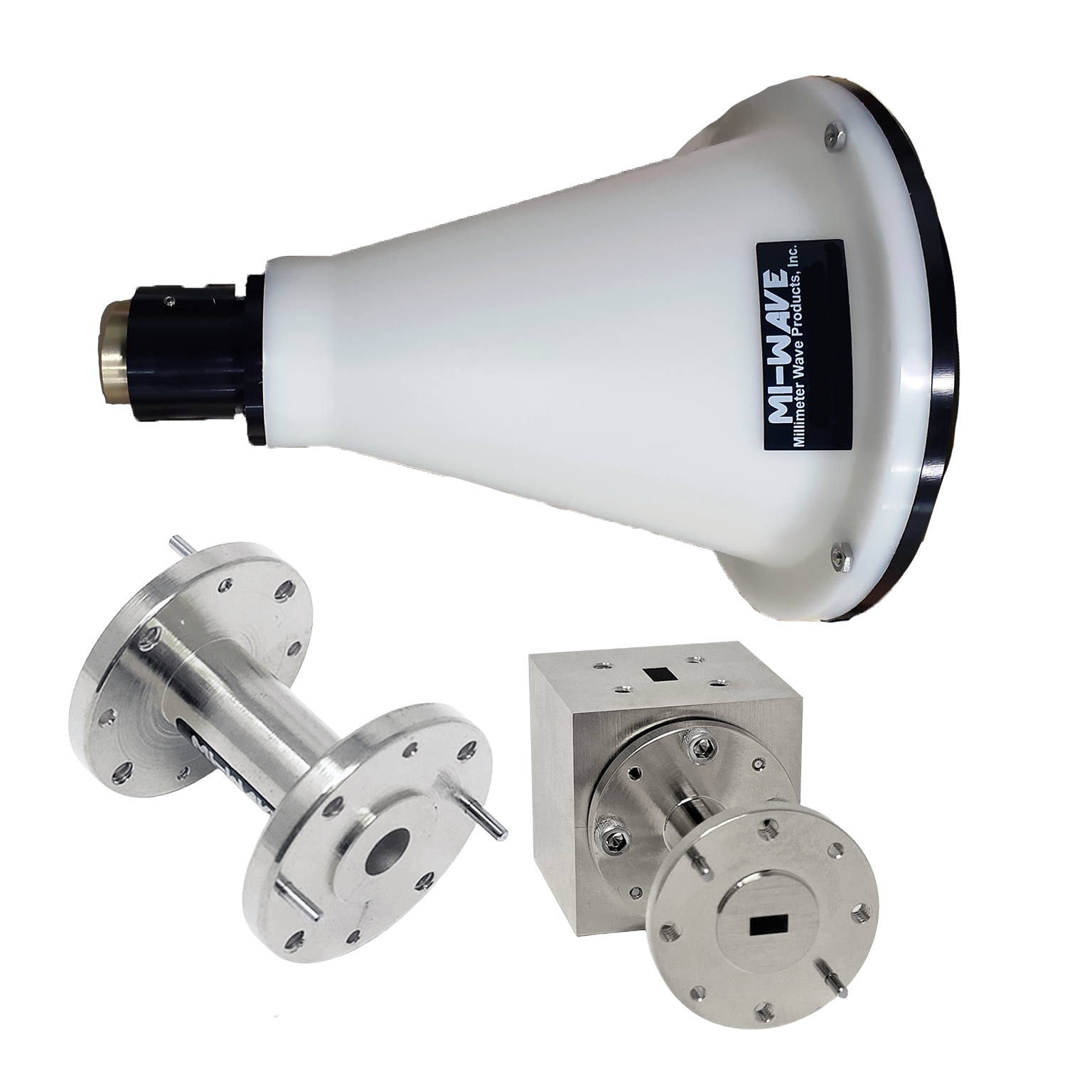
*Actual product may be different from the image shown per customers specifcations
*All data presented is collected from a sample lot.
* Actual data may vary unit to unit, slightly.
*All testing was performed under +25 °C case temperature.
*Consult factory to confirm if material, plating, size, shape, orientation and any electrical parameter is critical for the application as website information is for reference only.
*Millimeter Wave Products, Inc. reserves the right to change the information presented on website without notice as we continue to enhance the performance and design of our products.
Key Features & Performance Benefits
High Gain & Enhanced Directivity
Horn lens antennas combine the broadband characteristics of horn antennas with lens-based wavefront shaping to deliver high gain, improved directivity, and efficient RF energy focusing across microwave and millimeter-wave frequency bands.
RHCP/LHCP Circular Polarization Support
Series 258 Horn Lens Antennas can be integrated with Mi-Wave’s Series 282 Linear to Circular RF Polarizers to support Right-Hand Circular Polarization (RHCP) or Left-Hand Circular Polarization (LHCP) operation. Circular polarization helps reduce sensitivity to antenna orientation, minimize polarization mismatch losses, and improve signal reliability.
Series 281 OMT Compatibility
For systems requiring dual-linear polarization, Series 258 antennas can integrate with Mi-Wave’s Series 281 Orthomode Transducers (OMTs) to support separate Vertical (V) and Horizontal (H) polarization paths through the same antenna aperture while maintaining high isolation between channels.
Low Sidelobe Performance
The lens helps control aperture illumination and radiation distribution, reducing unwanted sidelobes and improving beam cleanliness. This is especially valuable in radar systems, antenna measurement ranges, and interference-sensitive environments.
Wideband Frequency Coverage
Series 258 Horn Lens Antennas support broadband operation from 8.4 to 220 GHz, making them suitable for RF, microwave, and millimeter-wave applications while reducing the need for multiple narrowband antennas.
Precise Beam Shaping
The lens provides additional control over the radiated wavefront, helping optimize beamwidth, improve pattern uniformity, and reduce distortion compared to conventional horn antennas.
Improved Aperture Efficiency
By focusing more RF energy into the desired radiation pattern, the horn lens design improves aperture utilization and overall antenna efficiency, supporting higher gain and better system performance.
Stable Radiation Patterns
Horn lens antennas provide consistent and repeatable radiation characteristics across frequency, making them ideal for calibration systems, measurement applications, and high-precision RF environments.
Low Phase Distortion
The lens helps maintain a more uniform phase front across the antenna aperture, reducing phase errors and improving signal integrity in high-frequency systems.
Optimized for High-Frequency Applications
These antennas are well suited for microwave and millimeter-wave systems where tight beam control, low loss, stable polarization performance, and predictable electrical characteristics are critical.
Compact High-Performance Design
Compared to many reflector-based antenna systems, horn lens antennas provide a more compact solution while still delivering high gain, controlled beamwidth, and stable radiation performance.
Flexible Configuration Options
Custom configurations are available to support specific frequency bands, gain requirements, lens types, waveguide interfaces, RHCP/LHCP operation, Series 281 OMT integration, and specialized mechanical packaging requirements.
RHCP/LHCP Horn Lens Antenna Overview
Mi-Wave's Series 258 RHCP/LHCP Horn Lens Antennas combine the broadband characteristics of a horn antenna with the focusing capability of a precision lens to produce high gain, narrow beamwidths, and stable radiation performance across microwave and millimeter-wave frequency bands.
For circular polarization applications, these antennas can be integrated with Mi-Wave's Series 282 Linear to Circular RF Polarizers to support Right-Hand Circular Polarization (RHCP) or Left-Hand Circular Polarization (LHCP). For systems requiring dual-linear polarization, they may also integrate with Mi-Wave's Series 281 Orthomode Transducers (OMTs) to provide separate Vertical and Horizontal polarization paths.
Series 258 RHCP/LHCP Horn Lens Signal Flow
RF Signal Enters
A linearly polarized RF signal enters through the waveguide input and feeds the antenna assembly.
Polarization Conversion
The Series 282 Linear to Circular RF Polarizer converts the incoming signal into RHCP or LHCP operation.
Lens Shapes the Wavefront
The lens focuses and reshapes the expanding electromagnetic wave to improve gain and directivity.
Focused Beam Radiates
The horn lens assembly produces a clean, high-gain beam with stable polarization and reduced sidelobes.
Applications
Mi-Wave Series 258 RHCP/LHCP Horn Lens Antennas are used in RF, microwave, and millimeter-wave systems that require high gain, low sidelobes, precise beam control, stable radiation patterns, and reliable circular polarization performance.
For circular polarization applications, Series 258 Horn Lens Antennas can be integrated with Mi-Wave’s Series 282 Linear to Circular RF Polarizers to support Right-Hand Circular Polarization (RHCP) or Left-Hand Circular Polarization (LHCP) operation. For dual-linear systems, they may also integrate with Mi-Wave’s Series 281 Orthomode Transducer (OMT) to support separate Vertical (V) and Horizontal (H) polarization paths.
Satellite Communications
Used in ground terminals, gateway systems, uplink/downlink testing, and Ka-, Q-, V-, and W-band communication links where RHCP/LHCP operation, controlled beam shaping, and low sidelobe performance help improve link quality and reduce interference.
Radar Systems & Testing
Ideal for radar cross-section testing, target illumination, FMCW and pulse radar platforms, radar calibration, and microwave or millimeter-wave radar research where focused beam performance, polarization control, and high directivity are critical.
Antenna Measurement Ranges
Used for antenna gain measurements, radiation pattern testing, near-field and far-field testing, beamwidth verification, sidelobe evaluation, polarization testing, and calibration of RF measurement systems.
RF & Microwave Laboratory Research
Supports millimeter-wave prototyping, wireless propagation studies, RF component testing, subsystem validation, antenna development, and academic, government, or commercial research programs.
EMC & RF Testing
Useful for radiated emissions testing, RF susceptibility testing, controlled illumination of devices under test, shielding effectiveness testing, and EMC compliance validation where directional RF control improves repeatability.
Frequently Asked Questions (FAQ)
What is a horn lens antenna?
A horn lens antenna is a directional antenna that combines a horn radiator with a dielectric or metallic lens to improve beam focusing, increase gain, reduce sidelobes, and provide enhanced directivity. Compared to conventional horn antennas, horn lens antennas offer tighter beam control and improved radiation performance.
What are the advantages of horn lens antennas?
Horn lens antennas provide several performance benefits, including:
- High gain and enhanced directivity
- Low sidelobe levels
- Narrow, well-controlled beamwidths
- Improved aperture efficiency
- Stable radiation patterns
- Low phase distortion
- Repeatable high-frequency performance
These characteristics make them well suited for demanding microwave and millimeter-wave applications.
What frequencies do Series 258 Horn Lens Antennas support?
Mi-Wave Series 258 Horn Lens Antennas support operation from approximately 8.4 GHz to 220 GHz, depending on the specific antenna configuration and frequency band.
How does the lens improve antenna performance?
The lens reshapes and focuses the electromagnetic wavefront as it exits the horn aperture. This process improves directivity, enhances aperture efficiency, suppresses sidelobes, improves beam symmetry, and helps produce more precise radiation characteristics.
Can horn lens antennas support RHCP or LHCP operation?
Yes. Series 258 Horn Lens Antennas can integrate with Mi-Wave’s Series 282 Linear to Circular RF Polarizers to support Right-Hand Circular Polarization (RHCP) or Left-Hand Circular Polarization (LHCP) operation.
What are the benefits of RHCP and LHCP operation?
Circular polarization offers several advantages, including:
- Reduced sensitivity to antenna orientation
- Lower polarization mismatch losses
- Improved link reliability
- Reduced multipath effects
- Enhanced performance in dynamic environments
These benefits are especially valuable in SatCom, telemetry, radar, and airborne systems.
Can horn lens antennas support dual-linear polarization?
Yes. Series 258 Horn Lens Antennas may integrate with Mi-Wave’s Series 281 Orthomode Transducers (OMTs) to support separate Vertical (V) and Horizontal (H) polarization paths through a shared antenna aperture while maintaining high isolation between channels.
What determines gain in a horn lens antenna?
Antenna gain is primarily influenced by:
- Aperture size
- Operating frequency
- Lens efficiency
- Overall antenna efficiency
Larger apertures and higher frequencies generally provide higher gain performance.
What is beamwidth in a horn lens antenna?
Beamwidth is the angular width of the antenna’s main radiation beam. Horn lens antennas are designed to produce narrow, well-controlled beams that improve signal focus, spatial resolution, and measurement accuracy.
What applications commonly use Series 258 Horn Lens Antennas?
Series 258 Horn Lens Antennas are commonly used in:
- Satellite communications (SatCom)
- Radar systems and target testing
- Antenna measurement ranges
- RF and microwave laboratories
- EMC and RF compliance testing
- Millimeter-wave research
- Telemetry and tracking systems
- Aerospace and defense applications
Are horn lens antennas suitable for RF measurement applications?
Yes. Their stable radiation patterns, low sidelobes, high gain, and repeatable performance make them ideal for antenna calibration, gain measurements, pattern characterization, and precision RF testing.
Can horn lens antennas be customized?
Yes. Mi-Wave offers custom horn lens antenna configurations to support specific:
- Frequency bands
- Gain requirements
- RHCP/LHCP operation
- Series 281 OMT integration
- Lens materials and types
- Waveguide interfaces
- Mechanical packaging requirements
What materials are used in horn lens antennas?
Horn lens antennas typically utilize precision-machined metallic horn structures combined with dielectric or metallic lens elements selected according to frequency, performance objectives, environmental conditions, and application requirements.
Why use a dielectric lens in a horn antenna?
Dielectric lenses improve beam shaping and directivity while often reducing antenna weight compared to alternative focusing structures. They are commonly used in laboratory systems, field deployments, test environments, and integrated RF platforms requiring compact, high-performance antenna solutions.
Are horn lens antennas suitable for millimeter-wave frequencies?
Yes. Series 258 Horn Lens Antennas are specifically designed for microwave and millimeter-wave operation, providing stable performance, precise beam control, and efficient radiation characteristics across high-frequency bands where conventional antenna designs may become less effective.
Horn Lens Antenna Engineering Calculators
Spot Focus Antenna Engineering Calculators
These RF engineering calculators help estimate antenna performance for spot focus antennas, including communications systems, radar platforms, antenna measurement ranges, and microwave and millimeter-wave test environments. Use them to calculate antenna gain, beamwidth, reflector diameter required for target gain, effective aperture, free-space path loss, and wavelength across RF, microwave, and millimeter-wave frequencies.
Spot focus antennas are designed for tight beamwidth, focused energy distribution, and strong directional performance. A typical starting efficiency range for many systems is 0.50 to 0.70.
Antenna Gain Calculator
Antenna Gain (dBi):
Antenna Beamwidth Calculator
Reflector Size Required for Target Gain
Antenna Effective Aperture Calculator
Effective Aperture (m²):
Free Space Path Loss Calculator
RF Wavelength Calculator
Wavelength (mm):
Glossary of RHCP/LHCP Horn Lens Antenna Terms
This glossary defines common terminology related to Series 258 RHCP/LHCP Horn Lens Antennas used in RF, microwave, and millimeter-wave systems requiring high gain, low sidelobes, controlled beam shaping, stable radiation performance, and circular polarization capability. These antennas are commonly used in satellite communications, radar systems, antenna measurement ranges, RF laboratories, EMC testing, telemetry systems, and advanced research platforms.
For circular polarization applications, Series 258 Horn Lens Antennas can integrate with Mi-Wave’s Series 282 Linear to Circular RF Polarizers to support Right-Hand Circular Polarization (RHCP) and Left-Hand Circular Polarization (LHCP) operation. For dual-linear systems, they may also integrate with Series 281 Orthomode Transducers (OMTs) to provide separate Vertical and Horizontal polarization paths.
Antenna Fundamentals
Horn Lens Antenna
A hybrid directional antenna that combines a horn radiator with a dielectric or metallic lens to improve gain, directivity, beam shaping, and sidelobe performance.
Horn Antenna
A flared waveguide structure designed to radiate RF energy with broadband performance and controlled directivity.
RF Lens
A dielectric or metallic structure used to focus, shape, or redirect electromagnetic waves to improve antenna radiation characteristics.
Dielectric Lens
A lens made from non-conductive material that refracts RF energy to improve beam focusing and aperture efficiency.
Metal Lens
A conductive lens structure used to shape RF wavefronts in specialized or high-power microwave systems.
Aperture
The radiating opening of an antenna through which RF energy is transmitted or received.
Aperture Area
The physical size of the antenna opening, which directly affects gain, directivity, and beamwidth.
Polarization Terms
Polarization
The orientation and behavior of the electric field of an RF signal as it propagates through space.
Linear Polarization
A polarization state where the electric field remains fixed along a single plane.
Vertical Polarization (V)
An RF polarization orientation where the electric field is vertically aligned.
Horizontal Polarization (H)
An RF polarization orientation where the electric field is horizontally aligned.
Dual Polarization
A system architecture that supports simultaneous Vertical (V) and Horizontal (H) polarization operation through the same antenna aperture.
Orthomode Transducer (OMT)
A waveguide component used to separate or combine orthogonal polarization paths while maintaining high isolation between channels.
Series 281 OMT
Mi-Wave’s Orthomode Transducer family used to support dual-linear polarization antenna systems.
Linear to Circular RF Polarizer
A waveguide component that converts linearly polarized RF energy into circularly polarized RF energy.
Series 282 Linear to Circular RF Polarizer
Mi-Wave’s polarizer family used to generate RHCP or LHCP operation from linearly polarized RF signals.
Right-Hand Circular Polarization (RHCP)
A circular polarization state where the electric field rotates in the right-hand direction relative to the direction of propagation.
Left-Hand Circular Polarization (LHCP)
A circular polarization state where the electric field rotates in the left-hand direction relative to the direction of propagation.
Circular Polarization
A polarization state in which the electric field continuously rotates as the wave propagates.
Axial Ratio
A measure of circular polarization quality indicating how closely the antenna approaches ideal circular polarization.
Polarization Isolation
The ability of a system to separate desired polarization signals from unwanted cross-polarized energy.
Polarization Mismatch
Signal loss that occurs when transmit and receive antennas do not share compatible polarization states.
Radiation Characteristics
Antenna Gain
A measure of how effectively an antenna directs RF energy in a specific direction.
Directivity
The ability of an antenna to concentrate RF energy into a preferred radiation direction.
Beamwidth
The angular width of the antenna’s primary radiation beam.
Half-Power Beamwidth (HPBW)
The angle between points where radiated power decreases by 3 dB from the peak signal level.
Sidelobes
Secondary radiation peaks outside the main beam that can introduce interference or measurement inaccuracies.
Radiation Pattern
A graphical representation of how RF energy is distributed around an antenna.
Beam Shaping
The process of controlling RF wavefront distribution to optimize beamwidth, directivity, or sidelobe performance.
Phase Front
The shape and alignment of the electromagnetic wave as it propagates through space.
Phase Center
The effective point from which RF radiation appears to originate within the antenna structure.
Low Sidelobe Performance
A radiation characteristic where unwanted sidelobes are minimized to improve beam cleanliness and reduce interference.
Performance & Efficiency
Aperture Efficiency
The effectiveness of an antenna in converting physical aperture size into usable directional gain.
Effective Aperture (Ae)
The equivalent area over which an antenna effectively captures or radiates RF energy.
Lens Efficiency
The effectiveness of the lens in shaping and focusing RF energy with minimal loss.
Phase Error
Deviation from a uniform phase distribution across the antenna aperture that can degrade beam quality.
Insertion Loss
Signal power lost as RF energy passes through antenna components, transitions, or lens materials.
Spillover Loss
RF energy radiated outside the intended aperture or beam path, reducing antenna efficiency.
VSWR (Voltage Standing Wave Ratio)
A measurement of impedance matching quality between RF components and the antenna system.
Return Loss
The amount of reflected RF power caused by impedance mismatch.
Broadband Operation
Antenna performance maintained across a wide frequency range.
RF & Frequency Terms
Radio Frequency (RF)
Electromagnetic frequencies used for communication, radar, sensing, and wireless systems.
Microwave Frequencies
Typically refers to frequencies between 1 GHz and 30 GHz.
Millimeter-Wave (mmWave)
Generally refers to frequencies from 30 GHz to 300 GHz.
Frequency (f)
The number of electromagnetic wave cycles per second, typically measured in GHz.
Wavelength (λ)
The physical distance between repeating peaks of an electromagnetic wave.
Waveguide
A conductive transmission structure used to guide high-frequency RF energy with low loss.
Waveguide Interface
A standardized mechanical and electrical transition used to connect RF components.
Applications & Systems
Satellite Communications (SatCom)
Communication systems that use satellites to transmit and receive RF signals across long distances.
Telemetry Systems
Wireless systems used to transmit measurement, status, or tracking information from remote platforms.
Radar Systems
Systems that transmit and receive RF energy to detect, track, or measure objects.
Antenna Measurement Range
A controlled RF environment used for antenna gain, beam pattern, and radiation testing.
EMC Testing
Electromagnetic compatibility testing used to evaluate interference and RF emissions behavior.
RF Test Systems
Equipment and instrumentation used to analyze RF performance in laboratory or production environments.
Millimeter-Wave Research
Research involving high-frequency microwave and mmWave systems for communications, sensing, imaging, and advanced RF development.
Aerospace & Defense Systems
High-performance RF systems used in airborne, ground-based, and defense applications requiring reliable antenna performance and precise beam control.
Common Frequency Bands
X-Band
8–12 GHz
Ku-Band
12–18 GHz
Ka-Band
26–40 GHz
Q-Band
33–50 GHz
V-Band
50–75 GHz
W-Band
75–110 GHz
D-Band
110–170 GHz
Extended Millimeter-Wave
170–220 GHz
These frequency bands are commonly used in satellite communications, radar systems, wireless links, test equipment, and millimeter-wave research applications supported by Series 258 Horn Lens Antenna configurations.
| Model | Band | Reflector Diameter | Frequency Range | Gain | 3 dB Beamwidth | Polarization | RF Port | Housing Material | LINK |
|---|---|---|---|---|---|---|---|---|---|
| 258X-12/39-DP-LHCP/RHCP | X-Band | 12 in | 8.2–12.4 GHz | 26 dB | 6.5° | LHCP / RHCP | WR-90 Waveguide, UG-39/U Flange | Aluminum | |
| 258Ku-9/419-DP-LHCP/RHCP | Ku-Band | 9 in | 12.4–18 GHz | 27 dB | 5.8° | LHCP / RHCP | WR-62 Waveguide, UG-419/U Flange | Aluminum | |
| 258Ku-12/419-DP-LHCP/RHCP | Ku-Band | 12 in | 12.4–18 GHz | 30 dB | 4.5° | LHCP / RHCP | WR-62 Waveguide, UG-419/U Flange | Aluminum | |
| 258K-6/595-DP-LHCP/RHCP | K-Band | 6 in | 18–26.5 GHz | 26.5 dB | 6° | LHCP / RHCP | WR-42 Waveguide, UG-595/U Flange | HDPE | |
| 258K-9/595-DP-LHCP/RHCP | K-Band | 9 in | 18–26.5 GHz | 30 dB | 4° | LHCP / RHCP | WR-42 Waveguide, UG-595/U Flange | Aluminum | |
| 258K-12/595-DP-LHCP/RHCP | K-Band | 12 in | 18–26.5 GHz | 33 dB | 3° | LHCP / RHCP | WR-42 Waveguide, UG-595/U Flange | Aluminum | |
| 258A-6/599-DP-LHCP/RHCP | Ka-Band | 6 in | 26.5–40 GHz | 30 dB | 4.2° | LHCP / RHCP | WR-28 Waveguide, UG-599/U or UG-381/U Flange | HDPE | |
| 258A-9/599-DP-LHCP/RHCP | Ka-Band | 9 in | 26.5–40 GHz | 33 dB | 3° | LHCP / RHCP | WR-28 Waveguide, UG-599/U or UG-381/U Flange | Aluminum | |
| 258A-12/599-DP-LHCP/RHCP | Ka-Band | 12 in | 26.5–40 GHz | 36 dB | 2° | LHCP / RHCP | WR-28 Waveguide, UG-599/U or UG-381/U Flange | Aluminum | |
| 258B-3/383-DP-LHCP/RHCP | Q-Band | 3 in | 33–50 GHz | 26 dB | 6.5° | LHCP / RHCP | WR-22 Waveguide, UG-383/U Flange | Aluminum | |
| 258B-6/383-DP-LHCP/RHCP | Q-Band | 6 in | 33–50 GHz | 32 dB | 3.5° | LHCP / RHCP | WR-22 Waveguide, UG-383/U Flange | HDPE | |
| 258B-9/383-DP-LHCP/RHCP | Q-Band | 9 in | 33–50 GHz | 36 dB | 2.5° | LHCP / RHCP | WR-22 Waveguide, UG-383/U Flange | Aluminum | |
| 258B-12/383-DP-LHCP/RHCP | Q-Band | 12 in | 33–50 GHz | 38.5 dB | 1.7° | LHCP / RHCP | WR-22 Waveguide, UG-383/U Flange | Aluminum | |
| 258U-3/383-DP-LHCP/RHCP | U-Band | 3 in | 40–60 GHz | 28 dB | 5.5° | LHCP / RHCP | WR-19 Waveguide, UG-383/U-M Flange | Aluminum | |
| 258U-6/383-DP-LHCP/RHCP | U-Band | 6 in | 40–60 GHz | 34 dB | 2.8° | LHCP / RHCP | WR-19 Waveguide, UG-383/U-M Flange | HDPE | |
| 258U-9/383-DP-LHCP/RHCP | U-Band | 9 in | 40–60 GHz | 37.5 dB | 2° | LHCP / RHCP | WR-19 Waveguide, UG-383/U-M Flange | Aluminum | |
| 258U-12/383-DP-LHCP/RHCP | U-Band | 12 in | 40–60 GHz | 39 dB | 1.5° | LHCP / RHCP | WR-19 Waveguide, UG-383/U-M Flange | Aluminum | |
| 258V-3/385-DP-LHCP/RHCP | V-Band | 3 in | 50–75 GHz | 30 dB | 4.5° | LHCP / RHCP | WR-15 Waveguide, UG-385/U-M Flange | Aluminum | |
| 258V-6/385-DP-LHCP/RHCP | V-Band | 6 in | 50–75 GHz | 36 dB | 2.5° | LHCP / RHCP | WR-15 Waveguide, UG-385/U-M Flange | HDPE | |
| 258V-9/385-DP-LHCP/RHCP | V-Band | 9 in | 50–75 GHz | 39 dB | 1.5° | LHCP / RHCP | WR-15 Waveguide, UG-385/U-M Flange | Aluminum | |
| 258V-12/385-DP-LHCP/RHCP | V-Band | 12 in | 50–75 GHz | 42 dB | 1.2° | LHCP / RHCP | WR-15 Waveguide, UG-385/U-M Flange | Aluminum | |
| 258E-3/387-DP-LHCP/RHCP | E-Band | 3 in | 60–90 GHz | 31 dB | 3.5° | LHCP / RHCP | WR-12 Waveguide, UG-387/U Flange | Aluminum | |
| 258E-6/387-DP-LHCP/RHCP | E-Band | 6 in | 60–90 GHz | 37 dB | 1.8° | LHCP / RHCP | WR-12 Waveguide, UG-387/U Flange | HDPE | |
| 258E-9/387-DP-LHCP/RHCP | E-Band | 9 in | 60–90 GHz | 41 dB | 1.2° | LHCP / RHCP | WR-12 Waveguide, UG-387/U Flange | Aluminum | |
| 258E-12/387-DP-LHCP/RHCP | E-Band | 12 in | 60–90 GHz | 43 dB | 1° | LHCP / RHCP | WR-12 Waveguide, UG-387/U Flange | Aluminum | |
| 258W-3/387-DP-LHCP/RHCP | W-Band | 3 in | 75–110 GHz | 33 dB | 2.9° | LHCP / RHCP | WR-10 Waveguide, UG-387/U-M Flange | Aluminum | |
| 258W-6/387-DP-LHCP/RHCP | W-Band | 6 in | 75–110 GHz | 39 dB | 1.5° | LHCP / RHCP | WR-10 Waveguide, UG-387/U-M Flange | HDPE | |
| 258W-9/387-DP-LHCP/RHCP | W-Band | 9 in | 75–110 GHz | 42 dB | 1° | LHCP / RHCP | WR-10 Waveguide, UG-387/U-M Flange | Aluminum | |
| 258W-12/387-DP-LHCP/RHCP | W-Band | 12 in | 75–110 GHz | 45 dB | 0.8° | LHCP / RHCP | WR-10 Waveguide, UG-387/U-M Flange | Aluminum | |
| 258F-3/387-DP-LHCP/RHCP | F-Band | 3 in | 90–140 GHz | 35.5 dB | 2.26° | LHCP / RHCP | WR-08 Waveguide, UG-387/U-M Flange | Aluminum | |
| 258F-6/387-DP-LHCP/RHCP | F-Band | 6 in | 90–140 GHz | 40.5 dB | 1.13° | LHCP / RHCP | WR-08 Waveguide, UG-387/U-M Flange | HDPE | |
| 258F-9/387-DP-LHCP/RHCP | F-Band | 9 in | 90–140 GHz | 43.5 dB | 0.75° | LHCP / RHCP | WR-08 Waveguide, UG-387/U-M Flange | Aluminum | |
| 258F-12/387-DP-LHCP/RHCP | F-Band | 12 in | 90–140 GHz | 46.5 dB | 0.57° | LHCP / RHCP | WR-08 Waveguide, UG-387/U-M Flange | Aluminum | |
| 258D-3/387-DP-LHCP/RHCP | D-Band | 3 in | 110–170 GHz | 36 dB | 1.86° | LHCP / RHCP | WR-06 Waveguide, UG-387/U-M Flange | Aluminum | |
| 258D-6/387-DP-LHCP/RHCP | D-Band | 6 in | 110–170 GHz | 42 dB | 0.93° | LHCP / RHCP | WR-06 Waveguide, UG-387/U-M Flange | HDPE | |
| 258D-9/387-DP-LHCP/RHCP | D-Band | 9 in | 110–170 GHz | 45.5 dB | 0.62° | LHCP / RHCP | WR-06 Waveguide, UG-387/U-M Flange | Aluminum | |
| 258D-12/387-DP-LHCP/RHCP | D-Band | 12 in | 110–170 GHz | 48 dB | 0.46° | LHCP / RHCP | WR-06 Waveguide, UG-387/U-M Flange | Aluminum |
*All data presented is collected from a sample lot.
* Actual data may vary unit to unit, slightly.
*All testing was performed under +25 °C case temperature.
*Consult factory to confirm if material, plating, size, shape, orientation and any electrical parameter is critical for the application as website information is for reference only.
*Millimeter Wave Products, Inc. reserves the right to change the information presented on website without notice as we continue to enhance the performance and design of our products.
Interested in this product or other Mi-Wave solutions?
Contact our team to discuss your frequency range, interface needs, and application requirements.
Custom configurations are available for specialized RF, microwave, and millimeter-wave systems.
Return to Dual Polarized Horn Lens Antennas (RHCP | LHCP)
Return to RHCP/LHCP Antennas
Return to Antennas