
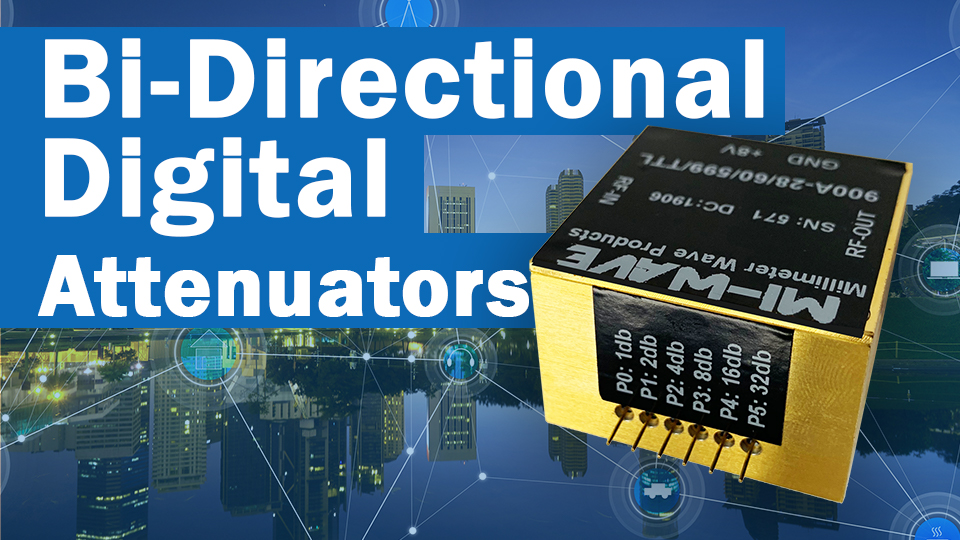
Bi-Directional Digital Attenuators
Mi-Wave’s 900 Series Bi-Directional Digital Attenuators are high-performance RF components designed for precise, fast, and repeatable signal control across microwave and millimeter-wave frequencies. Engineered for demanding applications, these digitally controlled attenuators provide broad bandwidth, high dynamic range, and low insertion loss, making them ideal for modern RF systems.
With TTL-controlled digital attenuation, the 900 Series enables accurate signal adjustment in 1 dB steps, supporting attenuation ranges up to 60+ dB. The bi-directional design allows RF signals to pass in either direction, enabling simultaneous transmit and receive functionality, which is especially valuable in 5G field testing, radar systems, and communication platforms.
These attenuators are optimized for high-speed operation, offering fast switching times and excellent attenuation accuracy, while maintaining compact, rugged form factors suitable for both laboratory and field environments.
The standard models shown represent only part of Mi-Wave’s broader product capabilities. Custom configurations are available to support specific frequency bands, interfaces, and application requirements, enabling optimized solutions for specialized RF, microwave, and millimeter-wave systems.
Watch our informational video to learn more about this product family, including its key features, operating principles, and common applications.
*Actual product may be different from the image shown per customers specifcations
*All data presented is collected from a sample lot.
* Actual data may vary unit to unit, slightly.
*All testing was performed under +25 °C case temperature.
*Consult factory to confirm if material, plating, size, shape, orientation and any electrical parameter is critical for the application as website information is for reference only.
*Millimeter Wave Products, Inc. reserves the right to change the information presented on website without notice as we continue to enhance the performance and design of our products.
Features & Specifications
Mi-Wave’s 900 Series Digital Attenuators are engineered for high-speed, high-precision RF signal control.
Bi-Directional Operation
Supports RF signal flow in both directions, enabling simultaneous transmit and receive functionality.
Wide Attenuation Range: Up to 62 dB
Provides flexible signal control across a broad dynamic range.
Fine Resolution: 1 dB Steps (6-Bit Control)
Enables precise attenuation control using TTL digital signals.
High-Speed Switching (<70 ns)
Ultra-fast rise and fall times support dynamic RF systems and real-time control applications.
Low Insertion Loss
Optimized design minimizes signal loss while maintaining accurate attenuation.
TTL Digital Control Interface
Simple and reliable control using standard TTL logic signals.
High Power Handling
Supports input power levels up to approximately 25 dBm CW, with strong linear performance.
Compact and Lightweight Design
Small form factor ideal for portable systems and space-constrained applications.
Excellent Attenuation Accuracy
Maintains high precision with typical accuracy of ±1 dB.
Broadband Microwave and mmWave Coverage
Designed for applications including Ka-band (e.g., 27.5–28.5 GHz) and beyond.
Applications
Mi-Wave’s 900 Series Bi-Directional Digital Attenuators are used in advanced RF systems requiring fast, precise, and automated signal control.
5G Radio Field Testing
Enables simultaneous transmit and receive signal control in 28 GHz 5G systems, supporting real-world testing environments.
Test and Measurement Systems
Ideal for automated test setups requiring fast switching and precise attenuation control.
Radar and Electronic Warfare (EW)
Supports dynamic RF environments where rapid signal adjustment and bidirectional operation are critical.
Fiber Optic and Broadband Telecom Systems
Used in high-frequency communication infrastructure for signal conditioning and control.
Microwave Radio and VSAT
Provides signal level management in satellite and point-to-point communication systems.
Space and Aerospace Applications
Suitable for high-frequency systems requiring compact, reliable, and high-performance components.
Sensors and Instrumentation
Supports accurate signal control in sensing and measurement systems.
Automated RF Systems
Integrates easily into digitally controlled environments requiring repeatable and programmable attenuation.
Frequently Asked Questions (FAQ)
What is a bi-directional digital attenuator?
A bi-directional digital attenuator allows RF signals to pass in either direction while providing digitally controlled attenuation.
What makes the 900 Series unique?
It combines bi-directional operation, fast switching speed, and digital control, making it ideal for modern RF and 5G systems.
What is the attenuation range?
Typical models provide attenuation from 0 dB up to 60–62 dB in 1 dB steps.
How is attenuation controlled?
Attenuation is controlled באמצעות TTL digital signals, typically using a multi-bit control interface.
What is the switching speed?
The attenuator features rise and fall times under 70 nanoseconds, enabling fast signal adjustments.
What frequency range does it support?
Models are available for microwave and mmWave frequencies, including Ka-band applications such as 27.5–28.5 GHz.
What is the power handling capability?
Typical input power handling is up to 25 dBm CW, with a P1dB around 20 dBm.
What applications benefit from bidirectional operation?
Applications like 5G testing, radar, and full-duplex communication systems benefit from simultaneous transmit and receive capability.
RF Attenuator Calculators
These RF attenuator calculators are designed to support microwave and millimeter-wave engineers working with direct reading precision attenuators, waveguide attenuators, and laboratory RF test setups. Use these tools to quickly convert attenuation values, estimate power levels, evaluate cascaded loss, and analyze impedance match performance for systems spanning X-Band through J-Band.
dB to Power Ratio
Convert attenuation or gain in decibels to a linear power ratio.
Power Ratio to dB
Convert a linear power ratio into decibels.
dBm to Watts
Convert RF power in dBm to watts for test and system-level calculations.
Watts to dBm
Convert watts to dBm for RF signal level analysis.
Cascaded Attenuation Calculator
Add multiple attenuator values together to determine total path attenuation.
VSWR to Return Loss
Estimate return loss from a known VSWR value.
Glossary of Fixed Waveguide Attenuator Terms
Digital Attenuator Concepts
Digital Attenuator
An attenuator controlled by digital signals, allowing discrete attenuation levels.
Bi-Directional Attenuator
An attenuator that allows RF signals to pass in both directions without performance degradation.
TTL Control (Transistor-Transistor Logic)
A digital control method using standard logic voltage levels (typically 0–5V) to set attenuation states.
Bit Control (Binary Weighted Attenuation)
Each control bit corresponds to a specific attenuation value (e.g., 1 dB, 2 dB, 4 dB, etc.).
Least Significant Bit (LSB)
The smallest attenuation step, typically 1 dB in digital attenuators.
Electrical Performance
Attenuation Range
The total range of signal reduction available, such as 0 to 62 dB.
Insertion Loss
The inherent signal loss when the attenuator is set to minimum attenuation.
Attenuation Accuracy
How closely the actual attenuation matches the programmed value.
Bit Error (Attenuation Error)
Deviation in attenuation caused by inaccuracies in digital control states.
P1dB (1 dB Compression Point)
The input or output power level where signal compression begins.
Power Handling
Maximum RF input power the attenuator can safely handle.
Speed and Control
Switching Speed
The time required to change from one attenuation state to another.
Rise Time / Fall Time
The time it takes for attenuation to transition between levels.
Digital Switching
The process of changing attenuation levels via digital control signals.
RF and Frequency
Microwave Frequencies
Typically 1 GHz to 30 GHz.
Millimeter-Wave (mmWave)
Frequencies above 30 GHz used in advanced RF systems.
Ka-Band
A frequency band from approximately 26.5 GHz to 40 GHz, commonly used in 5G and satellite communications.
System Applications
Full-Duplex Communication
Simultaneous transmission and reception of signals, enabled by bidirectional components.
Automatic Test Equipment (ATE)
Systems that use programmable components for automated RF testing.
5G Field Testing
Real-world testing of 5G communication systems, often requiring dynamic signal control.
Signal Conditioning
Adjusting signal levels to optimize system performance.
White Papers
28 GHz Bidirectional 0 to 62 dB Voltage Controlled Variable Digital Attenuator for 5G Application
Abstract
Digitally controlled attenuators are the key components in communication, radar, instrumentation, and automatic test systems. Broad bandwidth, high dynamic attenuation range, low insertion loss, high control resolution and fast control speed are key considerations in nearly all applications.
Bi-Directional Digital Attenuators
If you are looking for quality built bi-directional digital attenuators, then use Millimeter wave products Inc. We we specialize in manufacturing the highest quality digital attenuators for many needs.
The 900 Series bi-directional digital attenuators are the latest in mmwave product research, design and production. We can manufacture to any custom size or specification, please consult Mi-Wave for further information.
Interested in this product or other Mi-Wave solutions?
Contact our team to discuss your frequency range, interface needs, and application requirements.
Custom configurations are available for specialized RF, microwave, and millimeter-wave systems.
Return to Attenuators
Return to Products Page