
Mi-Wave’s 178 Series Full Band Y-Junction Isolators are high-performance waveguide ferrite devices designed to provide reliable isolation across standard microwave and millimeter-wave frequency bands. Based on an H-plane three-port Y-junction architecture, these isolators use ferrite-based non-reciprocal behavior to direct reflected energy away from the input and into an internal matched load.
In operation, RF energy entering the input port is transmitted to the output port with low insertion loss, while any reflected energy is circulated to a third port that is internally terminated, preventing it from returning to the source. This approach provides robust isolation and improved system stability, particularly in high-frequency and high-power environments.
The 178 Series is engineered with precision-machined waveguide interfaces, ensuring extremely flat mating surfaces for optimal flange connections and minimal discontinuities. This results in improved impedance matching, reduced reflections, and consistent performance across the full waveguide band.
Available in standard waveguide sizes from WR-42 through WR-8, these isolators support applications spanning K-band through F-band, making them well suited for broadband microwave and mmWave systems.
The standard models shown represent only part of Mi-Wave’s broader product capabilities. Custom configurations are available to support specific frequency bands, interfaces, and application requirements, enabling optimized solutions for specialized RF, microwave, and millimeter-wave systems.
Watch our informational video to learn more about this product family, including its key features, operating principles, and common applications.
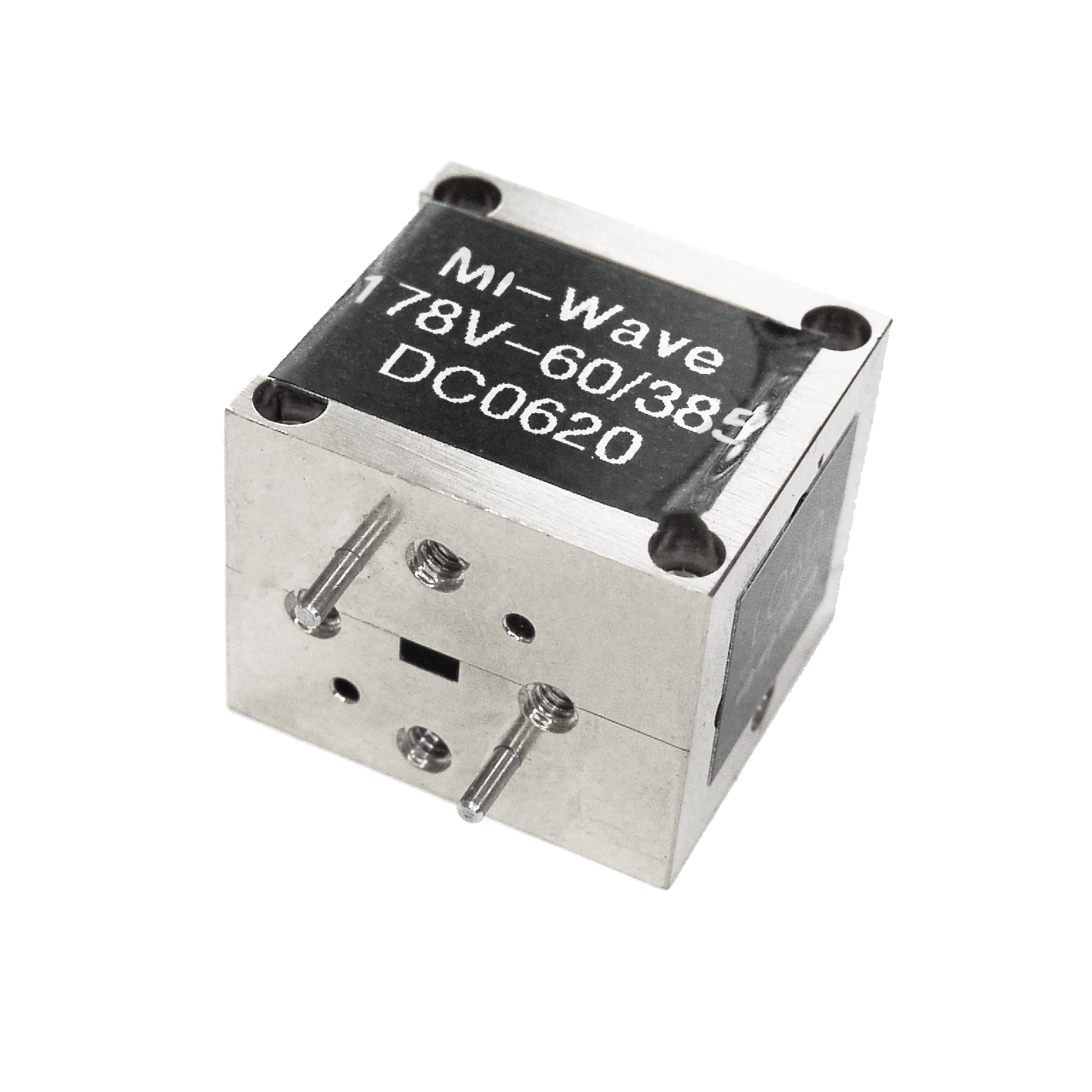
| Model | Waveguide Band | Frequency Range | Bandwidth | Isolation | Insertion Loss | VSWR Max | Avg Power | Peak Power | Input / Output Ports |
|---|---|---|---|---|---|---|---|---|---|
| 178K-XX/595 | K-Band | 18–26.5 GHz | 4 GHz | 20 dB | 0.4 dB | 1.3:1 | 5 W | 1 kW | WR-42 Waveguide, UG-595/U Flange |
| 178A-XX/599 | Ka-Band | 26.5–40 GHz | 4 GHz | 20 dB | 0.4 dB | 1.3:1 | 5 W | 1 kW | WR-28 Waveguide, UG-599/U Flange |
| 178B-XX/383 | Q-Band | 33–50 GHz | 4 GHz | 20 dB | 0.5 dB | 1.3:1 | 4 W | 1 kW | WR-22 Waveguide, UG-383/U Flange |
| 178U-XX/383 | U-Band | 40–60 GHz | 4 GHz | 18 dB | 0.7 dB | 1.35:1 | 4 W | 1 kW | WR-19 Waveguide, UG-383/U-M Flange |
| 178V-XX/385 | V-Band | 50–75 GHz | 4 GHz | 18 dB | 0.8 dB | 1.4:1 | 4 W | 1 kW | WR-15 Waveguide, UG-385/U Flange |
| 178E-XX/387 | E-Band | 60–90 GHz | 4 GHz | 15 dB | 0.9 dB | 1.4:1 | 4 W | 1 kW | WR-12 Waveguide, UG-387/U Flange |
| 178W-XX/387 | W-Band | 75–110 GHz | 4 GHz | 15 dB | 1 dB | 1.4:1 | 3 W | 1 kW | WR-10 Waveguide, UG-387/U-M Flange |
| 178F-XX/387 | F-Band | 90–140 GHz | 4 GHz | 15 dB | 1.3 dB | 1.4:1 | 1 W | 1 kW | WR-08 Waveguide, UG-387/U-M Flange |
*All data presented is collected from a sample lot.
* Actual data may vary unit to unit, slightly.
*All testing was performed under +25 °C case temperature.
*Consult factory to confirm if material, plating, size, shape, orientation and any electrical parameter is critical for the application as website information is for reference only.
*Millimeter Wave Products, Inc. reserves the right to change the information presented on website without notice as we continue to enhance the performance and design of our products.
Features & Specifications
Y-Junction Circulator-Based Isolation
The isolator is built on a three-port ferrite Y-junction design, allowing reflected signals to be redirected and absorbed internally rather than returned to the source. This provides strong and reliable isolation in compact waveguide form.
Full Waveguide Band Operation
The 178 Series is designed to operate across the entire standard waveguide band, enabling broadband performance without the need for narrowband tuning or multiple components.
Low Insertion Loss for Forward Signal Integrity
Efficient signal transmission from input to output minimizes power loss, helping preserve system gain and maintain high-performance operation across microwave and mmWave frequencies.
Internal Matched Load for Reflected Energy Absorption
Reflected signals are routed to an internally integrated load, eliminating the need for external terminations and simplifying system integration.
Precision Machined Waveguide Interfaces
All mating surfaces are machined to extreme flatness, ensuring optimal flange connections, reduced discontinuities, and improved impedance matching across the interface.
Wide Frequency Coverage (WR-42 to WR-8)
Supports applications from K-band through F-band, covering a wide range of microwave and millimeter-wave system requirements.
How Y-Junction Isolators Work
The 178 Series operates using a three-port circulator-based topology, configured as an isolator by terminating one port internally.
In a Y-junction circulator, RF energy entering one port is routed to the next port in a rotational sequence determined by the ferrite material and magnetic bias. In this isolator configuration:
- Forward signal entering Port 1 is routed to Port 2 (output)
- Any reflected signal entering Port 2 is routed to Port 3
- Port 3 is internally terminated with a matched load, where the energy is absorbed
This creates effective isolation between input and output without requiring additional external components.
Because the device operates using ferrite-based non-reciprocal behavior, the signal routing is inherently directional. This ensures that forward transmission is preserved while reverse energy is removed from the system, improving stability and protecting upstream components.
Applications
RF and Microwave Test Systems
Y-junction isolators are widely used in test setups to protect signal sources and instrumentation from reflections, improving measurement accuracy and repeatability.
High-Frequency Communication Systems
In microwave and mmWave communication systems, isolators help maintain signal integrity by reducing standing waves and preventing interference caused by reflections.
Amplifier Protection and Stability
Power amplifiers benefit from isolators that prevent reflected energy from re-entering the device, reducing the risk of oscillation, compression effects, and long-term damage.
Subsystem Integration in RF Chains
The compact and integrated nature of Y-junction isolators makes them well suited for multi-stage RF assemblies, where isolation between stages is required to maintain performance.
Aerospace and Defense Systems
Used in radar, electronic warfare, and satellite communication systems, these isolators provide stable, reliable performance in demanding operational environments.
Frequently Asked Questions (FAQ)
What is the purpose of a waveguide isolator?
An isolator allows RF energy to pass in one direction while blocking reflections in the opposite direction, protecting sensitive components like amplifiers and signal sources.
How is a Faraday isolator different from a circulator?
An isolator is essentially a two-port device derived from a circulator, typically with one port terminated. It provides simpler integration when only forward isolation is required.
Do these isolators require external power or biasing?
No. The 115 Series uses an integral permanent magnet, eliminating the need for external biasing.
Why is isolation important in RF systems?
High isolation prevents reflected signals from degrading performance, causing instability, or damaging components such as power amplifiers.
What frequency ranges are available?
Standard waveguide models are available from 18 GHz up to 325 GHz, covering microwave through millimeter-wave bands.
Can these be customized?
Yes. MI-Wave offers custom designs for specific frequency bands, power levels, and mechanical requirements.
Isolator Performance Calculators
These calculators help estimate forward loss, reflected power suppression, return loss behavior, and leakage levels when integrating Faraday isolators into microwave and millimeter-wave signal chains.
Reflected Power After Isolation
Estimate the reflected power that remains after the isolator suppresses reverse energy.
Output Power with Insertion Loss
Calculate forward output power after insertion loss through the isolator.
Return Loss to Reflected Power
Estimate reflected power from input power and return loss.
VSWR to Return Loss
Convert VSWR to return loss to evaluate impedance match quality.
Linear Leakage from Isolation
Estimate the remaining reverse leakage as a linear ratio from isolation in dB.
Interested in this product or other Mi-Wave solutions?
Contact our team to discuss your frequency range, interface needs, and application requirements.
Custom configurations are available for specialized RF, microwave, and millimeter-wave systems.
Return to Isolators
Return to Products Page