
Products> Circulators
Millimeter Wave Waveguide Circulators & RF Isolators
Mi-Wave’s RF Circulators are passive, non-reciprocal three-port waveguide devices designed to control the direction of RF signal flow in microwave and millimeter-wave systems. Using ferrite materials and precision magnetic biasing, circulators route RF energy sequentially from one port to the next while providing excellent isolation between ports, helping improve system stability, reduce reflections, and protect sensitive RF components.
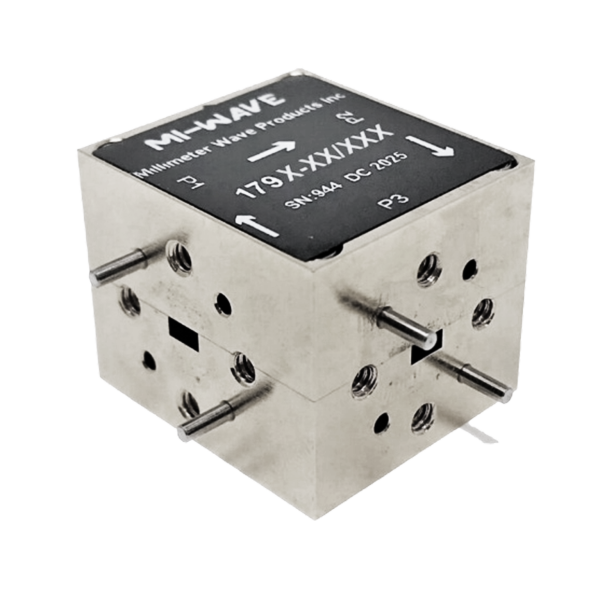
Mi-Wave’s circulator product family includes the Series 179 Y-Junction Circulators, available across frequency bands from 18 GHz to 110 GHz. Designed for low insertion loss, high isolation, and reliable broadband performance, these circulators are ideal for radar, satellite communications (SatCom), electronic warfare (EW), RF test and measurement, frequency conversion systems, and aerospace and defense applications.
Mi-Wave circulators integrate seamlessly with our isolators, frequency converters, mixers, amplifiers, filters, waveguide components, and antenna systems, providing complete RF and millimeter-wave subsystem solutions. Standard and custom configurations are available to meet specific frequency ranges, power handling requirements, waveguide interfaces, and mechanical specifications.
The standard models shown represent only part of Mi-Wave’s broader product capabilities. Custom configurations are available to support specific frequency bands, interfaces, and application requirements, enabling optimized solutions for specialized RF, microwave, and millimeter-wave systems.
Watch our informational video to learn more about this product family, including its key features, operating principles, and common applications.
Y-Junction Circulators (Series 179)
Features
Broadband Frequency Coverage
Mi-Wave RF circulators are available from 18 GHz through 110 GHz, supporting numerous standard waveguide bands used throughout microwave and millimeter-wave communications, radar, aerospace, and defense systems.
Series 179 Y-Junction Circulators
The Series 179 utilizes a classic ferrite Y-junction design that offers excellent insertion loss, isolation, and VSWR over broad operating bandwidths. These devices are ideal for general-purpose microwave systems requiring dependable performance and compact size.
Low Insertion Loss
Efficient signal transmission minimizes power loss through the circulator, helping preserve transmitter output power, receiver sensitivity, and overall RF system efficiency.
High Isolation
Excellent isolation prevents unwanted coupling between adjacent RF components, reducing interference and protecting amplifiers, oscillators, and receivers from reflected energy.
Excellent VSWR
Carefully matched waveguide interfaces minimize signal reflections while maintaining efficient power transfer between connected RF components.
Passive Operation
No external power, bias voltage, or control electronics are required, making circulators highly reliable components suitable for continuous operation in demanding environments.
Rugged Waveguide Construction
Precision-machined waveguide assemblies ensure long-term mechanical durability, repeatable electrical performance, and compatibility with commercial, aerospace, and military RF systems.
Custom Engineering Support
Custom frequency ranges, flange configurations, power handling capabilities, and environmental options are available to meet unique system requirements.
RF Circulators Overview
RF circulators are passive, non-reciprocal three-port waveguide devices that precisely control the direction of microwave and millimeter-wave signal flow within an RF system. Unlike reciprocal components that allow signals to travel equally in both directions, circulators route RF energy sequentially from one port to the next while isolating the remaining port. This unique behavior enables multiple RF devices to share common transmission paths while minimizing interference and protecting sensitive components.
Mi-Wave’s Series 179 Y-Junction Circulators utilize precision ferrite materials and permanent magnetic biasing to establish a preferred direction of signal propagation. When RF energy enters one port, it is efficiently transferred to the adjacent port with minimal insertion loss, while the third port remains isolated. Because this process is entirely passive, circulators require no external power or control circuitry, providing reliable long-term operation in demanding microwave and millimeter-wave environments.
In many RF systems, circulators are used to separate transmit and receive paths that share a common antenna. During transmission, RF power is routed from the transmitter to the antenna while isolating the receiver. When a signal is received, the returning energy is directed from the antenna to the receiver without feeding back into the transmitter. This directional routing improves system efficiency while protecting amplifiers, receivers, mixers, and other sensitive RF components from reflected power and unwanted signal interaction.
Mi-Wave’s Series 179 Y-Junction Circulators are available across frequency bands from 18 GHz to 110 GHz, making them ideal for radar systems, satellite communications (SatCom), electronic warfare (EW), RF test and measurement, frequency conversion systems, aerospace and defense platforms, and research laboratories. They integrate seamlessly with Mi-Wave’s isolators, mixers, frequency converters, filters, amplifiers, antennas, and other waveguide components to create complete high-performance microwave and millimeter-wave subsystems.
RF Circulator Signal Flow
A three-port circulator routes microwave signals in one direction while isolating the remaining port. This enables transmitters, receivers, and antennas to share the same RF path without interference.
Circulator
Transmit Mode
RF power enters Port 1 from the transmitter and is routed to Port 2, delivering energy to the antenna while isolating the receiver.
Receive Mode
Incoming RF signals from the antenna enter Port 2 and are automatically routed to Port 3, where the receiver processes the signal.
Port Isolation
The unused port remains isolated, reducing unwanted reflections, improving amplifier stability, and protecting sensitive RF components.
Applications
Supporting Critical RF and Microwave Systems
Because circulators provide both directional signal routing and port isolation, they are used throughout modern microwave systems.
Typical applications include:
Radar Systems
Separating transmitters and receivers sharing a common antenna while protecting sensitive receiver front ends from high transmit power.
Satellite Communications (SatCom)
Routing uplink and downlink signals while improving isolation between high-power amplifiers and low-noise receivers.
Electronic Warfare (EW)
Supporting high-power microwave transmitters, jamming systems, direction-finding equipment, and electronic surveillance platforms.
Test & Measurement
Improving measurement repeatability in network analyzers, signal generators, spectrum analyzers, and automated RF test systems.
Shared Antenna Systems
Allowing multiple RF paths to utilize a single antenna without excessive signal interaction.
Frequency Conversion Systems
Installed alongside mixers, upconverters, downconverters, and local oscillators to improve signal isolation throughout conversion chains.
Aerospace & Defense
Used throughout airborne, naval, ground, and space-based microwave communication and sensing platforms.
Research Laboratories
Supporting advanced microwave experimentation, component characterization, and millimeter-wave development.
Frequently Asked Questions (FAQ)
What is an RF circulator?
An RF circulator is a passive, non-reciprocal three-port waveguide device that directs microwave and millimeter-wave signals from one port to the next in a predetermined direction. This controlled signal routing helps improve system performance while isolating sensitive RF components from unwanted reflections.
How does an RF circulator work?
RF circulators use ferrite materials and permanent magnetic biasing to create non-reciprocal signal propagation. A signal entering Port 1 exits Port 2, a signal entering Port 2 exits Port 3, and a signal entering Port 3 exits Port 1, allowing predictable signal routing without external power.
What is the difference between a circulator and an isolator?
A circulator is a three-port device that routes RF energy sequentially between ports. An isolator is typically a two-port device that permits forward transmission while attenuating reverse-traveling signals. Many isolators are created by terminating one port of a circulator with an absorptive load.
Why are RF circulators important?
Circulators improve RF system reliability by controlling signal paths, reducing unwanted reflections, protecting sensitive components, and enabling transmitters and receivers to share common antennas without interference.
Do RF circulators require external power?
No. Mi-Wave’s Series 179 Y-Junction Circulators are completely passive devices and require no external power supply or control circuitry.
What frequency range is available?
The Series 179 Y-Junction Circulators are available across microwave and millimeter-wave frequency bands from 18 GHz to 110 GHz, depending on the selected waveguide size.
What applications use RF circulators?
RF circulators are commonly used in:
- Radar systems
- Satellite communications (SatCom)
- Electronic Warfare (EW)
- RF test and measurement
- Frequency converters
- Shared antenna systems
- Microwave communication systems
- Aerospace and defense platforms
- Research laboratories
Can RF circulators protect power amplifiers?
Yes. By directing reflected energy away from transmitters and high-power amplifiers, circulators help improve amplifier stability and reduce the effects of load mismatches.
Can one antenna be used for both transmit and receive?
Yes. Circulators are frequently used to allow transmitters and receivers to share a common antenna while maintaining isolation between the two signal paths.
What waveguide interfaces are available?
Mi-Wave offers circulators in multiple standard rectangular waveguide sizes covering the supported frequency bands. Custom flange configurations may also be available.
Are custom circulators available?
Yes. Custom solutions can be developed for specific frequency ranges, waveguide interfaces, flange types, power handling requirements, and environmental conditions.
RF Circulator Calculators
Estimate impedance mismatch, reflected power, insertion loss, isolation leakage, cascaded RF loss, and directional port routing for microwave and millimeter-wave circulator applications.
Return Loss & VSWR
Convert return loss into VSWR, reflection coefficient, and reflected power.
Reflected Power
Estimate reflected and delivered power from forward power and return loss.
Insertion Loss
Calculate output power after signal loss through a circulator.
Isolation Leakage
Estimate unwanted signal leakage between isolated circulator ports.
Cascaded RF Component Loss
Calculate total insertion loss and final output power through multiple circulators, isolators, filters, adapters, or waveguide components.
Three-Port Circulator Routing
Select an input port to visualize clockwise or counterclockwise RF signal routing.
Glossary
Circulator
A passive three-port RF device that directs microwave energy from one port to the next in a single rotational direction.
Y-Junction Circulator
A ferrite-based three-port circulator that uses a Y-shaped junction to achieve directional signal routing with low insertion loss and high isolation.
Non-Reciprocal Device
An RF component whose transmission characteristics differ depending on the direction of signal propagation.
Ferrite Material
A magnetic ceramic material whose electromagnetic properties change under a magnetic field, enabling non-reciprocal RF operation.
Permanent Magnetic Bias
A fixed magnetic field applied to ferrite material to establish the preferred direction of RF signal flow without requiring electrical power.
Port Isolation
The amount of attenuation between ports that are not intended to exchange signals. High isolation reduces interference and protects connected RF components.
Insertion Loss
The reduction in signal power as RF energy passes through the circulator. Lower insertion loss improves overall system efficiency.
Return Loss
A measurement of how much RF energy is reflected due to impedance mismatches between connected components.
VSWR (Voltage Standing Wave Ratio)
A measure of impedance matching in an RF system. Lower VSWR indicates better power transfer and fewer reflections.
Reflection Coefficient (Γ)
The ratio of reflected signal amplitude to the incident signal amplitude at an impedance discontinuity.
Standing Wave
A stationary voltage and current pattern created by reflections caused by impedance mismatches in an RF transmission path.
Waveguide
A hollow metallic transmission line used to carry microwave and millimeter-wave signals with very low loss.
Shared Antenna System
An RF architecture where a single antenna is used for both transmitting and receiving signals through devices such as circulators.
Duplex Operation
The ability to transmit and receive simultaneously or alternately using a common antenna while maintaining isolation between signal paths.
Power Amplifier (PA)
An RF amplifier that increases signal power before transmission. Circulators help protect power amplifiers from reflected energy.
Low Noise Amplifier (LNA)
A receiver amplifier designed to amplify weak RF signals while adding minimal noise. Circulators help isolate LNAs from high-power transmit signals.
Frequency Converter
An RF subsystem that translates signals from one frequency to another using mixers and local oscillators. Circulators are often integrated into these systems to improve isolation.
Microwave Frequency
The portion of the electromagnetic spectrum generally spanning 1 GHz to 30 GHz, widely used for radar, communications, and instrumentation.
Millimeter-Wave (mmWave)
Electromagnetic frequencies typically ranging from 30 GHz to 300 GHz, enabling high-bandwidth communications, advanced sensing, radar, and scientific research.
Radar
A system that transmits RF energy and analyzes reflected signals to determine the location, speed, or characteristics of objects. Circulators allow transmitters and receivers to efficiently share a common antenna.
Interested in this product or other Mi-Wave solutions?
Contact our team to discuss your frequency range, interface needs, and application requirements.
Custom configurations are available for specialized RF, microwave, and millimeter-wave systems.
Return to Products Page