
Products> Passive Products > Isolators
Mi-Wave’s RF Isolators are passive, non-reciprocal two-port devices designed to protect RF, microwave, and millimeter-wave systems from reflected power caused by impedance mismatches and changing load conditions. By allowing signals to pass with low insertion loss in the forward direction while attenuating reverse-traveling energy, isolators improve amplifier stability, preserve signal integrity, and protect sensitive RF components.
Our product line includes the Series 115 Faraday Isolators, Series 116 Compact Isolators, and Series 178 Y-Junction Isolators, offering solutions across a wide range of frequency bands, power levels, and waveguide configurations. Standard and custom designs are available to meet specific electrical and mechanical requirements.
Mi-Wave RF isolators are widely used in satellite communications (SatCom), radar, electronic warfare (EW), RF test and measurement, frequency conversion systems, and aerospace and defense applications. They integrate seamlessly with Mi-Wave’s circulators, frequency converters, mixers, amplifiers, filters, waveguide components, and antenna systems to provide complete RF and millimeter-wave subsystem solutions.
The standard models shown represent only part of Mi-Wave’s broader product capabilities. Custom configurations are available to support specific frequency bands, interfaces, and application requirements, enabling optimized solutions for specialized RF, microwave, and millimeter-wave systems.
Watch our informational video to learn more about this product family, including its key features, operating principles, and common applications.
Faraday Isolators
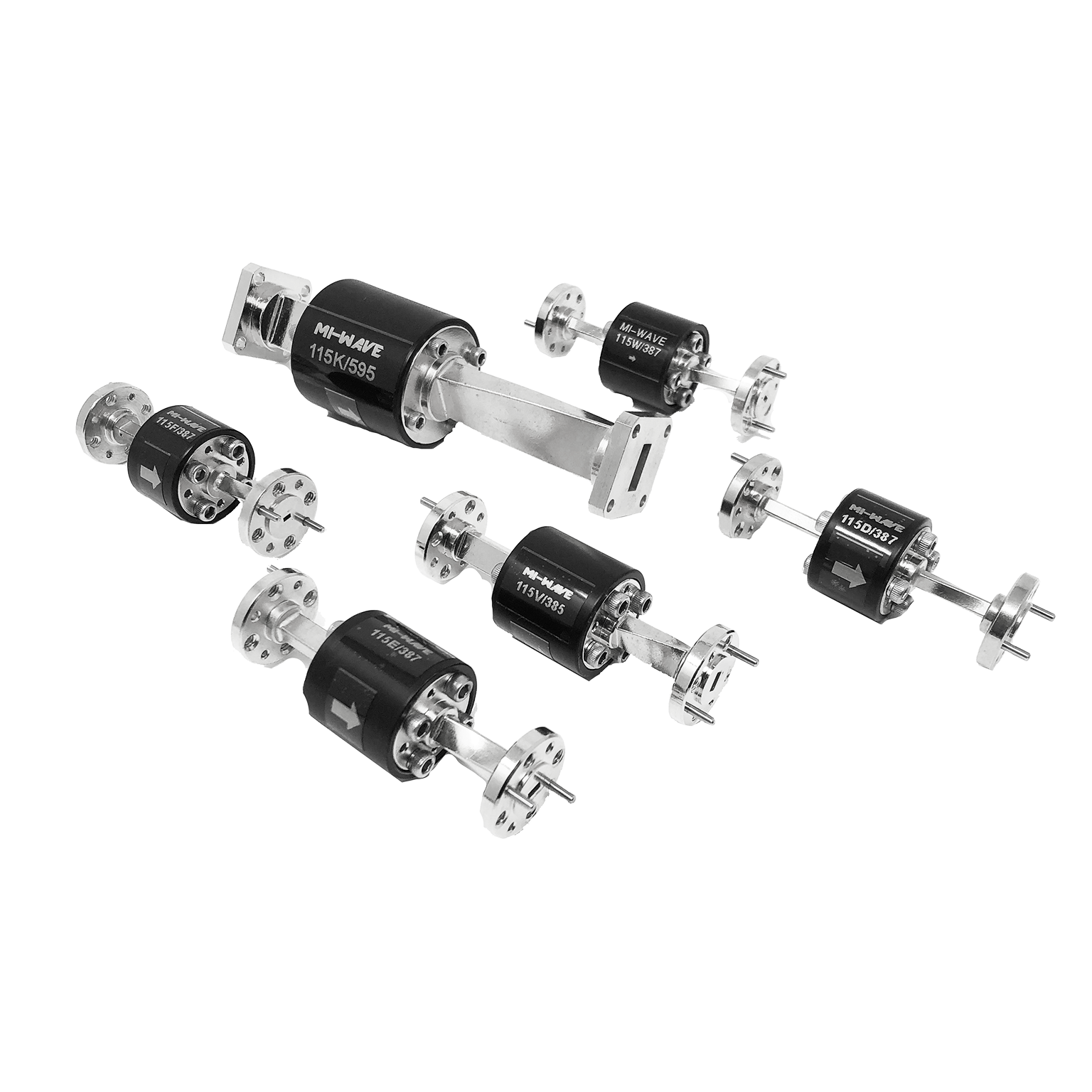
Series 115
Compact Isolators
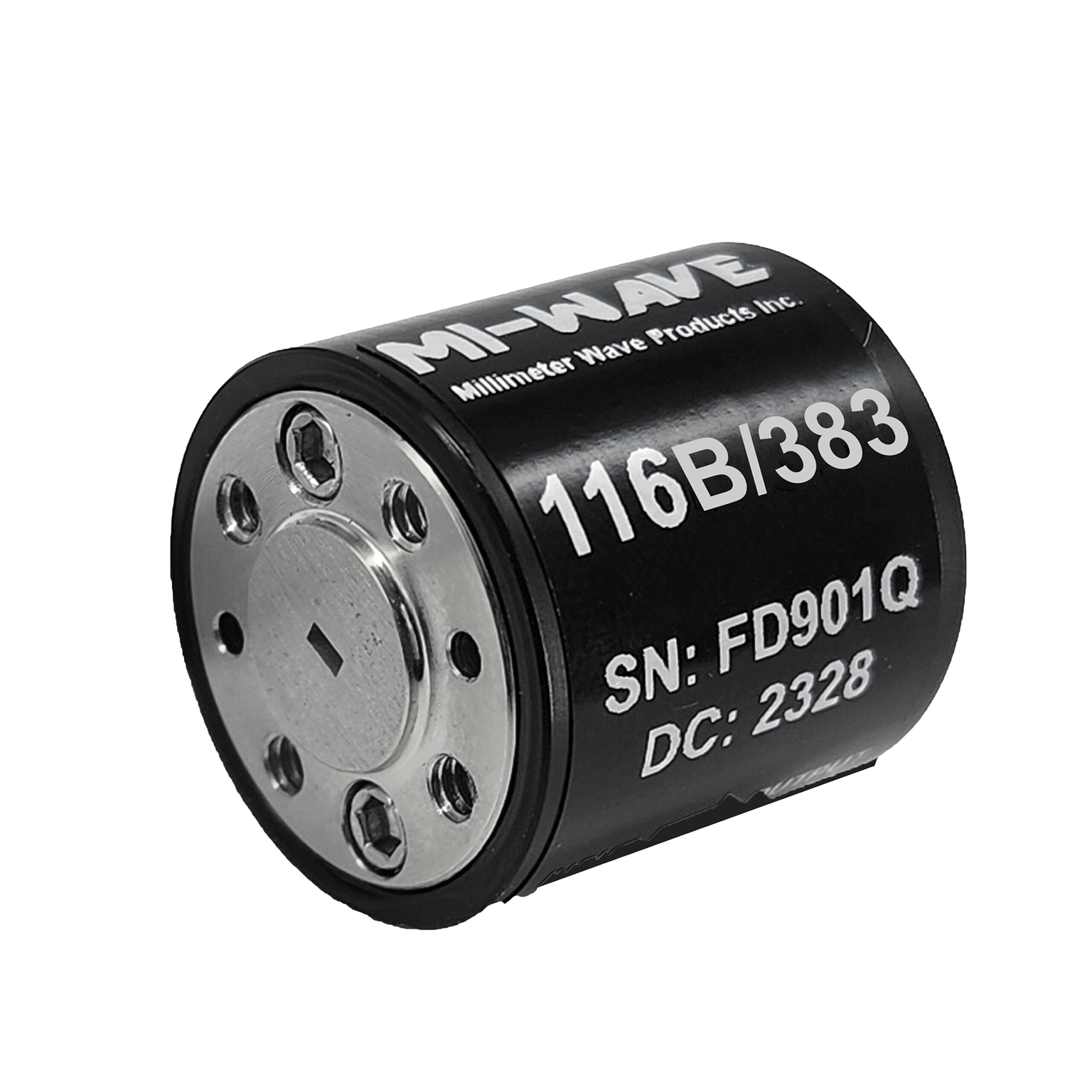
Series 116
Y-Junction Isolators
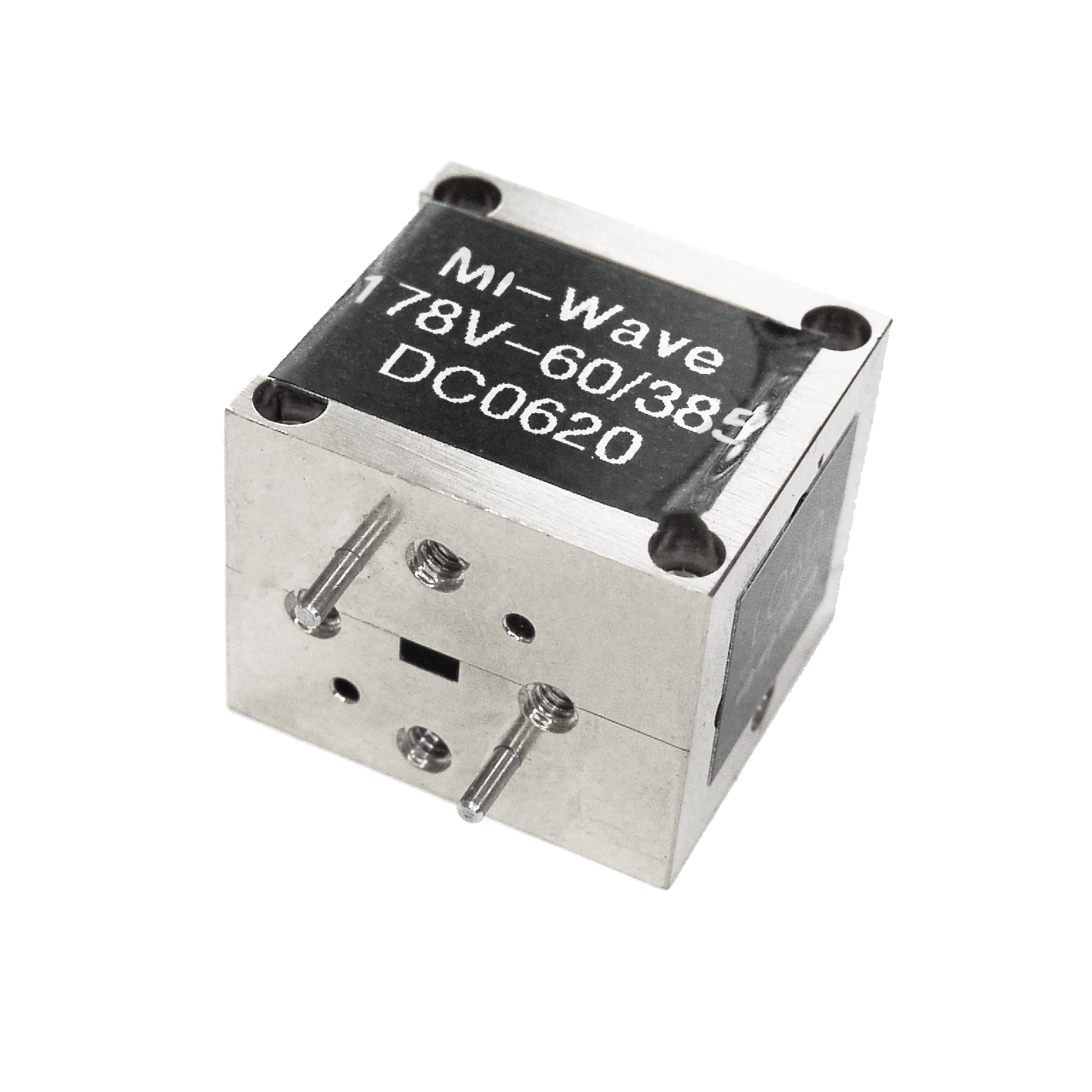
Series 178
Key Features & Performance Benefits
Broadband Frequency Coverage
Mi-Wave isolators are available across a wide range of RF, microwave, and millimeter-wave frequency bands, providing reliable performance for communications, radar, instrumentation, and research applications.
Low Insertion Loss
Designed to minimize signal attenuation in the forward direction, Mi-Wave isolators help preserve system gain, improve receiver sensitivity, and maximize overall RF efficiency.
High Reverse Isolation
Excellent isolation protects sensitive RF components from reflected power caused by impedance mismatches, helping improve amplifier stability, reduce standing waves, and enhance overall system reliability.
Improved System Stability
By preventing reflected signals from propagating back toward the source, isolators reduce oscillations, minimize gain ripple, and help maintain consistent system performance.
Passive, Self-Contained Operation
Most isolator designs operate without external power or control circuitry, simplifying system integration while providing reliable, maintenance-free operation.
Wide Waveguide Compatibility
Available with standard waveguide interfaces across numerous frequency bands for straightforward integration into RF, microwave, and millimeter-wave systems.
Precision Mechanical Construction
Manufactured using precision machining and controlled assembly processes to ensure consistent electrical performance, excellent repeatability, and long-term mechanical reliability.
Stable Electrical Performance
Designed to provide consistent insertion loss, isolation, and impedance matching across the specified operating frequency range, supporting predictable system behavior in demanding environments.
Rugged Design for Demanding Applications
Suitable for laboratory, commercial, aerospace, defense, and industrial applications requiring dependable RF performance under a variety of operating conditions.
Flexible Integration
Compatible with amplifiers, transmitters, receivers, oscillators, frequency converters, mixers, test equipment, radar systems, satellite communication terminals, and other microwave subsystems.
Custom Configurations Available
Mi-Wave offers custom isolator solutions with application-specific frequency ranges, waveguide sizes, flange styles, power handling capabilities, and mechanical configurations to meet unique system requirements.
RF Isolator Overview
Mi-Wave RF Isolators are passive, non-reciprocal components designed to allow RF energy to travel efficiently in one direction while suppressing unwanted reflections in the opposite direction. By minimizing reverse power, isolators help protect amplifiers, oscillators, frequency converters, signal generators, and sensitive measurement equipment from impedance mismatches and reflected energy that can degrade system performance.
Installed between an RF source and a load, an isolator transmits the desired forward signal with low insertion loss while directing reflected energy into an internal absorptive load where it is safely dissipated. This improves amplifier stability, reduces standing waves, preserves signal integrity, and enhances measurement repeatability across RF, microwave, and millimeter-wave systems.
How an RF Isolator Works
Oscillator
Signal Generator
High Reverse Isolation
Receiver
Device Under Test
Forward Signal Transmission
The desired RF signal enters the isolator and passes to the output with minimal insertion loss, preserving available signal power and maintaining efficient system operation.
Reflection Occurs
If the load or antenna presents an impedance mismatch, a portion of the RF energy is reflected back toward the source.
Reverse Signal Suppression
The isolator prevents reflected energy from propagating back to the source by redirecting the reverse signal into an internal absorbing load.
Protected RF System
By absorbing reflected power, the isolator improves amplifier stability, reduces standing waves, protects sensitive components, and maintains consistent RF performance.
Applications
RF & Microwave Test Systems
Mi-Wave isolators are widely used in laboratory and production test environments to protect signal sources and measurement equipment from reflected power. By maintaining a stable impedance environment, they improve measurement repeatability and accuracy during S-parameter, gain, power, and frequency response testing.
Amplifier Protection
Isolators are commonly installed at the output of RF, microwave, and millimeter-wave power amplifiers to prevent reflected energy from returning to the amplifier. This helps improve amplifier stability, reduce the likelihood of oscillation, and protect sensitive components from damage caused by load mismatches.
Radar Systems
Used in radar transmitters, receivers, and transceiver modules, isolators help maintain stable RF performance by minimizing reflections and preserving signal integrity. They support reliable operation in surveillance, tracking, imaging, weather, and automotive radar systems.
Satellite Communications (SatCom)
In satellite communication systems, isolators protect high-frequency components while improving impedance matching and minimizing reflected power within uplink and downlink signal chains. They are commonly integrated into gateway stations, ground terminals, and satellite payload subsystems.
Frequency Conversion Systems
Frequently incorporated into upconverters, downconverters, mixers, local oscillator chains, and frequency generation modules, isolators help maintain directional signal flow, reduce unwanted interactions between stages, and improve overall converter stability.
RF Communication Systems
Isolators enhance the performance of microwave and millimeter-wave communication links by reducing standing waves, improving impedance matching, and maintaining consistent signal transmission across high-frequency networks.
Test & Measurement Instrumentation
Integrated into spectrum analyzers, signal generators, network analyzers, calibration systems, and automated test equipment (ATE), isolators improve measurement consistency while protecting sensitive instrumentation from reflected RF energy.
Aerospace & Defense Systems
Aerospace and defense platforms rely on isolators to provide dependable RF performance in demanding environments. Applications include electronic warfare (EW), electronic intelligence (ELINT), signal intelligence (SIGINT), radar, secure communications, and other mission-critical microwave and millimeter-wave systems.
Research & Development
Universities, government laboratories, and commercial research organizations use isolators in experimental RF systems where stable signal transmission, low reflection, and repeatable measurements are essential for device characterization and system development.
Integrated RF Subsystems
Isolators are commonly incorporated into multi-stage RF assemblies including transmitters, receivers, transceivers, amplifiers, oscillators, synthesizers, and integrated microwave modules, where they help improve system stability, reduce component interaction, and preserve signal quality.
Isolator Performance Calculators
These calculators help estimate forward loss, reflected power suppression, return loss behavior, and leakage levels when integrating Faraday isolators into microwave and millimeter-wave signal chains.
Reflected Power After Isolation
Estimate the reflected power that remains after the isolator suppresses reverse energy.
Output Power with Insertion Loss
Calculate forward output power after insertion loss through the isolator.
Return Loss to Reflected Power
Estimate reflected power from input power and return loss.
VSWR to Return Loss
Convert VSWR to return loss to evaluate impedance match quality.
Linear Leakage from Isolation
Estimate the remaining reverse leakage as a linear ratio from isolation in dB.
Glossary of RF Isolator Terms
This glossary defines common terminology associated with RF, microwave, and millimeter-wave isolators. These passive, non-reciprocal components are used to protect amplifiers, oscillators, frequency converters, test equipment, and other sensitive RF devices from reflected power and impedance mismatches.
RF Isolator
A passive, non-reciprocal RF component that allows electromagnetic energy to pass efficiently in the forward direction while strongly attenuating signals traveling in the reverse direction.
Faraday Isolator
An isolator that uses magnetically biased ferrite material and the Faraday rotation effect to provide directional RF transmission and reverse-signal suppression.
Non-Reciprocity
A property in which a component exhibits different transmission characteristics depending on the direction of signal travel. Non-reciprocity is fundamental to isolators and circulators.
Ferrite Material
A magnetic ceramic material used in many isolators to produce direction-dependent RF behavior when exposed to a magnetic bias field.
Ferrimagnetic Material
A class of magnetic materials, including ferrites, in which magnetic moments align in opposing directions with unequal strength, producing a net magnetic response.
Faraday Rotation
The rotation of an electromagnetic wave’s polarization as it passes through a magnetically biased material. This effect is used in Faraday isolators to separate forward and reverse signals.
Faraday Rotation Constant
A material-dependent parameter that describes the amount of polarization rotation produced per unit length and magnetic field strength.
Gyromagnetic Effect
The interaction between magnetic fields and electron spin motion within ferrite materials that enables non-reciprocal RF propagation and Faraday rotation.
Magnetic Bias Field
A static magnetic field applied to the ferrite material, typically by a permanent magnet, to establish the non-reciprocal behavior required for isolation.
Permanent Magnet Bias
A self-contained magnetic bias arrangement that allows the isolator to operate without external power or active control circuitry.
Polarization Rotation Angle
The amount by which the electric field orientation rotates as a signal travels through a ferrite section. Some Faraday isolators are designed around a controlled 45-degree rotation.
Forward Direction
The intended signal path through an isolator, typically from the RF source toward the antenna, load, or downstream component.
Reverse Direction
The direction traveled by reflected RF energy returning from a mismatched load, antenna, or downstream component toward the source.
Insertion Loss (S21)
The signal power lost as RF energy passes through the isolator in the forward direction. Lower insertion loss indicates more efficient transmission.
Isolation (S12)
The amount of attenuation applied to a signal traveling in the reverse direction. Higher isolation provides stronger protection from reflected power.
Return Loss (S11)
A measurement of the amount of RF power reflected at the isolator input due to impedance mismatch. Higher return loss generally indicates a better match.
VSWR
Voltage Standing Wave Ratio, a measurement of impedance matching quality. A value closer to 1:1 indicates lower reflections and better power transfer.
Standing Wave Ratio (SWR)
A general term describing the relationship between forward and reflected waves in a transmission system. VSWR refers specifically to voltage standing waves.
Reflected Power
RF energy that returns toward the source because of an impedance mismatch at an antenna, load, connector, or downstream device.
Absorptive Load
An internal termination that receives and dissipates unwanted reverse-traveling RF energy as heat.
Thermal Dissipation
The process of safely removing heat generated when reflected RF power is absorbed within the isolator.
Power Handling
The maximum forward or reverse RF power that an isolator can safely accommodate without electrical or mechanical degradation.
Waveguide
A metallic transmission structure used to guide microwave and millimeter-wave energy between RF components.
Waveguide Mode
The electromagnetic field distribution supported inside a waveguide, such as TE10 in rectangular waveguide or TE11 in circular waveguide.
Dominant Mode
The lowest-order waveguide mode that propagates above cutoff frequency and is normally used for standard RF transmission.
Mode Conversion
Unwanted conversion from the intended waveguide mode into another mode, which can increase loss, distortion, or measurement uncertainty.
Polarization Alignment
The alignment of the electromagnetic field orientation with the internal waveguide or isolator structure to support efficient forward transmission.
Broadband Operation
The ability of an isolator to maintain specified insertion loss, isolation, and impedance matching across a broad frequency range.
Full Waveguide Band
Operation across most or all of the standard frequency range associated with a particular waveguide size.
Frequency Bandwidth
The range of frequencies over which the isolator meets its specified electrical performance.
Group Delay
The time required for a modulated signal envelope to pass through the isolator.
Group Delay Stability
The consistency of signal delay across frequency, which is important in phase-sensitive, wideband, radar, and communication systems.
Scattering Parameters
RF measurements used to characterize transmission and reflection behavior. Common isolator parameters include S21 for forward transmission, S12 for reverse isolation, and S11 or S22 for return loss.
Source Protection
The use of an isolator to prevent reflected power from reaching an amplifier, oscillator, signal generator, or other sensitive RF source.
Amplifier Stability
The ability of an amplifier to operate without unwanted oscillation or gain variation. Isolators improve stability by reducing load-dependent reflections.
Gain Ripple
Variation in signal gain across frequency, often caused by standing waves and impedance mismatches. Isolators can reduce ripple by suppressing reverse reflections.
Impedance Mismatch
A condition in which connected RF components do not have matching impedances, causing some power to be reflected.
mmWave Systems
Microwave systems operating approximately from 30 GHz to 300 GHz, where waveguide isolators are commonly used for low-loss, high-frequency signal routing.
Circulator
A multi-port, non-reciprocal component that routes signals sequentially from one port to the next. An isolator can often be implemented using a circulator with one port terminated in an absorptive load.
Interested in this product or other Mi-Wave solutions?
Contact our team to discuss your frequency range, interface needs, and application requirements.
Custom configurations are available for specialized RF, microwave, and millimeter-wave systems.
Return to Products Page