
Mi-Wave’s Radar Target Simulators are precision RF test modules designed to enable accurate, repeatable emulation of moving radar targets in laboratory and production environments. These high-performance systems eliminate the need for costly and time-consuming field testing by recreating real-world radar scenarios under controlled conditions.
Engineered for both microwave and millimeter-wave radar bands, Mi-Wave Radar Target Simulators support applications across defense, aerospace, automotive radar, and advanced research systems. By introducing controlled Doppler shifts and supporting independent I/Q modulation, these modules allow engineers to simulate target motion, velocity, and direction with high fidelity.
Designed as compact, integrated RF subsystems, these simulators deliver low spurious response, high image suppression, and stable RF performance, ensuring accurate target representation and reliable test results. They are ideal for validating radar receivers, signal processors, and full radar systems throughout development, production, and quality assurance phases.
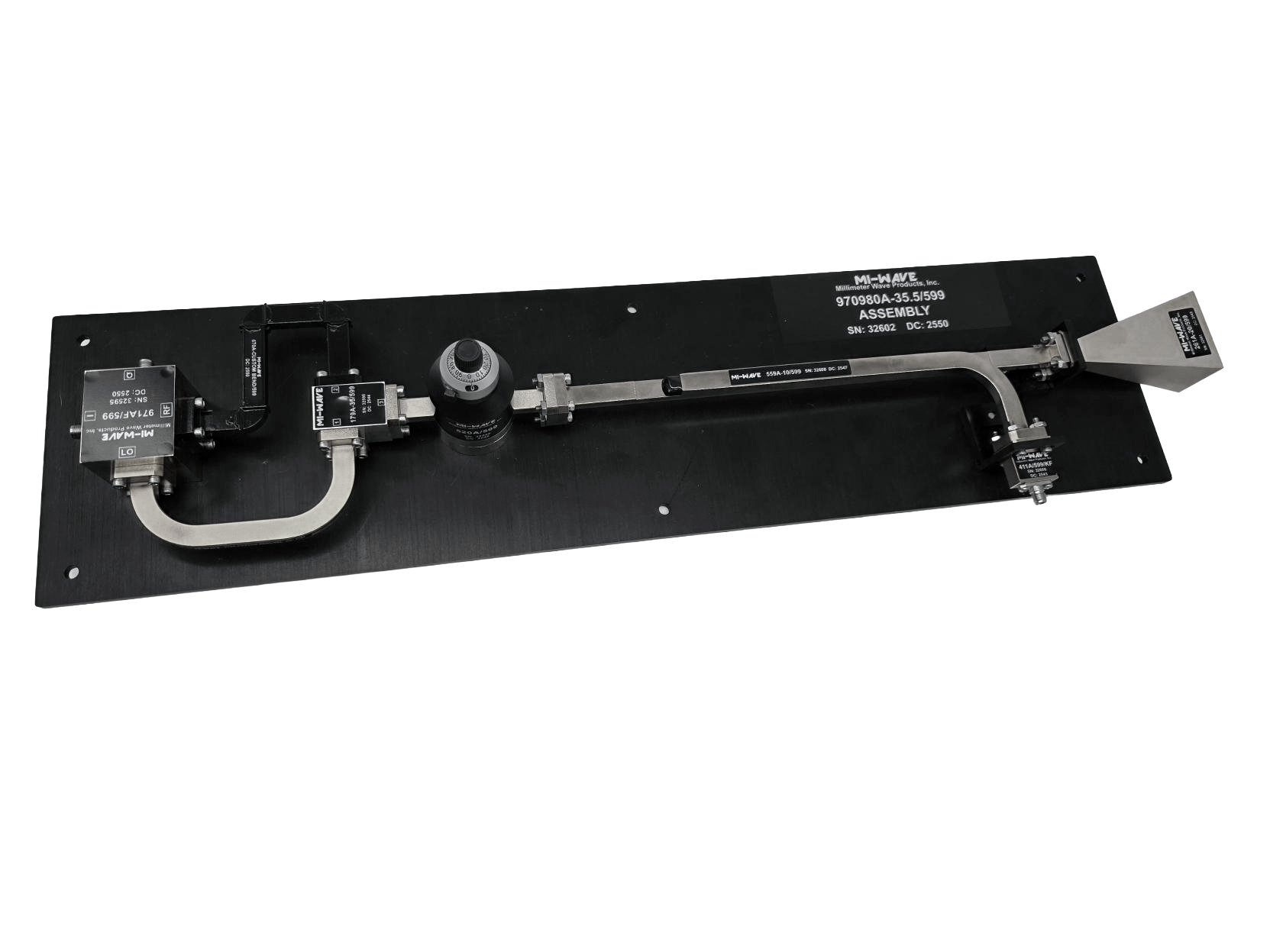
| Model | Band | Frequency | Bandwidth | Routing Loss | Image Rejection | Attenuation Level | I/Q Driven Current | RF Port | I/Q Connector | LINK |
|---|---|---|---|---|---|---|---|---|---|---|
| 977K-24.15/595 | K-Band | 24 GHz | ±50 MHz | 12 dB | -20 dBc | 30 dB | 10 mA | WR-42 Waveguide, UG-595/U Flange | SMA Female | |
| 977A-35.5/595 | Ka-Band | 35.5 GHz | ±75 MHz | 12 dB | -20 dBc | 30 dB | 10 mA | WR-28 Waveguide, UG-599/U Flange | SMA Female | |
| 977V-60/385 | V-Band | 60 GHz | ±100 MHz | 13 dB | -20 dBc | 30 dB | 10 mA | WR-15 Waveguide, UG-385/U Flange | SMA Female | |
| 977E-76.5/387 | E-Band | 76.5 GHz | ±100 MHz | 14 dB | -20 dBc | 30 dB | 10 mA | WR-12 Waveguide, UG-387/U Flange | SMA Female | |
| 977W-94/387 | W-Band | 94 GHz | ±100 MHz | 15 dB | -20 dBc | 30 dB | 10 mA | WR-10 Waveguide, UG-387/U-M Flange | SMA Female |
Key Features & Performance Benefits
Mi-Wave Radar Target Simulators are engineered for high-accuracy radar emulation and system validation.
Accurate Doppler Target Simulation
Generates precise Doppler frequency shifts to emulate moving radar targets.
Independent I/Q Control Inputs
Enables realistic simulation of target motion, direction, and velocity profiles.
High Image Suppression
Ensures clean target signals with minimal unwanted image frequencies.
Low Spurious and Harmonic Content
Maintains signal purity for accurate radar system evaluation.
Low Insertion Loss
Preserves signal integrity across the RF path.
Compact, Integrated RF Module Design
Optimized for laboratory setups and system-level integration.
Waveguide and Coaxial Interface Options
Supports standard radar system interfaces across multiple frequency bands.
Broadband Microwave and mmWave Support
Available for radar bands including K, Ka, V, and W-band.
Stable and Repeatable Performance
Designed for consistent test results across development and production environments.
Applications
Mi-Wave Radar Target Simulators are used in advanced radar systems requiring controlled, repeatable target emulation.
Doppler Radar System Testing
Simulates moving targets to validate radar detection and tracking performance.
Radar Receiver Verification
Tests receiver sensitivity, selectivity, and signal processing accuracy.
Radar Signal Processor Evaluation
Supports validation of Doppler processing algorithms and target classification systems.
Automated Test Equipment (ATE)
Integrates into automated systems for repeatable radar subsystem testing.
Laboratory-Based Radar Emulation
Enables controlled testing without the need for outdoor or live target environments.
Radar Algorithm Development
Supports development and tuning of tracking, detection, and filtering algorithms.
Production Testing and Quality Assurance
Ensures consistent performance across manufactured radar systems.
Defense and Aerospace Radar Systems
Supports high-frequency radar applications in mission-critical environments.
How Radar Target Simulators Work
Mi-Wave Radar Target Simulators emulate moving targets by introducing a precise Doppler shift into an RF signal. This Doppler shift represents the relative motion between the radar system and a simulated target.
Using independent I (in-phase) and Q (quadrature) control inputs, the system modulates the signal to replicate realistic motion profiles. By adjusting frequency, phase, and modulation parameters, engineers can simulate:
- Approaching targets
- Receding targets
- Variable velocities
- Complex motion patterns
This allows radar systems to be tested under realistic yet fully controlled conditions, improving development efficiency and ensuring repeatable validation.
Frequently Asked Questions (FAQs)
What is a radar target simulator?
A radar target simulator is a device that emulates moving targets by applying Doppler shifts to RF signals, allowing radar systems to be tested without real-world targets.
How does Doppler simulation work?
It introduces a frequency shift to mimic the relative motion between a radar system and a target.
What are I/Q inputs used for?
I/Q inputs allow precise control of signal phase and amplitude, enabling realistic simulation of motion and velocity.
Why use a radar target simulator instead of field testing?
They provide repeatable, controlled conditions, reduce costs, and accelerate development timelines.
What radar systems can be tested?
These simulators support automotive radar, defense radar, aerospace systems, and research platforms.
What frequency bands are supported?
Typical bands include K, Ka, V, and W-band, with custom options available.
Can these systems simulate multiple targets?
Advanced or custom configurations can support multi-target simulation.
Are these suitable for automated testing?
Yes, they integrate easily into ATE systems and production test environments.
Radar Target Simulator Calculators
These radar calculators help estimate Doppler shift, target velocity, wavelength, round-trip delay, range resolution, received power, and target separation for microwave and millimeter-wave radar systems. They are useful for laboratory radar testing, Doppler target emulation, receiver validation, and 977 Series radar target simulator applications.
Doppler Shift Calculator
Calculate Doppler frequency shift based on radar frequency and target velocity.
Target Velocity Calculator
Calculate target velocity from Doppler shift and radar frequency.
Wavelength Calculator
Calculate radar wavelength from operating frequency.
Round-Trip Delay Calculator
Calculate radar signal round-trip delay from target range.
Range Resolution Calculator
Estimate radar range resolution from signal bandwidth.
Simplified Radar Equation Calculator
Estimate received power using a simplified monostatic radar equation.
Doppler Separation Calculator
Calculate Doppler separation between two targets moving at different velocities.
Velocity Resolution Calculator
Estimate minimum velocity separation from coherent processing interval.
Glossary of Radar Target Simulation Terms
Radar Fundamentals
Radar (Radio Detection and Ranging)
A system that uses RF signals to detect, locate, and track objects.
Radar Target Simulator
A device that emulates radar targets by modifying RF signals to simulate motion.
Radar Cross Section (RCS)
A measure of how detectable an object is by radar.
Doppler and Motion
Doppler Shift
A change in frequency caused by relative motion between a source and a receiver.
Doppler Frequency
The frequency offset used to represent target velocity.
Velocity Simulation
The process of emulating target speed using Doppler modulation.
Approaching Target
A simulated target moving toward the radar, producing a positive Doppler shift.
Receding Target
A simulated target moving away from the radar, producing a negative Doppler shift.
Signal Processing
I/Q Modulation
A method of representing signals using in-phase (I) and quadrature (Q) components.
Phase Control
Adjustment of signal phase to simulate motion and direction.
Image Suppression
Reduction of unwanted mirror-frequency signals in RF systems.
Spurious Signals
Unwanted signals generated by nonlinearities or system imperfections.
RF Performance
Insertion Loss
Signal loss introduced by a component in the RF path.
Harmonics
Multiples of a fundamental frequency that can distort signal integrity.
Dynamic Range
The range of signal levels a system can accurately process.
Signal Integrity
The quality and accuracy of an RF signal as it passes through a system.
System Applications
Automated Test Equipment (ATE)
Systems used for automated testing of electronic and RF components.
Radar Receiver
The part of a radar system that processes incoming signals.
Signal Processor
Processes radar data to extract information such as distance and velocity.
Algorithm Development
Design and testing of software used for radar detection and tracking.
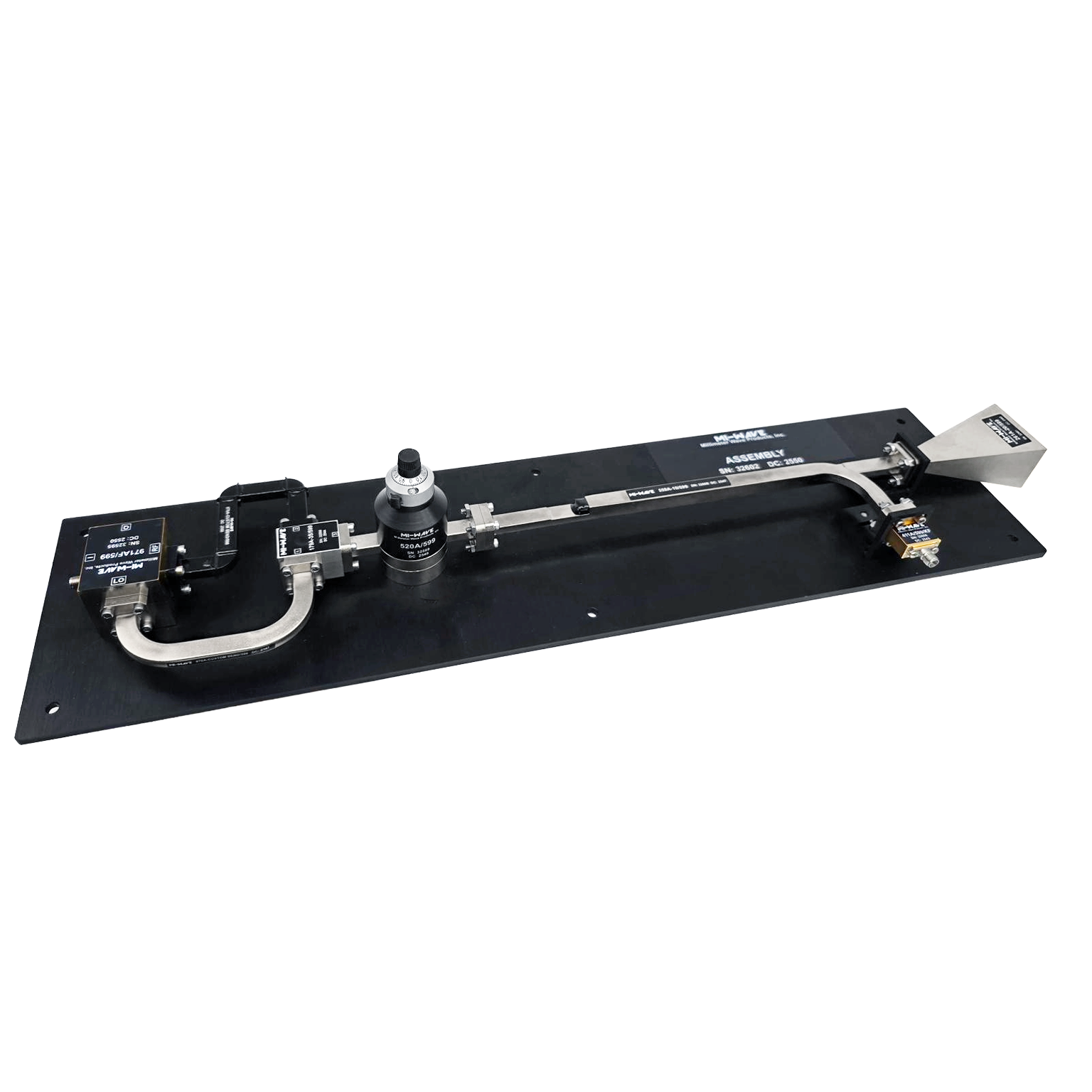
With more than 35 years of experience in millimeter-wave and microwave RF, Mi-Wave delivers high-performance solutions across design, prototyping, manufacturing, and custom system development.
We specialize in Radar Target Simulators, Target Generation Modules, and custom RF systems supporting defense, aerospace, telecommunications, satellite communications, scientific research, and advanced test environments.
Our team works closely with customers to transform complex requirements into reliable, production-ready hardware for demanding applications.
From compact and multi-channel architectures to high-frequency systems operating in harsh environments, Mi-Wave provides tailored solutions backed by precision manufacturing, thorough testing, and proven engineering expertise.
Whether you need a Radar Target Simulator or a custom RF system, our team supports your project from concept through deployment with a focus on performance, reliability, and long-term success.