
Application Note
Radar Target Simulator (RTS): Operating Principle, Architecture, and System Integration
Published by: Mi-Wave© (Millimeter Wave Products Inc.)
Authored by: Shashi Saggam
1. Purpose
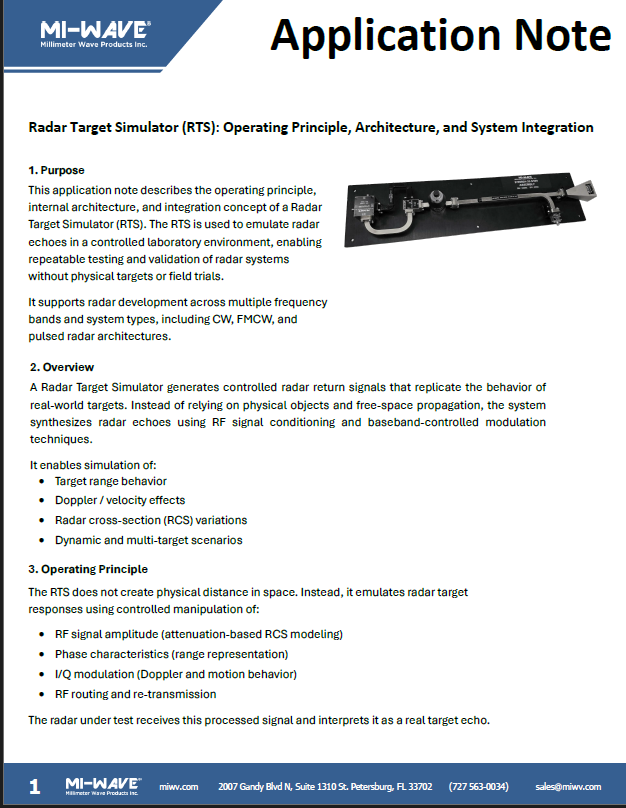
This application note describes the operating principle, internal architecture, and integration concept of a Radar Target Simulator (RTS). The RTS is used to emulate radar echoes in a controlled laboratory environment, enabling repeatable testing and validation of radar systems without physical targets or field trials.
It supports radar development across multiple frequency bands and system types, including CW, FMCW, and pulsed radar architectures.
2. Overview
A Radar Target Simulator generates controlled radar return signals that replicate the behavior of real-world targets. Instead of relying on physical objects and free-space propagation, the system synthesizes radar echoes using RF signal conditioning and baseband-controlled modulation techniques.
It enables simulation of:
- Target range behavior
- Doppler / velocity effects
- Radar cross-section (RCS) variations
- Dynamic and multi-target scenarios
3. Operating Principle
The RTS does not create physical distance in space. Instead, it emulates radar target responses using controlled manipulation of:
- RF signal amplitude (attenuation-based RCS modeling)
- Phase characteristics (range representation)
- I/Q modulation (Doppler and motion behavior)
- RF routing and re-transmission
The radar under test receives this processed signal and interprets it as a real target echo.
4. Range (Distance) Simulation
Range behavior is emulated electronically using:
- Phase shift / delay control
- Attenuation (signal strength variation)
- I/Q-based modulation techniques
Conceptual mapping:
- High signal strength + low phase delay → near target
- Lower signal strength + higher phase delay → distant target
This allows flexible representation of target distances across a calibrated range depending on system configuration.
5. Doppler and Velocity Simulation
Doppler shift is generated using baseband I/Q control signals.
- fd = Doppler frequency shift
- v = target velocity
- λ = radar wavelength
Velocity control is achieved through:
- Phase difference between I and Q → determines direction (approaching or receding)
- Frequency of I/Q signals → defines speed of motion
- Time-varying I/Q profiles → enables dynamic motion and micro-motion effects
This allows simulation of a wide range of target speeds, limited primarily by system bandwidth and configuration.
6. System Architecture
A typical Radar Target Simulator consists of RF and baseband subsystems working together.
6.1 RF Subsystem
- Antenna (shared interface for transmitting and receiving radar signals)
- Circulator (directional routing of incoming/outgoing signals)
- Attenuator (RCS and range emulation control)
- Directional coupler (signal sampling and monitoring)
- I/Q mixer or RF modulation stage (signal transformation block)
6.2 Baseband Control Subsystem
- I/Q waveform generator (AWG or DSP-based system)
- Scenario generation software (target definition and motion profiles)
- Timing and synchronization control unit
7. Signal Flow Description
The operation of the RTS can be summarized as follows:
- Radar under test transmits a signal toward the simulator antenna.
- The signal enters the circulator and is routed into the internal RF processing chain.
- The signal passes through attenuation stages representing target strength and range effects.
- I/Q-controlled modulation is applied to introduce Doppler and motion characteristics.
- The modified RF signal is routed back through the circulator and directional coupler.
- The antenna re-radiates the processed signal toward the radar receiver.
- A coupled port provides a sampled signal for monitoring and calibration purposes.
8. Role of I and Q Signals
I and Q signals are control inputs used to define the behavior of the simulated radar target.
They are used to control:
- Target velocity (Doppler generation)
- Direction of motion (approaching or receding)
- Phase evolution (range representation)
- Dynamic target behavior (micro-motion, fluctuations, multi-target scenarios)
Key point:
I and Q signals define how the RF signal is modified within the simulator to generate the desired radar echo characteristics.
9. Target Size and RCS Emulation
Target size and radar cross-section (RCS) are emulated using attenuation control:
- Higher attenuation → weaker return signal → smaller target or larger distance
- Lower attenuation → stronger return signal → larger target or closer distance
This allows flexible modeling of different reflectivity conditions.
10. External Equipment Requirements
A Radar Target Simulator requires external equipment for full functionality:
- I/Q waveform generator (AWG or DSP system)
- Radar system under test (DUT)
- Control and scenario generation software
- RF cabling or waveguide components appropriate for the operating frequency band
- Synchronization and triggering interface for coherent radar operation
The RTS operates as a hardware-in-the-loop system and depends on external waveform and control inputs.
11. Functional Capabilities
The RTS enables:
- Electronic emulation of target range behavior
- Doppler and velocity simulation using I/Q control
- Approaching and receding motion generation
- Variable target strength (RCS emulation)
- Dynamic and multi-target scenario generation
- Repeatable laboratory-based radar testing
12. Typical Applications
Radar target simulators are widely used in:
- Radar system design and validation
- FMCW and CW radar testing
- Automotive radar development and calibration
- Industrial sensing and proximity radar testing
- Algorithm development (tracking, classification, Doppler processing)
- Production testing and quality assurance
13. Conclusion
A Radar Target Simulator is a hybrid RF and baseband-controlled system that replaces physical target testing with electronically synthesized radar echoes. By combining RF signal routing components with I/Q-based control techniques, it enables precise and repeatable simulation of range, velocity, and target characteristics across multiple radar platforms.
This significantly reduces testing complexity, improves repeatability, and accelerates radar system development across laboratory and production environments.

How to Order & Custom Products
As the manufacturing source, we have top sales engineers ready to answer all your questions and quote you on product needs. You’ll find our prices are some of the best since we manufacture all our millimeter wave products in house.
Have a custom job or unique need? No problem! Contact us so we can work on solutions to meet your needs.
2007 Gandy Blvd N
Suite 1310
St. Petersburg, FL 33702
Tel: 727-563-0034
Fax: 727-563-0031
Email: sales@miwv.com