
Products> Isolators> Full Band – Compact Isolators > 116H/387 H-Band Compact Isolators
Description:
Mi-Wave’s 116 series H-band isolator uses the Faraday principle of rotation in a broadband dielectric waveguide design to achieve high isolation across full waveguide bands. High-quality ferrite material is used in these isolators, and the magnetic field is produced by an integral permanent magnet. To ensure maximum reproducibility and performance, a combination of precise machining operations and refined assembly techniques are used.
Features
• Low insertion loss
• Full waveguide band
• Excellent isolation across the band
• Faraday rotation principle of operation
Applications
• Test Labs
• Sub-Assemblies
• Automotive Industry
• MMwave Test Systems
The standard models shown represent only part of Mi-Wave’s broader product capabilities. Custom configurations are available to support specific frequency bands, interfaces, and application requirements, enabling optimized solutions for specialized RF, microwave, and millimeter-wave systems.
Watch our informational video to learn more about this product family, including its key features, operating principles, and common applications.
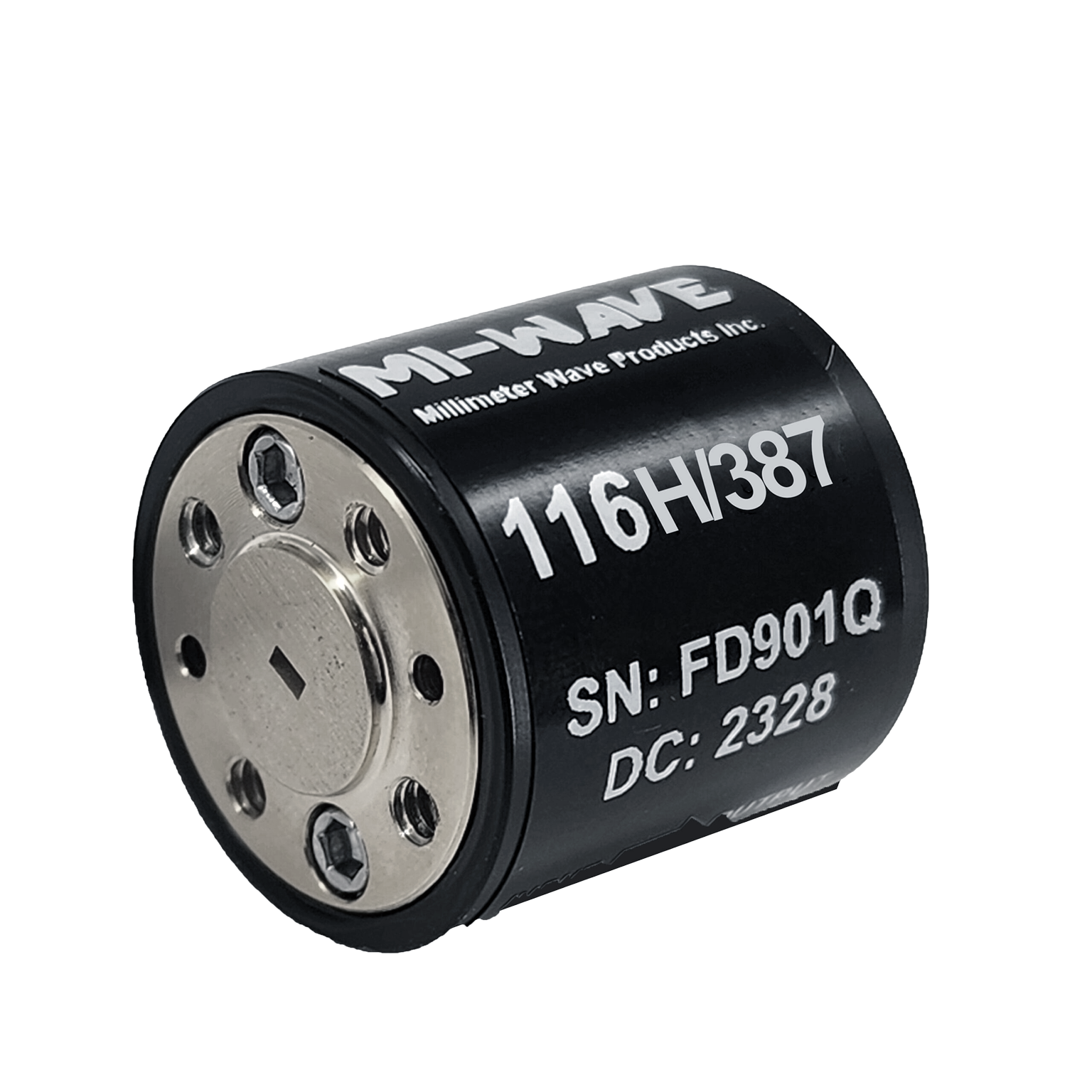
* Images, Plots & Datasheets are for reference only.
* Outline Drawings keep enhancing which may alter dimensions, please contact us for latest specifications.
Features & Specifications
Compact Mechanical Design for Integrated Systems
The 116 Series is optimized for applications where space is limited. Its compact form factor allows for easier integration into tight RF assemblies, modules, and subsystem enclosures, making it ideal for modern high-density designs.
Broadband Full Waveguide Band Operation
These isolators are designed to operate across the entire waveguide band, enabling wideband system operation without the need for multiple narrowband components.
Low Insertion Loss for Efficient Signal Transmission
Forward signal loss is minimized to preserve system gain and maintain overall RF performance, particularly important in mmWave and high-frequency applications.
High Isolation for Reliable Reverse Suppression
Strong reverse attenuation ensures reflected energy is effectively suppressed, improving system stability and protecting sensitive components from mismatch conditions.
Passive Operation with Permanent Magnet Bias
The use of an internal permanent magnet eliminates the need for external biasing, simplifying system design and enhancing long-term reliability.
How Compact Faraday Isolators Work
The 116 Series operates based on the Faraday rotation principle, enabling non-reciprocal signal transmission in a compact waveguide structure.
At the core of the device is a ferrite material that is magnetically biased by a permanent magnet. When an electromagnetic wave passes through this ferrite, the interaction between the wave and the magnetic field causes the polarization of the signal to rotate.
Forward Signal Behavior
As the forward signal enters the isolator, it passes through the ferrite section where its polarization is rotated by a controlled amount. The internal geometry of the device is designed so that, after rotation, the signal aligns with the output waveguide structure and continues forward with minimal insertion loss.
This alignment is carefully engineered to maintain efficient transmission across the entire waveguide band, even in a compact physical structure.
Reverse Signal Behavior
When a signal reflects back from the load or a downstream component, it re-enters the isolator from the output side. Because Faraday rotation is non-reciprocal, the reflected signal experiences additional rotation in the same direction rather than reversing.
This results in a total rotation that causes the signal to become misaligned with the input path. Instead of propagating backward, the signal is directed into an absorptive region within the isolator, where it is dissipated as heat.
Why This Matters in Compact Designs
In compact RF systems, components are often placed in close proximity, increasing the likelihood of:
- Reflections between stages
- Impedance mismatches
- Coupling effects between components
The 116 Series mitigates these issues by enforcing directional signal flow, even in tight layouts. This improves:
- Amplifier stability
- Measurement accuracy
- Overall system reliability
Key Engineering Insight
Unlike reciprocal devices, where forward and reverse paths behave identically, the 116 Series isolator introduces direction-dependent phase and polarization behavior. This is what allows it to distinguish between intended signal flow and unwanted reflections.
Even in a reduced-size form factor, the internal ferrite structure and magnetic biasing maintain consistent broadband performance, ensuring that compact packaging does not come at the expense of RF integrity.
Selecting RF Isolators
When selecting an RF isolator, it is important to evaluate the key electrical and mechanical parameters that affect system compatibility and performance.
Isolation (dB)
Isolation defines how effectively the isolator suppresses reverse-traveling power from the output back toward the input. Higher isolation provides better protection for upstream components and improves overall system stability.
Insertion Loss (dB)
Insertion loss is the amount of signal attenuation introduced in the forward path from port 1 to port 2. Lower insertion loss is desirable because it preserves signal strength, system gain, and link efficiency.
Power Handling (W)
Power handling refers to the amount of RF power the isolator can support while maintaining its specified electrical performance. This includes both:
- Forward Power, which is the signal entering port 1 and transmitted to port 2
- Reverse Power, which is the reflected energy entering port 2 that the isolator must absorb or suppress
Properly selecting these parameters ensures the isolator will protect the system effectively without compromising signal performance.
Applications
RF and Millimeter-Wave Test Systems
In laboratory and production test environments, isolators are commonly placed between signal sources and devices under test to prevent reflected power from affecting measurement accuracy. By stabilizing the source impedance, they improve repeatability and reduce uncertainty in S-parameter and power measurements.
Amplifier Protection in RF Chains
Power amplifiers, particularly at microwave and mmWave frequencies, are highly sensitive to load mismatches. Integrating an isolator at the amplifier output helps prevent reflected energy from re-entering the device, reducing the risk of oscillation, compression artifacts, or long-term damage.
Automotive Radar and Sensing Systems
In automotive radar applications operating at high frequencies, isolators contribute to stable signal generation and reception by minimizing internal reflections. This supports more consistent detection performance and improved signal integrity in complex electromagnetic environments.
Sub-Assemblies and Integrated RF Modules
Isolators are frequently incorporated into multi-stage RF subsystems, including up/downconverter chains, transceiver front ends, and frequency generation modules. Their ability to enforce directional signal flow helps simplify system architecture and reduce unwanted interactions between stages.
Communication Systems and Signal Chains
In communication systems, particularly those operating in the microwave and millimeter-wave spectrum, isolators improve overall link performance by reducing standing waves and maintaining consistent impedance conditions. This results in more stable transmission characteristics and improved spectral purity.
Aerospace and Defense Systems
High-reliability applications such as radar, electronic warfare, and satellite communication systems rely on isolators to maintain consistent RF behavior under demanding conditions. The passive, magnetically biased design of the 115 Series makes it well suited for environments where robustness and predictability are critical.
Frequently Asked Questions (FAQ)
What is the 116 Series Compact Isolator used for?
The 116 Series is designed to provide unidirectional signal flow and protection from reflected power in RF and millimeter-wave systems. Its compact form factor makes it especially useful in densely integrated modules, subsystems, and space-constrained assemblies.
How does a compact isolator differ from a standard waveguide isolator?
Electrically, the function is the same. The difference is mechanical. The 116 Series is optimized for reduced size and weight, allowing it to fit into tighter system architectures without sacrificing isolation or broadband performance.
What frequency range does the 116 Series cover?
The 116 Series operates across full waveguide bands, depending on the specific model and waveguide size. This allows for broadband operation without the need for multiple narrowband components.
Do these isolators require external biasing or power?
No. The 116 Series uses an integral permanent magnet to create the required magnetic bias field, eliminating the need for external power or control circuits.
What level of isolation can I expect?
Typical isolation is greater than 30 dB, depending on frequency band and design. This level of isolation is sufficient to protect most RF components from harmful reflections.
How much insertion loss should be expected?
Insertion loss is designed to be as low as possible across the band, typically well under 1 dB depending on frequency. Lower insertion loss helps preserve signal strength and system efficiency.
Where should a compact isolator be placed in an RF system?
They are commonly placed:
- At the output of amplifiers
- Before sensitive receivers or mixers
- Between stages in multi-component RF chains
This ensures reflections are absorbed before they can impact upstream components.
What happens to reflected power inside the isolator?
Reflected energy entering the output port is rotated and redirected into an internal absorbing structure, where it is dissipated as heat rather than being returned to the source.
Are these suitable for mmWave and high-frequency systems?
Yes. The 116 Series is specifically designed for microwave and millimeter-wave operation, making it ideal for applications such as radar, Satcom, automotive sensing, and high-frequency test systems.
Can the 116 Series be customized?
Yes. MI-Wave offers customization options including frequency band, mechanical configuration, and performance parameters to meet specific system requirements.
Isolator Performance Calculators
These calculators help estimate forward loss, reflected power suppression, return loss behavior, and leakage levels when integrating Faraday isolators into microwave and millimeter-wave signal chains.
Reflected Power After Isolation
Estimate the reflected power that remains after the isolator suppresses reverse energy.
Output Power with Insertion Loss
Calculate forward output power after insertion loss through the isolator.
Return Loss to Reflected Power
Estimate reflected power from input power and return loss.
VSWR to Return Loss
Convert VSWR to return loss to evaluate impedance match quality.
Linear Leakage from Isolation
Estimate the remaining reverse leakage as a linear ratio from isolation in dB.
| Model | Band | Frequency Range | Isolation | Insertion Loss, Typical | VSWR Max | Power Handling CW | RF Port | LINK |
|---|---|---|---|---|---|---|---|---|
| 116K/595 | K-Band | 18–26.5 GHz | 25 dB | 2.25 dB | 1.30:1 | 2 W | WR-42 Waveguide, UG-595/U Flange | |
| 116(34)/595 | WR-34 | 22–33 GHz | 25 dB | 2.25 dB | 1.30:1 | 2 W | WR-34 Waveguide, UG-595/U Square Flange | |
| 116(34)/381 | WR-34 | 22–33 GHz | 25 dB | 2.25 dB | 1.30:1 | 2 W | WR-34 Waveguide, UG-381/U Round Flange | |
| 116A/599 | Ka-Band | 26.5–40 GHz | 25 dB | 2.25 dB | 1.30:1 | 1.5 W | WR-28 Waveguide, UG-599/U Square Flange | |
| 116B/383 | Q-Band | 33–50 GHz | 25 dB | 2.55 dB | 1.30:1 | 1.5 W | WR-22 Waveguide, UG-383/U Round Flange | |
| 116U/383 | U-Band | 40–60 GHz | 25 dB | 2.75 dB | 1.30:1 | 1.5 W | WR-19 Waveguide, UG-383/U-M Round Flange | |
| 116V/385 | V-Band | 50–75 GHz | 25 dB | 2.95 dB | 1.30:1 | 1 W | WR-15 Waveguide, UG-385/U Round Flange | |
| 116E/387 | E-Band | 60–90 GHz | 25 dB | 3.25 dB | 1.35:1 | 1 W | WR-12 Waveguide, UG-387/U Round Flange | |
| 116W/387 | W-Band | 75–110 GHz | 25 dB | 3.45 dB | 1.40:1 | 1 W | WR-10 Waveguide, UG-387/U-M Round Flange | |
| 116F/387 | F-Band | 90–140 GHz | 22 dB | 3.95 dB | 1.50:1 | 0.4 W | WR-08 Waveguide, UG-387/U-M Round Flange | |
| 116D/387 | D-Band | 110–170 GHz | 20 dB | 4.35 dB | 1.50:1 | 0.2 W | WR-06 Waveguide, UG-387/U-M Round Flange | |
| 116G/387 | G-Band | 140–220 GHz | 20 dB | 4.75 dB | 1.50:1 | 0.2 W | WR-05 Waveguide, UG-387/U-M Round Flange | |
| 116H/387 | H-Band | 170–260 GHz | 20 dB | 6.25 dB | 1.50:1 | 0.1 W | WR-04 Waveguide, UG-387/U-M Round Flange | |
| 116J/387 | J-Band | 220–325 GHz | 20 dB | 12 dB | 1.50:1 | 0.1 W | WR-03 Waveguide, UG-387/U-M Round Flange |
*All data presented is collected from a sample lot.
* Actual data may vary unit to unit, slightly.
*All testing was performed under +25 °C case temperature.
*Consult factory to confirm if material, plating, size, shape, orientation and any electrical parameter is critical for the application as website information is for reference only.
*Millimeter Wave Products, Inc. reserves the right to change the information presented on website without notice as we continue to enhance the performance and design of our products.
H-Band Isolators
Our H-band Isolators are for the spectrum in the millimeter wave range of frequencies from 170 to 260 gigahertz (GHz).
Designed for full waveguide band operation, the 116 series isolator is used in swept frequency applications. These components provide a high degree of isolation between signal sources and mismatched loads by attenuating the reflected signals. The insertion loss in the forward direction is minimized to allow for the full available power from the signal source-isolator combination. Typical applications for these broadband isolators include laboratory setups as well as millimeter wave test sets and automotive radar
See datasheets, outline drawings and band specific info.
Click on the links below.
Interested in this product or other Mi-Wave solutions?
Contact our team to discuss your frequency range, interface needs, and application requirements.
Custom configurations are available for specialized RF, microwave, and millimeter-wave systems.
Return to Compact Isolators
Return to Isolators
Return to Products Page