
Products> Antenna Products > Standard Gain Horns > 261(2.8)-25/387 Standard Gain Horns
Description:
Mi-Wave’s WR-2.8 Gain Horn Antennas operate in the 260GHZ to 400GHz spectrum and are created with the end consumer in mind. We know you need and demand the absolute best when it comes to wr-2.8 horn antennas and look to provide you with the best solutions possible. Some of the highlights of our wr-2.8 horn antennas are listed below:
We can customize horn antennas for all your needs.
Features
• Made with precise dimensional tolerance control
• Gain calibration is accurate to 0.5 dB over full waveguide bandwidth
Applications
• Low F/D Antennas
• Surveillance Systems
• Offset Feed Antenna
The standard models shown represent only part of Mi-Wave’s broader probe antenna capabilities. Custom configurations are available to support specific frequency bands, interfaces, and application requirements, enabling optimized solutions for specialized RF, microwave, and millimeter-wave systems.
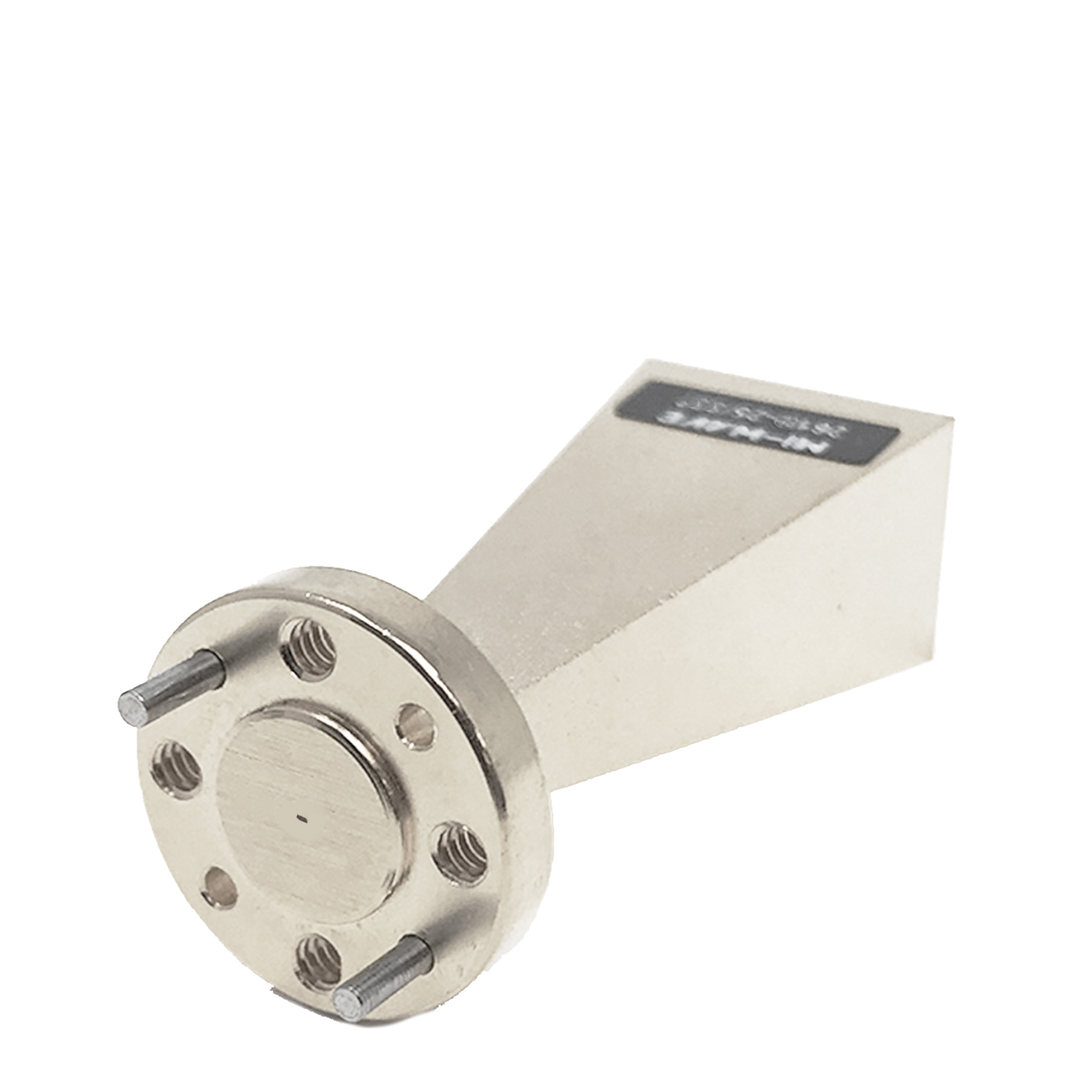
*Actual product may be different from the image shown per customers specifcations
*All data presented is collected from a sample lot.
* Actual data may vary unit to unit, slightly.
*All testing was performed under +25 °C case temperature.
*Consult factory to confirm if material, plating, size, shape, orientation and any electrical parameter is critical for the application as website information is for reference only.
*Millimeter Wave Products, Inc. reserves the right to change the information presented on website without notice as we continue to enhance the performance and design of our products.
Key Features & Performance Benefits
Accurate and Repeatable Gain
Standard gain horn antennas are designed to provide precisely known gain values, making them ideal as reference antennas for calibration and measurement systems.
Ultra-Wide Frequency Coverage (8.2–750 GHz)
Supports an extensive range of microwave, millimeter-wave, and submillimeter frequencies, enabling use across a wide variety of RF applications.
Predictable Radiation Patterns
Optimized horn geometry produces well-defined and stable beam patterns, allowing engineers to rely on consistent antenna performance.
Low VSWR and Excellent Impedance Matching
Designed to minimize reflections and ensure efficient power transfer, improving measurement accuracy and system performance.
Stable Polarization Characteristics
Maintains consistent polarization behavior across frequency, which is critical for calibration and high-precision RF systems.
High Directivity
Provides strong directional performance, improving signal clarity and reducing unwanted radiation.
Ideal for Calibration and Reference Use
Widely used as standard reference antennas in antenna measurement ranges, test labs, and verification systems.
Broad Waveguide Compatibility
Available with standard waveguide interfaces, allowing seamless integration into existing RF systems.
Robust Mechanical Construction
Built for durability and repeatability in both laboratory and field environments.
Custom Configurations Available
Supports custom frequency ranges, waveguide sizes, polarization types, and mechanical designs to meet specialized requirements.
Applications
Mi-Wave Standard Gain Horn Antennas are widely used in RF, microwave, and millimeter-wave systems that require accurate gain reference, predictable radiation patterns, and repeatable performance across wide frequency ranges.
These antennas are essential in environments where measurement accuracy, calibration traceability, and system verification are critical, making them a foundational tool in both laboratory and operational RF systems.
Antenna Calibration and Measurement
Standard gain horn antennas are most commonly used as reference antennas in antenna measurement systems due to their known gain characteristics and stable radiation patterns.
Typical applications include:
- Antenna gain calibration and validation
- Reference antenna measurements in test ranges
- Near-field and far-field antenna testing
- Radiation pattern characterization
- Verification of antenna beamwidth and sidelobe levels
- Calibration of measurement systems and instrumentation
- Standard reference use in accredited test facilities
Their traceable and repeatable performance makes them indispensable for ensuring measurement accuracy across RF systems.
RF and Microwave Test Systems
These antennas are widely used in RF testing and validation environments where consistent and predictable antenna behavior is required.
Typical applications include:
- RF system characterization and validation
- Component and subsystem testing
- Signal source verification
- Calibration setups for measurement equipment
- Performance benchmarking of RF devices
- EMC pre-compliance testing setups
- Laboratory-based RF experimentation
Their stable gain and low VSWR enable accurate signal measurement and system verification.
Radar Systems and Radar Testing
Standard gain horn antennas are used in radar systems where controlled radiation patterns and known gain performance are essential.
Common radar applications include:
- Radar cross-section (RCS) testing
- Radar calibration and system verification
- Signal transmission and reception in radar test setups
- FMCW and pulse radar research systems
- High-frequency radar experimentation
- Millimeter-wave radar development
Their predictable performance allows engineers to control signal illumination and improve measurement precision.
Communications Systems
These antennas are used in communication systems where known gain, stable polarization, and controlled beam patterns are required.
Typical applications include:
- Microwave and millimeter-wave communication links
- Satellite communication testing and validation
- Ground station calibration
- Signal transmission verification
- Experimental and prototype communication systems
- Link budget validation and RF planning
Their consistent characteristics support reliable system design and performance validation.
RF and Microwave Laboratory Research
Standard gain horn antennas are commonly used in academic, government, and industrial research environments where precise RF measurements are required.
Typical research applications include:
- Microwave and millimeter-wave system development
- RF propagation studies
- Advanced antenna design research
- Component characterization and validation
- Experimental RF system prototyping
- Government and defense research programs
These antennas provide a stable and repeatable RF reference platform for experimental work.
EMC and Compliance Testing
Standard gain horn antennas are also used in electromagnetic compatibility (EMC) testing environments where controlled radiation is required.
Common EMC applications include:
- Radiated emissions testing
- RF susceptibility testing
- Controlled RF illumination in chambers
- Compliance verification and certification testing
- Shielding effectiveness testing
Their predictable radiation patterns help ensure accurate and repeatable EMC measurements.
Frequently Asked Questions (FAQ)
What is a standard gain horn antenna?
A standard gain horn antenna is a precision antenna with a known and repeatable gain, commonly used as a reference in RF measurement and calibration systems.
Why are standard gain horn antennas used as reference antennas?
Because they provide accurate, stable, and predictable gain values, allowing engineers to calibrate and validate other antennas and RF systems.
What frequencies do these antennas support?
Mi-Wave standard gain horn antennas are available from 8.2 GHz to 750 GHz, covering microwave, millimeter-wave, and submillimeter frequencies.
What makes standard gain horns accurate?
Their precise geometry, controlled manufacturing tolerances, and well-characterized performance ensure consistent and repeatable results.
What is VSWR and why is it important?
VSWR measures how well an antenna is matched to a system. Low VSWR reduces reflections and improves measurement accuracy.
Are these antennas used outside of labs?
Yes. While commonly used in measurement systems, they are also used in communications, radar, and field testing applications.
Can standard gain horn antennas be customized?
Yes. Mi-Wave offers custom options for frequency bands, waveguide interfaces, polarization, and mechanical configurations.
What determines the gain of a horn antenna?
Gain is influenced by aperture size, frequency, and antenna efficiency.
What is the difference between standard gain horns and other antennas?
Standard gain horns are specifically designed for accuracy and repeatability, rather than maximum performance alone.
.
Standard Gain Horn Antenna Engineering Calculators
These RF engineering calculators help estimate antenna performance for standard gain horn antennas, including calibration systems, antenna measurement ranges, radar platforms, communications systems, and microwave and millimeter-wave test environments. Use them to calculate antenna gain, beamwidth, aperture size required for target gain, effective aperture, free-space path loss, and wavelength across RF, microwave, millimeter-wave, and submillimeter-wave frequencies.
Standard gain horn antennas are designed for accurate, repeatable gain, predictable radiation patterns, and stable reference performance. A typical starting efficiency range for many systems is 0.50 to 0.75.
Antenna Gain Calculator
Antenna Gain (dBi):
Antenna Beamwidth Calculator
Aperture Size Required for Target Gain
Antenna Effective Aperture Calculator
Effective Aperture (m²):
Free Space Path Loss Calculator
RF Wavelength Calculator
Wavelength (mm):
Glossary of Gain Horn Antenna Terms
This glossary provides detailed definitions of key terms related to gain horn antennas used in RF, microwave, and millimeter-wave systems. These antennas are commonly used in testing, measurement, communications, radar, and high-frequency research applications where precision, repeatability, and wideband performance are critical.
Antenna Fundamentals
Standard Gain Horn Antenna
A precision horn antenna with well-characterized and repeatable gain, used as a reference standard in RF and microwave measurement systems.
Horn Antenna
A flared waveguide structure that transitions guided waves into free space with controlled directivity and low loss.
Reference Antenna
An antenna with known performance used to calibrate measurement systems and validate other antennas.
Antenna Aperture
The physical opening through which RF energy is radiated. Larger apertures generally result in higher gain.
Radiation Pattern
A graphical representation of how an antenna radiates energy in space.
Main Lobe
The primary direction of radiation where most energy is concentrated.
Sidelobes
Secondary radiation peaks outside the main beam that can introduce interference.
Back Lobe
Radiation emitted opposite the main direction.
Electrical Performance Terms
Gain (dBi)
A logarithmic measure of how effectively an antenna directs RF energy compared to an isotropic source.
Directivity
The degree to which an antenna focuses energy in a specific direction.
VSWR (Voltage Standing Wave Ratio)
A measure of impedance matching. Lower VSWR indicates better power transfer and less reflection.
Return Loss (dB)
The amount of reflected signal power caused by impedance mismatch.
Impedance Matching
Ensuring maximum power transfer between RF components by minimizing reflections.
Polarization
The orientation of the electric field of the RF signal, typically linear or circular.
Gain Accuracy
The precision with which an antenna’s gain is known, critical for calibration applications.
Gain Stability
The consistency of gain across frequency, temperature, and environmental conditions.
Measurement and Calibration Terms
Calibration
The process of verifying system performance using a known reference standard.
Traceability
The ability to relate measurements to recognized standards through an unbroken chain of comparisons.
Reference Measurement
A measurement made using a known standard for comparison.
Near-Field Measurement
Measurement performed close to the antenna, requiring transformation to far-field data.
Far-Field Measurement
Measurement taken at a distance where the radiation pattern is fully developed.
Antenna Range
A controlled environment used for antenna testing and measurement.
Measurement Uncertainty
The degree of confidence in a measurement result.
RF and Frequency Terms
Radio Frequency (RF)
Electromagnetic frequencies used for communication, radar, and sensing.
Microwave (1–30 GHz)
Frequency range used in many communication and radar systems.
Millimeter-Wave (30–300 GHz)
High-frequency range used in advanced communications and radar systems.
Submillimeter-Wave (300–750 GHz)
Very high frequencies used in research and specialized applications.
Bandwidth
The range of frequencies over which an antenna operates effectively.
Wavelength (λ)
The physical length of one cycle of an electromagnetic wave.
Waveguide and Mechanical Terms
Waveguide
A structure that guides RF energy, commonly used at microwave and mmWave frequencies.
Waveguide Flange
A standardized connection method for joining waveguide components.
WR Designation
Standardized waveguide sizes (e.g., WR-90, WR-10) corresponding to frequency bands.
Aperture Size
The physical dimension of the horn opening, affecting gain and beamwidth.
Mechanical Tolerance
The allowable variation in manufacturing dimensions.
Precision Machining
High-accuracy fabrication required for high-frequency RF components.
Performance and Efficiency
Aperture Efficiency (η)
The ratio of effective radiating area to physical aperture.
Effective Aperture (Ae)
The portion of the antenna that effectively captures or transmits energy.
Ohmic Loss
Loss due to resistance in conductive materials.
Surface Roughness Effects
At high frequencies, surface imperfections increase RF losses.
Thermal Stability
The ability to maintain performance across temperature changes.
Applications and Systems
Test and Measurement Systems
Systems used to evaluate RF performance.
Radar Systems
Systems using RF for detection and tracking.
Communications Systems
Systems transmitting and receiving RF signals.
EMC Testing
Testing for electromagnetic compatibility and interference.
Research and Development (R&D)
Experimental and developmental RF work.
Frequency Bands
- X-Band: 8–12 GHz
- Ku-Band: 12–18 GHz
- Ka-Band: 26–40 GHz
- Q-Band: 33–50 GHz
- V-Band: 50–75 GHz
- W-Band: 75–110 GHz
- D-Band: 110–170 GHz
- Submillimeter Range: 170–750 GHz
| Model | Band | Frequency Range | Gain Typical | Polarization | Beamwidth E/H | Side Lobes E/H | RF Ports | LINK |
|---|---|---|---|---|---|---|---|---|
| 261X-15/39 | X-Band | 8.2–12.4 GHz | 15 dBi | Linear | 29.3° / 29° | 20 / 20 dB | WR-90 Waveguide, UG-39 Flange | |
| 261(75)-20/120 | WR-75 | 10–15 GHz | 20 dBi | Linear | 16.22° / 19.81° | 12 / 18 dB | WR-75 Waveguide, UBR-120/U Flange | |
| 261Ku-20/419 | Ku-Band | 12–18 GHz | 20 dBi | Linear | 16.90° / 17.80° | 16 / 18 dB | WR-90 Waveguide, UG-419/U Flange | |
| 261K-15/595 | K-Band | 18–26.5 GHz | 15 dBi | Linear | 19° / 21° | 20 / 23 dB | WR-42 Waveguide, UG-595/U Flange | |
| 261K-20/595 | K-Band | 18–26.5 GHz | 20 dBi | Linear | 19° / 21° | 20 / 20 dB | WR-42 Waveguide, UG-595/U Flange | |
| 261K-10/595 | K-Band | 18–26.5 GHz | 10 dBi | Linear | 55° / 57° | 17 / 25 dB | WR-42 Waveguide, UG-595/U Flange | |
| 261A-10/599 | Ka-Band | 26.5–40 GHz | 10 dBi | Linear | 56° / 54° | 20 / 20 dB | WR-28 Waveguide, UG-599/U Flange | |
| 261A-15/599 | Ka-Band | 26.5–40 GHz | 15 dBi | Linear | 33° / 33° | 20 / 20 dB | WR-28 Waveguide, UG-599/U Flange | |
| 261A-25/599 | Ka-Band | 26.5–40 GHz | 25 dBi | Linear | 7° / 9° | 20 / 20 dB | WR-28 Waveguide, UG-599/U Flange | |
| 261A-20/599 | Ka-Band | 26.5–40 GHz | 20 dBi | Linear | 16.57° / 16.58° | 20 / 20 dB | WR-28 Waveguide, UG-599/U Flange | |
| 261B-20/383 | Q-Band | 30–50 GHz | 20 dBi | Linear | 15° / 16° | 20 / 20 dB | WR-22 Waveguide, UG-383/U Flange | |
| 261B-15/383 | Q-Band | 33–50 GHz | 15 dBi | Linear | 39.81° / 25.9° | 20 / 20 dB | WR-22 Waveguide, UG-383/U Flange | |
| 261B-25/383 | Q-Band | 33–50 GHz | 25 dBi | Linear | 7° / 9° | 20 / 20 dB | WR-22 Waveguide, UG-383/U Flange | |
| 261U-15/383 | U-Band | 40–60 GHz | 15 dBi | Linear | 32° / 32° | 14 / 20 dB | WR-19 Waveguide, UG-383/U-M Flange | |
| 261U-20/383 | U-Band | 40–60 GHz | 20 dBi | Linear | 14° / 16° | 14 / 30 dB | WR-19 Waveguide, UG-383/U-M Flange | |
| 261U-25/383 | U-Band | 40–60 GHz | 25 dBi | Linear | 9° / 10° | 20 / 20 dB | WR-19 Waveguide, UG-383/U-M Flange | |
| 261U-10/383 | U-Band | 40–60 GHz | 10 dBi | Linear | 55° / 55° | 20 / 20 dB | WR-19 Waveguide, UG-383/U-M Flange | |
| 261V-10/385 | V-Band | 50–75 GHz | 10 dBi | Linear | 55° / 55° | 20 / 20 dB | WR-15 Waveguide, UG-385/U-M Flange | |
| 261V-15/385 | V-Band | 50–75 GHz | 15 dBi | Linear | 29° / 32° | 20 / 20 dB | WR-15 Waveguide, UG-385/U-M Flange | |
| 261V-20/385 | V-Band | 50–75 GHz | 20 dBi | Linear | 14° / 15° | 20 / 20 dB | WR-15 Waveguide, UG-385/U Flange | |
| 261V-25/385-FL | V-Band | 50–75 GHz | 25 dBi | Linear | 9° / 10° | 20 / 20 dB | WR-15 Waveguide, UG-385/U Flange | |
| 261E-10/387 | E-Band | 60–90 GHz | 10 dBi | Linear | 55° / 55° | 20 / 20 dB | WR-12 Waveguide, UG-387/U Flange | |
| 261E-15/387 | E-Band | 60–90 GHz | 15 dBi | Linear | 30° / 32° | 20 / 20 dB | WR-12 Waveguide, UG-387/U Flange | |
| 261E-20/387 | E-Band | 60–90 GHz | 20 dBi | Linear | 14° / 15° | 20 / 20 dB | WR-12 Waveguide, UG-387/U Flange | |
| 261E-25/387 | E-Band | 60–90 GHz | 25 dBi | Linear | 9° / 10° | 20 / 20 dB | WR-12 Waveguide, UG-387/U Flange | |
| 261W-10/387 | W-Band | 75–110 GHz | 10 dBi | Linear | 51.76° / 52° | 2 / 25 dB | WR-10 Waveguide, UG-387/U-M Flange | |
| 261W-15/387 | W-Band | 75–110 GHz | 15 dBi | Linear | 32° / 32° | 14 / 25 dB | WR-10 Waveguide, UG-387/U-M Flange | |
| 261W-20/387 | W-Band | 75–110 GHz | 20 dBi | Linear | 16° / 18° | 20 / 20 dB | WR-10 Waveguide, UG-387/U-M Flange | |
| 261W-25/387-FL | W-Band | 75–110 GHz | 25 dBi | Linear | 9° / 10° | 20 / 20 dB | WR-10 Waveguide, UG-387/U-M Flange | |
| 261F-10/387 | F-Band | 90–140 GHz | 10 dBi | Linear | 53° / 55° | 19 / 22 dB | WR-08 Waveguide, UG-387/U-M Flange | |
| 261F-15/387 | F-Band | 90–140 GHz | 15 dBi | Linear | 29.73° / 33.67° | 14 / 25 dB | WR-08 Waveguide, UG-387/U-M Flange | |
| 261F-20/387 | F-Band | 90–140 GHz | 20 dBi | Linear | 16° / 18° | 14 / 30 dB | WR-08 Waveguide, UG-387/U-M Flange | |
| 261F-25/387 | F-Band | 90–140 GHz | 25 dBi | Linear | 9° / 10° | 12 / 15 dB | WR-08 Waveguide, UG-387/U-M Flange | |
| 261D-25/387 | D-Band | 110–170 GHz | 25 dBi | Linear | 25° / 25.5° | 20 / 20 dB | WR-06 Waveguide, UG-387/U-M Flange | |
| 261D-15/387 | D-Band | 110–170 GHz | 15 dBi | Linear | 33° / 31° | 20 / 20 dB | WR-06 Waveguide, UG-387/U-M Flange | |
| 261D-20/387 | D-Band | 110–170 GHz | 20 dBi | Linear | 17° / 18° | 20 / 20 dB | WR-06 Waveguide, UG-387/U-M Flange | |
| 261G-10/387 | G-Band | 140–220 GHz | 10 dBi | Linear | 56° / 54° | 19 / 21 dB | WR-05 Waveguide, UG-387/U-M Flange | |
| 261G-15/387 | G-Band | 140–220 GHz | 15 dBi | Linear | 33.41° / 31.9° | 17 / 23 dB | WR-05 Waveguide, UG-387/U-M Flange | |
| 261G-20/387 | G-Band | 140–220 GHz | 20 dBi | Linear | 13° / 13° | 12 / 25 dB | WR-05 Waveguide, UG-387/U-M Flange | |
| 261G-25/387 | G-Band | 140–220 GHz | 25 dBi | Linear | 8.9° / 10.28° | 20 / 20 dB | WR-05 Waveguide, UG-387/U-M Flange | |
| 261H-25/387 | H-Band | 170–260 GHz | 25 dBi | Linear | 10° / 10° | — | WR-04 Waveguide, UG-387/U Flange | |
| 261J-25/387 | J-Band | 220–325 GHz | 25 dBi | Linear | 9° / 10° | 20 / 20 dB | WR-03 Waveguide, UG-387/U-M Flange | |
| 261J-15/387 | J-Band | 220–325 GHz | 15 dBi | Linear | 35° / 38° | 14 / 17 dB | WR-03 Waveguide, UG-387/U-M Flange | |
| 261(2.8)-25/387 | WR-2.8 | 260–400 GHz | 25 dBi | Linear | 26.18° / 25.8° | 20 / 20 dB | WR-2.8 Waveguide, UG-387/U-M Flange | |
| 261(2.2)/387 | WR-2.2 | 325–500 GHz | 25 dBi | Linear | 13° / 15° | 22 / 23 dB | WR-2.2 Waveguide, UG-387/U-M Flange | |
| 261(1.5)-25/387 | WR-1.5 | 500–750 GHz | 25 dBi | Linear | — | 22 / 23 dB | WR-1.5 Waveguide, UG-387/U-M Flange |
*All data presented is collected from a sample lot.
* Actual data may vary unit to unit, slightly.
*All testing was performed under +25 °C case temperature.
*Consult factory to confirm if material, plating, size, shape, orientation and any electrical parameter is critical for the application as website information is for reference only.
*Millimeter Wave Products, Inc. reserves the right to change the information presented on website without notice as we continue to enhance the performance and design of our products.
WR-2.8 Horn Antennas | WR-2.8 | 260 GHz – 400 GHz
If you are looking for wr-2.8 standard gain horn antennas, then you’ve come to the right place. At Millimeter wave products Inc. (Mi-Wave) we specialize in manufacturing the highest quality standard gain horn antennas for many needs.
What makes our standard gain horns the preferred choice?
Mi-Wave’s 261 Series standard gain horn antennas are fabricated with very close tolerances to ensure the precision of every horn manufactured by Mi-Wave. Each unit is joined to a short section of rectangular wave-guide and terminated in a standard flange. This is critical when you need the best quality millimeter wave products all doing their part in your application.