
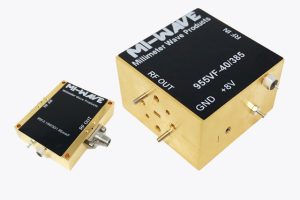
Ku-band, spanning roughly 12.4 GHz to 18 GHz, is the workhorse frequency range for satellite television, VSAT terminals, point-to-point microwave links, and a growing share of radar systems. Every one of these applications depends on an amplifier stage to either recover a weak received signal or push enough power out to close a link.
Like other microwave bands, Ku-band amplifiers split into two functional categories, low noise amplifiers for the receive side and power amplifiers for the transmit side, and confusing the two during specification is one of the more common sourcing mistakes.
This guide covers what a Ku-band amplifier actually does, the specifications worth prioritizing depending on its role, and a practical process for choosing between the available options.
What Does a Ku Band Amplifier Do
Receive-Side: Preserving a Weak Downlink Signal
SatCom downlinks and VSAT receive chains work with extremely weak signals by the time they reach ground equipment. Mi-Wave’s 955 Series Ku-band amplifier covers the 12–18 GHz range and is designed for this front-end role, where low noise figure is the specification that determines how much usable signal survives the trip from antenna to demodulator.
Transmit-Side: Delivering Uplink or Link Power
On the transmit side, VSAT uplinks, point-to-point radios, and some radar transmit chains, the priority shifts to delivering clean, stable output power. A medium power amplifier in this range is built for gain and output power rather than noise figure, since the input signal is already at a workable level.
Key Specifications to Evaluate
- Frequency range — confirm coverage of the full 12.4–18 GHz Ku-band or a narrower application-specific slice.
- Noise figure (receive side) — directly affects how much of a weak downlink signal survives the front end.
- Gain and output power, P1dB/Psat (transmit side) — determines how much clean power the amplifier can deliver into the link.
- Gain flatness — how consistently gain holds across the operating bandwidth, important for wideband SatCom carriers.
- VSWR — poor matching reflects energy back into the amplifier and degrades stability and gain.
- DC bias and power consumption — matters most in outdoor VSAT terminals and other power-constrained installations.
How to Choose the Right Ku Band Amplifier
1. Confirm Receive or Transmit Role First
This decision drives everything else. A receive-side Ku-band LNA is optimized for noise figure; a transmit-side power amplifier is optimized for output power and linearity. The two are not interchangeable.
2. Match the Exact Frequency Segment
Ku-band covers several sub-allocations depending on region and service (DBS, FSS, VSAT). Confirm the amplifier’s specified range covers the exact segment your link plan requires, with margin at the band edges.
3. Size Power and Linearity to the Link Budget
For transmit amplifiers, work backward from the link budget to determine required output power, then check the amplifier’s linearity and compression characteristics under your actual modulation scheme, not just at a single test tone.
4. Check Environmental and Mechanical Requirements
Outdoor VSAT and point-to-point installations demand attention to temperature range, weatherproofing, and DC power availability, in addition to the core RF specifications.
Common Applications
- VSAT terminals and satellite television downlinks, where receive-side sensitivity determines link margin.
- Point-to-point microwave links, using both amplifier types depending on link direction.
- Radar systems operating in the Ku-band, particularly in weather and tracking applications.
- RF test and measurement setups characterizing Ku-band components and systems.
Final Thoughts
A Ku-band amplifier is only the right choice once its role in the signal chain, receive or transmit, is clearly defined. From there, frequency coverage, power handling, and mechanical fit follow logically. Mi-Wave’s 955 Series spans both receive and transmit roles across Ku-band and adjacent frequencies, and the engineering team can help match a stock part or custom configuration to a specific SatCom, radar, or link application.