
How to Choose the Right Waveguide Calibration Kit
A vector network analyzer is only as accurate as the reference plane it was calibrated to. At millimeter-wave frequencies, a worn short, a mismatched flange, or a kit built for the neighboring band quietly shifts that reference plane, and every S-parameter measured afterward carries the error forward.
That is why the calibration standards matter as much as the analyzer itself. Choosing a kit comes down to a short list of checks – frequency band, waveguide size, standard quality, flange type, and VNA compatibility – and working through them before ordering saves repeat calibrations and doubtful measurements later.
What a Waveguide Calibration Kit Does
A waveguide calibration kit is a matched set of precision mechanical standards that a VNA uses to remove its own systematic errors from a measurement. By connecting standards with known electrical behavior and comparing what the analyzer reads against what it should read, the instrument can mathematically correct for directivity, source match, and tracking errors in the test setup.
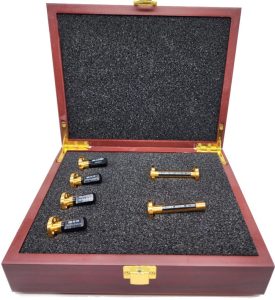
In waveguide, those standards are machined parts rather than coaxial connectors, so their accuracy depends on dimensional precision, flange quality, and how repeatably they mate to the test port. Inside a typical kit you will find offset shorts, a reference short, a termination load, and a straight waveguide section, all cut for one specific waveguide band.
Start With Your Frequency Band and Waveguide Size
Waveguide calibration kits are built around a defined operating band and a matching waveguide size, not a single center frequency. Mi-Wave’s 780 Series spans 18 GHz to 325 GHz, starting with K-Band (WR-42, 18-26.5 GHz) and continuing through Ka-Band (WR-28, 26.5-40 GHz), Q-Band (WR-22, 33-50 GHz), V-Band (WR-15, 50-75 GHz), E-Band (WR-12, 60-90 GHz), W-Band (WR-10, 75-110 GHz), and on to the D-Band and higher ranges.
Match the kit to the waveguide size of your test head or module first, then confirm that your measurement span sits inside the kit’s rated range. Calibrating beyond the band a kit was designed for is one of the fastest ways to get an unreliable result. If your application falls between standard bands, custom configurations are available on request.
Know What Belongs in the Kit
A complete kit gives the VNA enough different, well-characterized reflections to solve for its error terms. Mi-Wave’s 780 Series kits include the following standards:
- Offset Shorts: 1/8, 1/4, and 3/8 wavelength precision offset shorts. Each adds a different, known phase shift, so the set provides distinct reflection states across the band.
- Reference Short Circuit: the baseline reflection standard, an effectively total reflection with a known phase.
- Fixed Precision Termination: a matched load that approximates a perfectly absorbing, reflection-free port.
- Straight Waveguide Section: a rugged straight section of waveguide for connecting test ports during the calibration sequence.
- Foam-Lined Wooden Case: storage that protects the flange faces, which matters because a scratched or dented flange degrades every calibration made with it.
Check Standard Quality: Return Loss and VSWR
The closer each standard is to its ideal definition, the smaller the residual error left after calibration. The fixed shorts in the Mi-Wave 780 Series deliver return loss above 40 dB, and the listed VSWR across the series is 1.06:1. Those figures indicate how little energy a standard sends where it should not, and they set the floor for how clean your corrected measurements can be.
Ask for these numbers for the exact band you need, and compare them across the whole range rather than at midband alone, since standards tend to be at their best near the center and loosen toward the band edges.
Confirm Flange Compatibility
Flange type changes with band. The 780 Series uses UG-595/U and UG-599/U flanges at K-Band, WR-34, and Ka-Band, UG-383/U at Q-Band, UG-385/U at V-Band, and UG-387/U at E-Band and above. The kit’s flanges must mate directly with your test port or waveguide extension. Every adapter added between the kit and the port introduces another mismatch and another source of repeatability error that the calibration then has to absorb.
Make Sure It Works With Your VNA Platform
Waveguide kits are used with extender-based and module-based millimeter-wave systems, so check platform support before you buy. The 780 Series is compatible with VNAs from Keysight, Anritsu, and Rohde & Schwarz. Also confirm that your analyzer’s calibration routine uses the standards the kit provides, and that the correct standard definitions are loaded before you start measuring.
Match the Kit to the Application
The same kit serves several jobs. VNA calibration and component characterization are the core uses, where the goal is accurate S-parameters for filters, amplifiers, isolators, and other waveguide parts. Antenna measurement needs a clean reference plane so that gain and return loss figures can be trusted. Production test favors durable, repeatable standards that survive thousands of connections, which makes flange condition and case protection practical selection criteria and not afterthoughts.
Common Selection and Handling Mistakes to Avoid
- Wrong band: calibrating a wider span than the kit is rated for, or using the adjacent band’s kit because the flange happens to fit.
- Skipping inspection: connecting standards without checking flange faces and alignment pins for dirt, scratches, or damage.
- Inconsistent mating: tightening flanges differently from one calibration to the next, which shows up as poor repeatability.
- Disturbing the setup: moving cables or extenders after calibrating without verifying the result against a known device.
- Stacking adapters: adding adapters between the kit and the test port, then wondering why the corrected data still shows ripple.
Where This Kind of Component Comes From
Precision waveguide standards come from a small number of specialized manufacturers, because holding tight tolerances at millimeter-wave dimensions takes careful machining and measurement. Mi-Wave is one of them, producing calibration kits alongside a wider catalog of waveguide and millimeter-wave components used in test labs, radar, satellite, and 5G development.
Conclusion
Choosing a waveguide calibration kit is not about buying the widest frequency range on the list. It is about matching the band and waveguide size, confirming the standards are good enough for the accuracy you need, and making sure the flanges and VNA platform line up with your existing setup. Get those basics right and the calibration holds up across the full band, so the measurements that follow can be trusted.
If you are working out which kit fits your band, flange, and VNA setup, or need a custom configuration, Contact Us and our engineering team can help you match a kit to your measurement system.