
Product Description
Mi-Wave’s 650 Series H-Plane Tees are block-style waveguide components designed to divide RF power into two equal, in-phase output signals. Each tee features an H-plane coupling arm positioned on the narrow wall of the waveguide, allowing power applied at the coupling arm input to split evenly between the two main output ports.
Available in standard waveguide sizes from 12.4 GHz to 110 GHz, the 650 Series supports microwave and millimeter-wave test setups, waveguide assemblies, and RF signal distribution applications where simple in-phase power division is required.
Because the 650 Series uses an unmatched junction, it is not recommended for systems that require very low VSWR or precision impedance matching. Instead, these tees are best suited for general waveguide power division, laboratory testing, signal comparison, and non-critical matching applications.
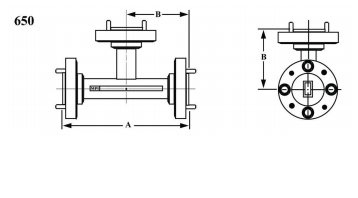
The standard models shown represent only part of Mi-Wave’s broader product capabilities. Custom configurations are available to support specific frequency bands, interfaces, and application requirements, enabling optimized solutions for specialized RF, microwave, and millimeter-wave systems.
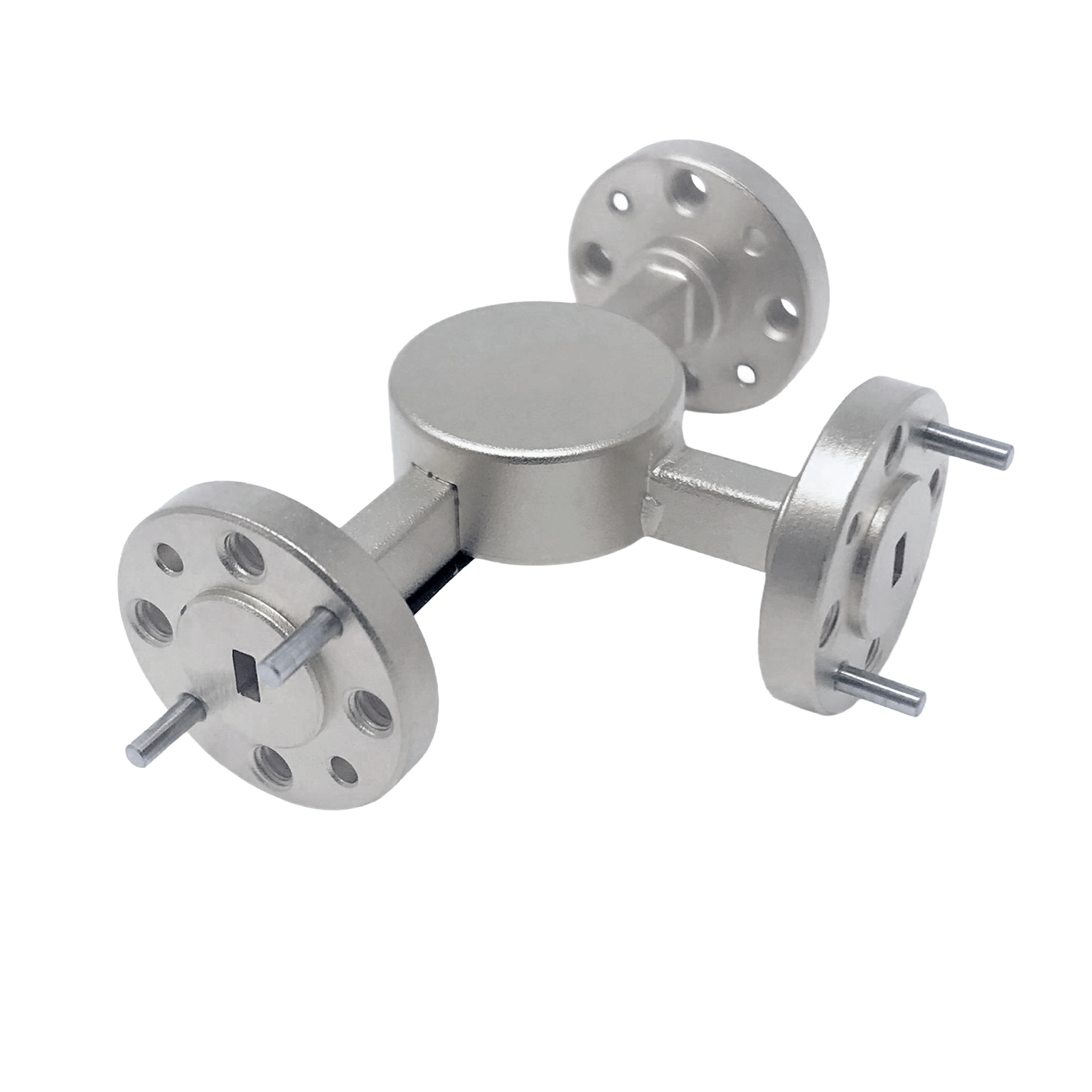
*Actual product may be different from the image shown per customers specifcations
*All data presented is collected from a sample lot.
* Actual data may vary unit to unit, slightly.
*All testing was performed under +25 °C case temperature.
*Consult factory to confirm if material, plating, size, shape, orientation and any electrical parameter is critical for the application as website information is for reference only.
*Millimeter Wave Products, Inc. reserves the right to change the information presented on website without notice as we continue to enhance the performance and design of our products.
| Model | Band | A (in) | A (mm) | B (in) | B (mm) | Weight (oz) |
|---|---|---|---|---|---|---|
| 650Ku | Ku-Band | 2.5 | 63.5 | 1.25 | 31.75 | 3.7 |
| 650K | K-Band | 2.4 | 60.96 | 1.2 | 30.48 | 3.7 |
| 650A | Ka-Band | 2.4 | 60.96 | 1.2 | 30.48 | 3.7 |
| 650B | Q-Band | 2.4 | 60.96 | 1.2 | 30.48 | 3.4 |
| 650U | U-Band | 2.4 | 60.96 | 1.2 | 30.48 | 3.2 |
Features & Performance Characteristics
Features & Performance Characteristics
In-Phase Power Division
The 650 Series H-Plane Tee divides input power into two equal output signals that remain in phase. This makes it useful for RF systems where phase alignment between two paths is important, such as signal distribution, comparison, and measurement setups.
H-Plane Waveguide Junction
The coupling arm is located on the narrow wall of the waveguide, creating an H-plane junction. This geometry determines the in-phase relationship between the two main output ports.
Broad Waveguide Coverage
Available from 12.4 GHz to 110 GHz, the 650 Series supports standard waveguide bands across microwave and millimeter-wave frequencies.
Block-Style Construction
The rigid block-style waveguide body provides mechanical stability and repeatable alignment when integrated into waveguide systems and laboratory test fixtures.
Unmatched Junction Design
The junction is not internally matched, meaning some reflections may occur. For this reason, the 650 Series is better suited for general-purpose signal splitting rather than low-VSWR precision networks.
How E & H Plane Tees Work
Waveguide tees operate by creating a junction where RF energy entering one port is divided into two output paths. The physical orientation of the junction determines whether the output signals are in phase or out of phase.
In an E-plane tee, the branch is placed along the broad wall of the rectangular waveguide, aligned with the electric field plane. This geometry causes the signal at the two main output ports to split equally but with opposite polarity, producing a 180-degree phase difference between the outputs.
In an H-plane tee, the branch is placed along the narrow wall of the rectangular waveguide, aligned with the magnetic field plane. This geometry splits the input power into two equal signals that remain in phase at the output ports.
Because the junction is not internally matched, some reflections can occur at the tee intersection. For this reason, E-plane and H-plane tees are best suited for general power division, test setups, and non-critical VSWR applications rather than precision-matched signal networks.
Applications
Waveguide Power Splitting
The 650 Series is used to divide one RF signal into two equal in-phase paths within rectangular waveguide systems.
RF Test and Measurement
These tees are useful in laboratory setups where engineers need to split signals for comparison, monitoring, or component testing.
Signal Distribution
H-plane tees can distribute RF power between two branches of a waveguide system when identical phase relationships are required.
Microwave and mmWave Subassemblies
The compact block-style design makes the 650 Series practical for integration into RF modules, waveguide benches, and subsystem layouts.
Phase-Aligned Test Paths
Because both main outputs remain in phase, H-plane tees are useful in applications where output phase consistency is important.
Frequently Asked Questions (FAQ)
What is an H-plane tee?
An H-plane tee is a waveguide component with a coupling arm located on the narrow wall of the waveguide. It splits input power into two equal, in-phase output signals.
What is the frequency range of the 650 Series?
The 650 Series H-Plane Tees are available in standard waveguide sizes from 12.4 GHz to 110 GHz.
Are the outputs in phase?
Yes. Power applied at the coupling arm input is divided into two equal signals that are in phase at the main output ports.
Are 650 Series H-Plane Tees matched?
No. These tees have unmatched junctions and are not recommended for applications requiring low VSWR.
What are H-plane tees used for?
They are used for waveguide power splitting, signal distribution, laboratory testing, RF comparison, and phase-aligned signal paths.
What is the difference between an H-plane tee and an E-plane tee?
An H-plane tee produces equal outputs that are in phase, while an E-plane tee produces equal outputs that are 180 degrees out of phase.
E & H Plane Tee Calculators
These calculators help estimate equal power split, output phase relationships, insertion loss impact, and VSWR to return loss for E-plane and H-plane waveguide tee applications.
Equal Power Split Calculator
Estimate output power at each port for an ideal 3 dB split.
Split with Insertion Loss
Estimate output power per port after ideal split and insertion loss.
Total Output Power
Estimate combined total power from two equal output ports.
E-Plane Phase Relationship
Shows the output phase relationship for an E-plane tee.
H-Plane Phase Relationship
Shows the output phase relationship for an H-plane tee.
VSWR to Return Loss
Convert VSWR to return loss to evaluate mismatch at a waveguide junction.
Glossary of E & H Plane Tee Terms
Waveguide Tee
A waveguide component that divides or combines RF energy through a branch junction.
E-Plane Tee
A waveguide tee with a branch junction on the broad wall of the waveguide. It produces equal output signals that are opposite in phase.
H-Plane Tee
A waveguide tee with a branch junction on the narrow wall of the waveguide. It produces equal output signals that are in phase.
Power Division
The process of splitting input RF power into two or more output paths.
In-Phase Signals
Signals that have the same phase relationship and reach their peaks and nulls at the same time.
Opposite Phase
A 180-degree phase difference between two signals, meaning one signal reaches its positive peak while the other reaches its negative peak.
Waveguide Junction
The point where waveguide paths meet or branch.
Unmatched Junction
A junction that is not internally optimized for minimum reflection, often resulting in higher VSWR than matched components.
VSWR
Voltage Standing Wave Ratio, a measure of impedance matching and reflected power.
Rectangular Waveguide
A hollow metallic transmission line used to guide microwave and millimeter-wave energy.
Broad Wall
The wider wall of a rectangular waveguide, associated with the E-plane tee junction.
Narrow Wall
The smaller wall of a rectangular waveguide, associated with the H-plane tee junction.