
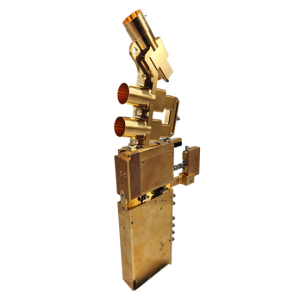
At frequencies between 71 GHz and 86 GHz, the gap between a system that meets its specification and one that does not comes down to decisions made at the component level. Wavelengths shrink to a few millimetres, tolerances tighten to microns, and every interface in the signal path — connector, transition, amplifier stage — contributes to the final link budget in ways that cannot be absorbed by system-level margin.
Designing an E-Band Transceiver Module that performs reliably across this frequency range requires more than selecting components with the right nominal specifications. It requires understanding how noise, linearity, phase stability, and thermal dissipation interact across the full transmit and receive chain, and making deliberate engineering choices at each stage before committing to a layout or procurement.
This article walks through the key decisions involved — from defining receiver noise budget and transmit chain specifications, to selecting the local oscillator architecture and waveguide interface standard — so that engineers approaching E-band system design for the first time, or revisiting an underperforming design, have a structured framework to work from.
Understand the E-Band Frequency Environment First
Before specifying any component, it is worth grounding the design in the propagation physics of the 71–86 GHz bands. The E-band spectrum covers two paired licensed bands: 71–76 GHz and 81–86 GHz, separated by a 10 GHz duplex spacing that enables full-duplex operation. These are not wide-open frequency ranges — link budgets must account for higher free-space path loss, rain attenuation, and the requirement for strict line-of-sight geometry.
At 1 km range, free-space path loss at 75 GHz exceeds that at 10 GHz by approximately 17.5 dB. Rain attenuation in the 71–86 GHz window typically adds 0.01 to 0.05 dB per metre depending on rain intensity and climate. Understanding these numbers before writing a receiver sensitivity requirement prevents the downstream problem of designing to a noise figure that leaves no margin for real-world deployment conditions.
Propagation factors to account for in the link budget:
- Free-space path loss scales with frequency squared — calculate it explicitly at 71 GHz, 78.5 GHz, and 86 GHz, not just mid-band
- Rain attenuation is the dominant impairment; use ITU-R P.838-3 rain attenuation models for the target deployment region
- Atmospheric oxygen absorption is relatively low in the 71–86 GHz window compared to the 60 GHz band — this is one reason E-band is allocated for longer-range links
- No link budget for E-band should assume diffraction or significant reflection contributions — LOS path clearance must be verified at the system design stage
Set the Receiver Noise Budget Before Selecting Components
Define the Noise Figure Allocation
The first active stage in the receive chain sets the ceiling for system noise figure. For an E-Band Transceiver Module, this is typically a dedicated low-noise amplifier stage positioned as close to the waveguide input aperture as the mechanical design permits. Low-noise amplifiers at E-band typically achieve noise figures in the range of 5 dB to 8 dB depending on operating frequency and temperature; every additional element ahead of this stage — waveguide runs, transitions, filters — contributes to the cascaded system noise figure through the Friis equation.
Work through the Friis cascade from the antenna port to the detector or ADC input before selecting any active component. The calculation will show precisely how much noise figure headroom exists in the first stage, and how sensitive the overall system noise figure is to small changes in that first element’s performance.
Account for Waveguide Loss Ahead of the First Amplifier
A waveguide run of 5 cm at E-band introduces approximately 0.3 to 0.5 dB of insertion loss. This loss appears directly in the Friis cascade as a gain-of-one, noise-factor-equal-to-loss stage immediately before the first amplifier. In a system targeting a 6 dB system noise figure, allowing 0.5 dB of waveguide loss before the LNA reduces the allowable LNA noise figure by 0.5 dB — a significant constraint at these frequencies.
The practical implication is that the physical distance between the waveguide input flange and the first amplifier stage must be minimised and explicitly budgeted in the noise analysis. This requirement often drives mechanical packaging decisions as much as RF performance does.
Specify the Transmit Chain for Linearity, Not Just Output Power
Output Power and P1dB
On the transmit side, the final output power specification should be derived from the link budget, not chosen arbitrarily. Power amplifiers in E-band modules are typically rated for output power levels in the range of +10 dBm to +20 dBm at the 1 dB compression point (P1dB). For modulation formats above 16-QAM, the operating point must be backed off from P1dB by several decibels to maintain the error vector magnitude (EVM) performance required by the waveform.
A common mistake is to specify peak output power without accounting for peak-to-average power ratio (PAPR). A 64-QAM signal with 8 dB PAPR driven by an amplifier with +17 dBm P1dB is effectively limited to an average output power of around +9 dBm for compliant EVM — significantly lower than the headline specification.
Gain Flatness and Spurious Management
Gain flatness across the operating bandwidth directly affects the complexity of digital pre-distortion and equalisation in the baseband. Specify gain flatness requirements in terms of peak-to-peak variation across the channel bandwidth, and verify them across temperature — gain tilt in E-band amplifier chains shifts with temperature in ways that are not always predictable from room-temperature data alone.
Key transmit chain specifications to lock down before component selection:
- P1dB at the output port, measured at the operating temperature range — not just at room temperature
- Gain flatness across the channel bandwidth: target below 1 dB peak-to-peak for high-order modulation formats
- Harmonic and spurious output levels: ITU-R and regional spectrum regulations set specific limits that must be met at the antenna port
- LO leakage at the RF port: excessive LO leakage in a full-duplex system can couple into the receive path and raise the noise floor
Choose the Local Oscillator Architecture Based on Phase Noise Requirements
Frequency Multiplication vs Direct Synthesis
Generating a stable LO signal at 71–86 GHz requires a deliberate architecture decision. The two main approaches are frequency multiplication from a lower-frequency reference and direct synthesis using a high-frequency PLL. Each has trade-offs in phase noise, power consumption, and frequency agility that must be matched to the system requirements.
In a frequency multiplication chain, phase noise from the reference oscillator multiplies by 20·log₁₀(N) dB where N is the total multiplication factor. A ×8 chain from a 10 GHz reference adds approximately 18 dB to the reference phase noise floor. The reference oscillator quality therefore sets the absolute floor for the LO — specifying a tight phase noise requirement at 75 GHz without specifying a compatible reference oscillator will result in a system that cannot meet its specification regardless of how well the multiplication chain is designed.
IF Section and Channel Filter
The IF filter defines the usable channel bandwidth and provides image rejection. For E-band backhaul applications with channel bandwidths of 250 MHz to 2 GHz, the filter must deliver sufficient out-of-band rejection while maintaining group delay variation low enough for the target modulation format.
Design the IF section around the following constraints:
- In-band passband ripple: keep below 0.5 dB peak-to-peak across the channel to preserve signal quality
- Group delay variation: characterise and include in the equalisation budget — uncompensated group delay ripple raises the error floor for high-order modulation
- Image rejection: target above 40 dBc using image-reject mixer topology or IF frequency selection that places the image outside the bandpass filter response
Select the Waveguide Interface Standard and Verify Mechanical Compatibility
For E-band transceivers, the standard waveguide interface is WR-12 (internal dimensions 3.099 mm × 1.549 mm), covering 60–90 GHz with UG-387/U flanges. For designs that operate primarily in the lower E-band (71–76 GHz), WR-15 waveguide (50–75 GHz) may be used where compatibility with existing V-band infrastructure is a requirement.
Waveguide interface selection affects not just electrical performance but also mechanical compatibility with antennas, test equipment, and waveguide runs. Verify the following before committing to a flange standard:
- Confirm that the antenna feed, waveguide run, and any in-line components all use the same flange standard and alignment pin configuration — mixing UG-385/U and UG-387/U flanges in the same assembly is a common source of assembly errors
- Verify that the coaxial connector family specified for any coaxial-to-waveguide transitions matches the frequency range of the operating band — 1.85 mm V-connectors are rated to 65 GHz; applications above this require 1.35 mm or 1.0 mm interfaces
- Specify flange torque values explicitly in the assembly procedure — flange misalignment of even a few tens of microns introduces measurable insertion loss and return loss degradation at E-band
Address Thermal Management Before Finalising the Layout
Power dissipation in E-band amplifier stages concentrates in a small physical volume. Thermal resistance from junction to case must be characterised across the full operating temperature range, and the mounting interface — whether conduction-cooled to a chassis or convection-cooled in a standalone housing — must maintain junction temperatures within the component manufacturer’s rated limits.
For mission-critical applications in defence or SATCOM, thermal cycling reliability is a qualification criterion, not just an operational one. Coefficient of thermal expansion (CTE) mismatch between waveguide assemblies, circuit substrates, and housings accumulates stress over thermal cycles. Address material selection and mechanical compliance in the package design before first hardware build — retrofitting thermal management after the fact is both expensive and rarely fully effective.
Conclusion
Designing and integrating an E-Band Transceiver Module is a process of managing trade-offs across noise, linearity, phase stability, waveguide interface precision, and thermal performance — simultaneously and interdependently. Working through the receiver noise budget before selecting components, deriving transmit power requirements from the link budget rather than catalogue defaults, choosing the LO architecture based on phase noise constraints, and verifying waveguide mechanical compatibility early in the design process are the steps that determine whether the final system meets its specification in the field.
Each decision made early in the process reduces the cost and risk of discovering a constraint after hardware has been committed. For engineers working on E-Band Transceiver systems across defence, backhaul, or SATCOM platforms, this structured approach to specification and integration is the foundation for reliable performance in demanding environments.