
Mi-Wave RF upconverters and downconverters deliver reliable, high-performance solutions for millimeter-wave frequency conversion in advanced communication, sensing, and instrumentation systems. The 970B-38.25/387S Q-Band Downconverter is engineered to translate Q-band RF signals centered at 38.25 GHz into a lower intermediate frequency, supporting receiver architectures where spectral purity, image suppression, and frequency stability are critical.
Operating over an RF input frequency range of 38.0 to 38.5 GHz, the 970B-38.25/387S converts incoming Q-band signals to a standard IF output of 950 to 1450 MHz, enabling seamless integration with common receivers, demodulators, and signal processing equipment. Its heterodyne conversion architecture provides stable, repeatable frequency translation with no frequency inversion, simplifying downstream system design.
The downconverter offers high conversion gain with digitally controlled attenuation, allowing precise level management across a wide range of operating conditions. With image rejection of up to 80 dB and low signal-related and signal-independent spurious performance, the 970B-38.25/387S preserves receiver sensitivity and minimizes the need for additional external filtering in dense RF environments.
Designed for integration into professional RF systems, the unit features a WR-22 waveguide RF input and SMA IF output, supporting standard Q-band front ends and L-band processing chains. Stable internal frequency references ensure consistent performance across operating temperatures, making the platform suitable for continuous operation in laboratory, ground-based, and controlled outdoor installations.
Mi-Wave Q-band downconverter platforms are used in a wide range of applications including satellite communication downlinks, radar receiver systems, telemetry and tracking platforms, radio astronomy, atmospheric sensing, and RF test and measurement environments. The 970B-38.25/387S provides a dependable frequency translation stage for high-frequency receiver systems where performance, stability, and signal integrity are essential.
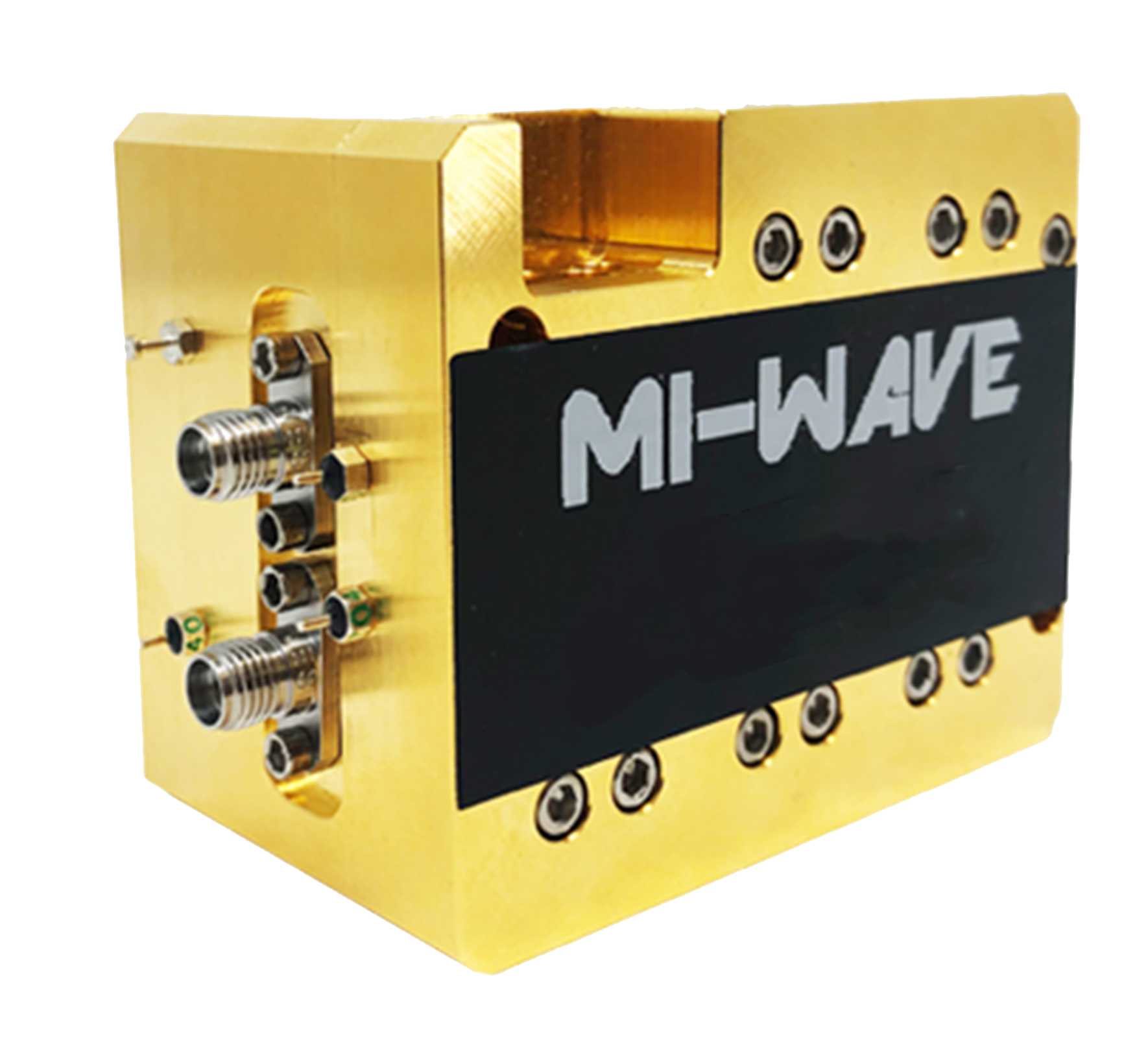
*Actual product may be different from the image shown per customers specifcations
*All data presented is collected from a sample lot.
* Actual data may vary unit to unit, slightly.
*All testing was performed under +25 °C case temperature.
*Consult factory to confirm if material, plating, size, shape, orientation and any electrical parameter is critical for the application as website information is for reference only.
*Millimeter Wave Products, Inc. reserves the right to change the information presented on website without notice as we continue to enhance the performance and design of our products.
Key Specifications (Summary)
RF Input Frequency: 38.0 – 38.5 GHz (Q-band)
IF Output Frequency: 950 – 1450 MHz
Frequency Inversion: No
RF Input Return Loss: ≤ 10 dB
IF Output Return Loss: ≤ 15 dB
RF Downconversion Performance
Conversion Gain: ≤ 30 dB
Gain Flatness: ±1 dB over 500 MHz bandwidth
1 dB Compression Point (P1dB): 5 dBm
Attenuation Range: 0 – 30 dB (0.5 dB steps)
Phase, Spurs, and Linearity
Image Rejection: 80 dB
Signal-Related Spurious: −65 dBc
Signal-Independent Spurious: −70 dBm
Third-Order Output Intercept (OIP3): 10 dBm
Phase Noise: TBD
Group Delay: TBD
Internal Frequency Stability: ±1 × 10⁻⁷ over operating temperature
Control and Configuration
Gain Control: Digitally controlled attenuation
Remote Control Interface: Not specified
Mechanical and Power
RF Input Interface: WR-22 Waveguide
Input Flange: UG-383/U
IF Output Connector: SMA (Female)
Operating Temperature: −10°C to +60°C
Storage Temperature: −40°C to +60°C
Power Input: 230 VAC ±10%
RF Frequency Converter Calculators
These calculators support RF upconverter and downconverter planning, including IF and LO frequency planning, high-side vs low-side injection, image frequency checks, conversion gain math, cascaded gain/noise figure, and output level estimates for transmit and receive chains.
Jump to: LO / IF Planner · Image Frequency · Output Level · Cascade Gain & NF · Mixing Spurs · Return Loss ↔ VSWR
1) LO / IF Frequency Planner (Upconversion & Downconversion)
Compute the missing frequency for a mixer stage. Choose a mode (downconversion or upconversion) and an injection type (high-side or low-side). This supports common heterodyne planning for IF↔RF conversion.
2) Image Frequency Calculator (Given LO and IF)
For a superheterodyne stage, the image is the unwanted RF that converts to the same IF as the desired signal. This tool computes desired RF and image RF for a selected injection scheme.
3) Output Level Estimator (Input dBm + Conversion Gain/Loss)
Estimate converter output level from input level and conversion gain (or loss). Useful for keeping stages out of compression and aligning IF/RF levels into PAs, LNAs, and digitizers.
4) Cascaded Gain & Noise Figure (Friis)
Estimate total gain and cascaded noise figure using Friis. Enter up to 4 stages (LNA, filter, converter, IF amp, etc.). Gains in dB; NFs in dB.
5) Mixer Spur Finder (m·LO ± n·RF)
Identify common mixing products near IF. Enter RF and LO and set max order. Outputs a list of spur frequencies. This is a planning helper for “spurious responses” discussions and frequency plans.
6) Return Loss ↔ VSWR Converter
Convert return loss (dB) to VSWR or VSWR to return loss. Helpful for spec writing and datasheet summaries.
RF Upconverter and Downconverter FAQ
These quick answers cover RF upconverters, RF downconverters, BUCs, LNBs, and frequency conversion specs used in satellite communications (SatCom), point-to-point microwave links, radar, telemetry, test and measurement, and 5G/mmWave systems.
Quick Answers
What does an RF upconverter do?
An RF upconverter translates a lower-frequency signal, such as IF or L-band, to a higher RF or microwave frequency so it can be transmitted by an antenna. In many transmit chains, the upconverter is followed by an RF power amplifier; when integrated, it is often called a Block Upconverter (BUC).
What does an RF downconverter do?
An RF downconverter converts a high-frequency RF input to a lower intermediate frequency (IF) that is easier to filter, amplify, digitize, and demodulate. In receiver front ends, a downconverter is often paired with an LNA; when integrated, it is commonly called an LNB (Low-Noise Block downconverter).
What is the difference between a BUC and an RF upconverter?
A BUC combines an RF upconverter with an integrated power amplifier to deliver higher output power for satellite uplinks and other transmit applications. An RF upconverter alone performs frequency translation but may not include the high-power amplification stage.
What IF frequencies are commonly used in RF systems?
Common IF frequencies include 70 MHz and 140 MHz, plus L-band IF ranges such as 950–2150 MHz. The best IF depends on the modem interface, channel plan, filtering requirements, and the overall superheterodyne architecture.
Why is image rejection important in frequency converters?
Image rejection suppresses unwanted signals that can downconvert to the same IF as the desired signal during mixing. Higher image rejection improves receiver sensitivity, reduces interference, and helps maintain spectral purity in dense RF environments.
More Technical Questions
What is an image frequency in a mixer or downconverter?
What is LO leakage and why does it matter?
What does low phase noise mean for RF upconverters and downconverters?
Why is a 10 MHz reference input used?
What is conversion gain, and how do gain control and digital attenuation help?
What does AGC do in a frequency conversion chain?
What is instantaneous bandwidth?
Where are RF frequency converters used?
Glossary of RF Frequency Converter Specification Terms
Core Frequency Conversion Terms
Upconversion
The process of translating a lower-frequency signal, such as IF or L-band, to a higher RF or millimeter-wave frequency using a mixer and local oscillator. Upconversion is used in transmit chains for satellite communication, radar, telemetry, and wireless systems.
Downconversion
The process of translating a high-frequency RF or millimeter-wave signal to a lower intermediate frequency for filtering, amplification, digitization, or demodulation. Downconversion is fundamental in receiver architectures.
Up-Downconverter
A frequency conversion device that integrates both upconversion and downconversion functions within a single unit, enabling bidirectional frequency translation between RF and IF stages.
Frequency Converter
A general RF component that performs upconversion, downconversion, or both, enabling frequency translation between IF, RF, and millimeter-wave bands.
Intermediate Frequency (IF)
A standardized frequency used between RF and baseband stages to simplify filtering, amplification, and signal processing. Common IF ranges include 70 MHz, 140 MHz, 950–1450 MHz, 950–2150 MHz, and 4–12 GHz.
RF Frequency
The operating radio frequency after conversion. In Mi-Wave 970 / 980 series products, RF frequencies commonly span X-band through Ku-, Ka-, Q-, and V-band.
Local Oscillator (LO) and Mixing Terms
Local Oscillator (LO)
A stable signal source used in a mixer to enable frequency translation. LO quality directly impacts phase noise, spurious performance, and frequency stability.
External LO Input
An externally supplied LO signal used to lock the converter to a system reference, improving synchronization and frequency accuracy across multiple devices.
LO Leakage
Unwanted LO energy appearing at the RF or IF ports. Low LO leakage reduces spurious emissions and interference.
Image Frequency
An undesired frequency that also converts to the same IF during mixing and must be suppressed through filtering or image-reject architectures.
Image Rejection
The ability of a frequency converter to suppress unwanted image frequencies. High image rejection improves receiver sensitivity and spectral purity.
Gain, Power, and Linearity Specifications
Conversion Gain
The net gain or loss introduced by the frequency conversion process. Conversion gain may be fixed or adjustable depending on design.
Gain Flatness
The variation of conversion gain across the operating bandwidth. Low gain flatness variation ensures uniform signal amplitude.
Digital Attenuation
Digitally controlled attenuation used to adjust output or conversion gain in precise, repeatable steps.
Automatic Gain Control (AGC)
A control function that automatically adjusts gain or attenuation to maintain a consistent output level despite input signal variations.
P1dB (1 dB Compression Point)
The output power level at which gain compresses by 1 dB from linear operation. Indicates the usable linear power range of the converter.
Output Power
The RF power level available at the output of an upconverter or the IF output of a downconverter.
OIP3 (Output Third-Order Intercept Point)
A measure of linearity indicating how well the device handles multiple signals without generating intermodulation distortion.
Noise and Signal Quality Metrics
Noise Figure (NF)
A measure of how much noise a component adds to the signal. Low noise figure is critical in downconverters and receiver front ends.
Phase Noise
Short-term frequency fluctuations of the LO or output signal, typically expressed in dBc/Hz. Low phase noise supports high-order modulation and radar resolution.
Frequency Stability
The ability of a converter or LO to maintain accurate frequency over time, temperature, and environmental conditions.
Reference Input
An external frequency reference, commonly 10 MHz, used to lock the LO and synchronize multiple RF systems.
Bandwidth and Channel Characteristics
Instantaneous Bandwidth
The frequency range over which the converter operates at a single tuning setting without retuning.
Operational Bandwidth
The total frequency span supported by the converter across its tuning range.
Tuning Resolution (Step Size)
The smallest frequency increment by which the LO or output frequency can be adjusted.
Multichannel Operation
A configuration where multiple independent frequency conversion paths operate in parallel within a single unit.
Spurious and Spectral Performance
Spurious Responses (Spurs)
Unwanted discrete frequency components generated by mixing products, harmonics, or nonlinearities.
Signal-Related Spurious
Spurious signals directly related to the input or output signal frequency.
Non-Signal-Related Spurious
Spurious emissions not directly tied to the signal frequency, often caused by internal oscillators or digital circuitry.
Harmonic Suppression
The attenuation of harmonic frequencies generated by nonlinear RF components.
Spectral Purity
The cleanliness of the output spectrum, characterized by low phase noise, low spurious content, and strong image suppression.
Interfaces, Packaging, and Integration
WR-Waveguide Interface
A standardized rectangular waveguide used for millimeter-wave RF interfaces, such as WR-28 (Ka-band) or WR-22 (Q-band).
Coaxial IF Interface
A coaxial connector, such as SMA or N-type, used for IF input or output connections.
Coupled Test Port
A low-level monitoring output that allows signal verification without interrupting the main RF path.
Commercial Rack-Mount Packaging
An enclosure designed for indoor laboratory, test, and ground-station installations.
Ruggedized or Environmental Packaging
Sealed or reinforced enclosures designed for outdoor, airborne, or harsh operating environments.
System-Level Terms
Receiver Front-End Protection
The use of frequency converters and filtering to prevent strong signals from overloading LNAs and mixers.
Dynamic Range
The range between the smallest and largest signal levels that can be processed without excessive noise or distortion.
Synchronization
The alignment of frequency and phase across multiple converters or channels using a common reference.
Regulatory Compliance
Ensuring frequency-converted signals meet emission limits and spectral mask requirements imposed by regulatory authorities.
| Model Number | Band | Description | Frequency (GHz) | Converter Type | # of Channels | Packaging | User Preferences | LINK |
|---|---|---|---|---|---|---|---|---|
| 980-10/385S | C, S, X | Upconverter | 2-18 | Synthesized | Block | 1,2,3,4 | Commercial Rack Environmental | Bandwidth Internal/External Ref Digital Attenuation AGC | |
| 980A-34.5/381 S | Ka | Upconverter | 26.5-40 | Synthesized | Block | 1,2,3,4 | Commercial Rack Environmental | Bandwidth Internal/External Ref Digital Attenuation AGC | |
| 970980A-35.61 /KF | Ka | Up-Downconverter | 35.61 | Synthesized | Block | 1,2,3,4 | Commercial Rack Environmental | Bandwidth Internal/External Ref Digital Attenuation AGC | |
| 970B-38.25/383S | Q | Downconverter | 38.0-38.5 | Synthesized | Block | 1,2,3,4 | Commercial Rack Environmental | Bandwidth Internal/External Ref Digital Attenuation AGC | |
| 970A-39.65/599 | Ka | Downconverter | 39.4-39.9 | Synthesized | Block | 1,2,3,4 | Commercial Rack Environmental | Bandwidth Internal/External Ref Digital Attenuation AGC | |
| 980B-43.25/383S | Q | Upconverter | 42.0-43.5 | Synthesized | Block | 1,2,3,4 | Commercial Rack Environmental | Bandwidth Internal/External Ref Digital Attenuation AGC | |
| 970U-47.2/51 .4/1.85mmF | U | Downconverter | 47.2-51.4 | Synthesized | Block | 1,2,3,4 | Commercial Rack Environmental | Bandwidth Internal/External Ref Digital Attenuation AGC | |
| 970980U B-47.2/51 .4/1.85mmF-PLO | U | Up-Downconverter | 47.2-51.4 | Synthesized | Block | 1,2,3,4 | Commercial Rack Environmental | Bandwidth Internal/External Ref Digital Attenuation AGC | |
| 970V-62.5/385 | V | Downconverter | 70-65 | Synthesized | Block | 1,2,3,4 | Commercial Rack Environmental | Bandwidth Internal/External Ref Digital Attenuation AGC | |
| 970E-70.4/86.4/387 | E | Downconverter | 70.4-86.4 | Synthesized | Block | 1,2,3,4 | Commercial Rack Environmental | Bandwidth Internal/External Ref Digital Attenuation AGC | |
| 970980W-20/387S | W | Up-Downconverter | 95-100 | Synthesized | Block | 1,2,3,4 | Commercial Rack Environmental | Bandwidth Internal/External Ref Digital Attenuation AGC |
RF Upconverters and Downconverters
RF Downconversion Functionality
The 970B-38.25/387S receives a Q-band RF input (38.0 to 38.5 GHz) and converts it to a standard L-band IF (950 to 1450 MHz) for easier filtering, amplification, digitization, and demodulation. This makes it a strong fit for receiver chains where frequency stability, spectral cleanliness, and repeatable tuning performance are essential.
Key downconversion characteristics include:
-
Q-band to L-band IF translation for receiver processing
-
High image rejection (80 dB) to protect receiver sensitivity
-
Low spurious performance for cleaner spectrum and easier channel planning
-
User-adjustable attenuation (0 to 30 dB) for level management and dynamic range control
-
Stable operation across typical system environments
Typical Applications
The 970B-38.25/387S Q-Band Downconverter is commonly used in:
-
Satellite communications downlinks and gateway receiver systems
-
Q-band payload testing and frequency planning support
-
Radar receiver chains and signal processing platforms
-
Telemetry and tracking receivers in high-frequency bands
-
Radio astronomy and scientific instrumentation where stability matters
-
RF and mmWave test and measurement systems for downconversion and validation
System Integration and Configuration
This downconverter supports streamlined integration into RF systems using:
-
WR-22 waveguide input with UG-383/U flange for Q-band front ends
-
SMA IF output for compatibility with common IF equipment
-
Built-in attenuation control for optimizing output level without external pads
-
Strong rejection and spurious control that reduces extra filtering burden downstream
Role in RF Signal Conversion Systems
Within a high-frequency receiver architecture, the 970B-38.25/387S functions as the primary frequency translation stage, enabling Q-band signals to be processed using widely supported IF hardware while preserving receiver sensitivity and signal integrity. Its combination of image suppression, stability, and gain control supports reliable operation in systems where clean conversion directly impacts performance.
Build Your RF Upconverter or Downconverter Needs and more!
Our team brings over 35 years of experience in the microwave and millimeter-wave RF industry, spanning design, prototyping, manufacturing, and system integration. We work closely with customers to help turn concepts into production-ready solutions, supporting a wide range of RF technologies. Contact us today to discuss RF upconverters, RF downconverters, transceivers, LNBs, low noise block upconverters, and custom RF sub-assembly systems.
Mi-Wave has designed, built, and supported numerous custom RF and millimeter-wave projects that require upconverters, downconverters, and integrated RF components within complex systems. From initial design and prototyping through full-scale manufacturing, our team supports every step of the development process. Contact us to discuss your project requirements and let Mi-Wave help engineer, manufacture, and deliver your RF assemblies with confidence.