
Every lane-change assist, automatic emergency braking intervention, and adaptive cruise control action in a modern vehicle depends on a tightly integrated set of millimeter wave components operating at 76 to 81 GHz. These components – collectively the radar front-end – detect other vehicles, pedestrians, cyclists, and stationary objects at ranges from a few centimetres to over 200 metres, across all weather conditions and lighting environments where a camera-based system would fail. The reliability of ADAS and autonomous driving functions depends entirely on the ability of these components to maintain accurate target detection performance in rain, fog, dust, and direct sunlight, simultaneously and without interruption.
This article examines each major component category in a 77 GHz automotive radar system, explains how they function and interact, and identifies the performance parameters that determine system-level detection capability. It also covers how these systems are tested in laboratory environments during development.
Why 77 GHz Is the Automotive Radar Standard
The 76 to 81 GHz frequency allocation for automotive radar provides an effective balance of characteristics for vehicle detection applications. At 77 GHz, the free-space wavelength of approximately 3.9 mm supports antenna designs with useful beam directivity in physically compact form factors – small enough to integrate into vehicle bumpers, grilles, and mirror housings without impacting vehicle styling. Higher frequencies would allow even more compact antennas but would suffer greater atmospheric and rain attenuation; lower frequencies would require physically larger antenna apertures to achieve equivalent beam directivity.
The 5 GHz of bandwidth available between 76 and 81 GHz enables FMCW waveforms with range resolutions below 4 cm. This fine range resolution makes it possible to distinguish closely spaced objects – for example, resolving a motorcycle following close behind a car – that would be unresolvable at lower frequencies. The combination of compact antenna size, acceptable atmospheric propagation, and fine range resolution made 76 to 81 GHz the global regulatory standard for short and long-range automotive radar.
Key Automotive Radar Components and How They Work
The 77 GHz Transceiver MMIC
The core of a modern automotive radar module is the 77 GHz transceiver MMIC – a highly integrated chip that contains the voltage-controlled oscillator, frequency dividers, transmit power amplifiers, receive low-noise amplifiers, mixers, and in many current designs the ADC and digital interfaces, all on a single silicon germanium (SiGe) BiCMOS or bulk CMOS die. The level of integration in a modern 77 GHz automotive radar MMIC would have required an entire rack of discrete RF equipment just twenty years ago.
The VCO inside the MMIC generates a linearly frequency-modulated chirp waveform – the FMCW signal – whose instantaneous frequency sweeps from 76 to 81 GHz at a rate controlled by a fractional-N PLL. The chirp parameters – bandwidth, duration, and repetition interval – determine the system’s range resolution, maximum unambiguous range, and velocity resolution. In MIMO radar configurations, multiple simultaneous chirps are transmitted from different antenna ports with orthogonal coding to create a virtual aperture larger than the physical antenna array.
Transmit Antenna Array
The transmit antenna in an automotive radar module is typically a printed patch array or slotted waveguide array on a low-loss PCB substrate. In MIMO configurations, two to four transmit antenna ports radiate simultaneously, with phase or timing offsets between channels that enable virtual aperture synthesis in post-processing. The antenna gain – typically 10 to 16 dBi at 77 GHz – concentrates the transmitted FMCW chirp into a directional beam, providing the EIRP needed to detect a passenger car at 200 metres with transmit power levels below 10 dBm at the antenna connector.
Antenna pattern quality – specifically the sidelobe levels and the beam symmetry – directly affects the system’s ability to correctly localise targets in angle. A poor sidelobe structure causes targets at the edge of the field of view to appear at incorrect azimuth positions, degrading the ADAS system’s situational awareness and potentially causing false interventions or missed detections.
Receive Array and Digital Beamforming
The receive antenna array – four to eight elements in most production radar modules – collects the reflected signal from targets in the field of view. Digital beamforming, implemented in the signal processor using amplitude and phase information from each receive channel independently, creates a synthetic aperture that resolves targets in both range and azimuth simultaneously. The angular resolution achievable is determined by the effective aperture of the combined transmit-receive virtual array, which in a 3Tx × 4Rx MIMO configuration creates a 12-element virtual aperture from 7 physical antenna elements.
Low-Noise Amplifier
The receive path low-noise amplifier (LNA) amplifies the weak reflected signal collected by the antenna before it reaches the mixer. At 77 GHz, the LNA noise figure – typically 4 to 8 dB in SiGe processes – directly determines the radar’s minimum detectable signal and therefore its maximum detection range for targets of a given radar cross section. Lower noise figure translates directly to extended detection range or the ability to detect smaller, lower-RCS targets such as cyclists and pedestrians at the same range. For testing and validating the sensitivity of receive chains in production automotive radar components, radar target simulators that generate known signal levels at precisely controlled Doppler frequencies are essential tools for quantifying LNA and receiver chain sensitivity against specification.
FMCW Mixer and IF Chain
The mixer in the receive chain multiplies the received reflected signal with a sample of the transmit waveform – the local oscillator. For FMCW radar, this multiplication produces an intermediate frequency (IF) tone whose frequency is proportional to target range: a nearby target at 10 metres produces an IF tone of a few kilohertz; a target at 200 metres produces an IF tone of tens of kilohertz. The IF signal is filtered, amplified, and digitized at the ADC, then processed by the signal processor to generate range-Doppler maps of the radar scene.
The performance of the mixer and IF chain – specifically the mixer conversion loss, image rejection, and IF bandwidth – directly affects the radar’s dynamic range and its ability to simultaneously detect strong nearby targets and weak distant targets. In system-level radar front-ends, frequency converters and IF chain components must be selected and characterised together with the transceiver MMIC to ensure that the complete signal chain meets the system’s simultaneous dynamic range requirements across all target ranges of interest.
Radar Signal Processor
The digital signal processor performs the range-FFT and Doppler-FFT operations that transform the digitized IF time-domain data into a range-Doppler map. CFAR (constant false alarm rate) target detection algorithms identify peaks in the range-Doppler map that correspond to real objects. Angle estimation algorithms combine the outputs of multiple receive channels to determine the azimuth and elevation of detected targets, and tracking algorithms maintain target identity across successive radar frames to produce stable, low-latency object list outputs for the ADAS decision controller.
In modern production radar modules, all signal processing from ADC output to object list generation is implemented on the same MMIC as the RF front-end – a level of integration that enables automotive radar modules measuring 60 × 80 mm to deliver complete ADAS-ready object list outputs while consuming only 3 to 5 watts of power.
Long-Range vs. Short-Range Radar Configurations
Automotive radar systems are deployed in multiple configurations optimised for different detection scenarios. Long-range radar (LRR) mounted in the front bumper uses a high-gain narrow-beam antenna to cover forward ranges of 150 to 250 metres for highway adaptive cruise control and automatic emergency braking. Short-range radar (SRR) modules at the vehicle corners use wide-beam antennas to cover a broader angular field of view at ranges of 20 to 50 metres for blind spot detection, rear cross-traffic alert, and parking assistance.
Both LRR and SRR can use the same 77 GHz transceiver MMIC; the antenna design, chirp parameters, and signal processing configuration differentiate the two system types. A modern passenger vehicle typically integrates one long-range radar and four to six short-range corner radars to provide 360-degree coverage for the full suite of ADAS functions.
Testing and Validation of Automotive Radar Systems
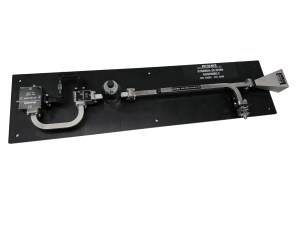
Before production deployment, automotive radar systems must be validated against detection, false alarm rate, and angular resolution specifications. Outdoor field testing is expensive and difficult to repeat with controlled target profiles. Laboratory testing using radar target simulators – instruments that generate emulated radar returns at precisely controlled frequencies, Doppler shifts, and power levels – allows the signal processing algorithms and receiver sensitivity to be validated against known target scenarios in a repeatable, controlled environment.
Mi-Wave’s radar target simulators support automotive radar validation at 76.5 GHz, generating Doppler shifts that correspond to approaching and receding vehicles, cyclists, and pedestrians with defined velocities. This allows test engineers to verify that the radar correctly detects minimum-speed targets, resolves multiple targets at similar ranges, and maintains the specified false alarm rate under complex multi-target scenarios – all in the laboratory, before the first vehicle integration test.
Conclusion
Automotive radar is not a single component but a tightly integrated system in which the transceiver MMIC, antenna arrays, LNA, mixer, IF chain, and signal processor each play a defined and irreplaceable role. The system’s ability to detect a pedestrian at 50 metres in rain, or to track a motorcycle changing lanes at 150 km/h, depends on every component in the signal chain performing to specification under real-world thermal, vibration, and electromagnetic interference conditions.
For engineers developing automotive radar modules or integrating them into ADAS platforms, understanding how each component contributes to system-level metrics – detection range, angular resolution, velocity resolution, and false alarm rate – is the foundation for effective design, component specification, and test validation.
Mi-Wave supports automotive radar development through its portfolio of radar target simulators, millimeter wave amplifiers, frequency converter components, and custom RF modules designed for operation in the 76 to 81 GHz automotive radar band. Engineers working on ADAS radar development or production test system design are welcome to contact Mi-Wave for component selection guidance and application support.