
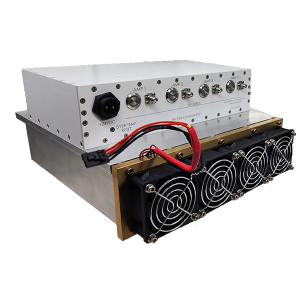
Generating a stable, low-noise amplified signal at Ka-band frequencies – 26.5 to 40 GHz – is one of the central hardware design challenges in millimeter wave engineering. The physical behaviour of transistor devices, substrate materials, and passive matching networks at these frequencies is fundamentally different from what engineers encounter at X-band or below. Parasitic capacitances that are negligible at 10 GHz introduce significant reactive loading at 35 GHz; skin-effect losses in conductors increase sharply with frequency; and the gain available from standard device technology drops at roughly 6 dB per octave as frequency climbs. All of these factors make Ka-band amplification a discipline that demands both the right component selection and a precise understanding of how every element in the signal chain behaves at these frequencies.
This article explains how a Ka band amplifier works at the circuit and system level, what performance parameters govern component selection for specific applications, and how these amplifiers integrate into the signal chains of radar and satellite communication hardware operating across this demanding frequency band.
Why Ka-Band Amplification Is Technically Demanding
At Ka-band frequencies, the transit time of electrons across a transistor’s active region becomes a meaningful fraction of the signal period. Standard silicon CMOS, which performs well through several gigahertz, cannot maintain useful gain at 30 to 40 GHz. Compound semiconductor technologies – principally gallium arsenide (GaAs) pseudomorphic HEMT and gallium nitride (GaN) HEMT – are the dominant device families for Ka-band amplification, because their electron mobility and carrier velocity are high enough to sustain meaningful transistor gain at these frequencies with acceptable noise performance.
Beyond device physics, the passive components that surround the transistor – matching networks, bias lines, and stabilisation circuits – must be implemented as distributed microwave structures rather than lumped inductors and capacitors. A 1 nH inductor that works conveniently as a bias choke at 2 GHz has an impedance of approximately 220 ohms at 35 GHz and becomes completely impractical in that role. Quarter-wave transmission line stubs, radial stubs, and other distributed elements with precisely controlled electrical lengths must replace every lumped component in the design. This requirement increases both the fabrication complexity and the tolerance demands of Ka-band amplifier hardware significantly.
How a Ka Band Amplifier Works
MMIC Architecture: Everything on One Die
A Ka band amplifier is built as a Monolithic Microwave Integrated Circuit, or MMIC. In this architecture, the transistors, matching networks, bias circuitry, and stabilisation elements are all fabricated together on a single compound semiconductor substrate – typically a GaAs or GaN wafer. Monolithic integration is not optional at Ka-band; it is a technical necessity. At these frequencies, even a short bond wire connecting a discrete transistor to an external matching network introduces enough inductance to shift resonant frequencies, destabilise the amplifier, or collapse gain bandwidth entirely. By eliminating all external connections within the amplifier function, the MMIC achieves the impedance control and electrical consistency that Ka-band performance demands.
Mi-Wave designs its Ka-band amplifier MMICs on both GaAs pHEMT and GaN HEMT processes, selecting the device technology based on application requirements. Low-noise receive-path stages use GaAs pHEMT, which achieves the lowest noise figures available from solid-state technology at these frequencies. High-power transmit stages use GaN HEMT, whose wider bandgap and higher breakdown voltage allow significantly greater power density than GaAs while maintaining acceptable efficiency.
Input and Output Matching Networks
Every transistor in a Ka-band MMIC has an optimum source impedance at which it produces minimum noise figure, and an optimum load impedance at which it delivers maximum gain or maximum output power. These optimum impedances are generally not 50 ohms. The matching networks on either side of the transistor transform the 50-ohm system impedance to the values the transistor requires, enabling each stage to perform at or near its theoretical limits within the system.
At Ka-band, matching networks are implemented as combinations of microstrip transmission lines, coupled lines, short-circuit stubs, and metal-insulator-metal (MIM) capacitors fabricated directly on the die. The physical dimensions of these structures are measured in the range of 100 to 500 micrometres and must be fabricated with tight dimensional tolerances to maintain designed electrical performance across production quantities and across temperature.
Bias Configuration and Amplifier Operating Class
A Ka-band amplifier’s operating class – the drain-source and gate-source DC bias conditions – determines the trade-off between linearity, efficiency, and gain. Class A operation, where the transistor is biased at the centre of its linear region, provides the highest linearity and flattest gain but the lowest DC-to-RF efficiency, typically 15 to 25% at Ka-band. Class AB operation reduces quiescent current and improves efficiency while sacrificing some linearity – a trade-off well-suited to communication waveforms. For pulsed radar transmitters, pulsed Class A or Class AB bias with active gate switching minimises average DC consumption while maintaining the peak output power the radar waveform requires.
Stability across all frequencies – ensuring the amplifier does not oscillate in-band or out-of-band – is a distinct design requirement. Ka-band MMICs have sufficient gain at lower microwave frequencies to potentially oscillate through feedback paths created by package parasitics or PCB trace coupling. Resistive stabilisation elements placed in the bias network suppress out-of-band gain without significantly degrading in-band performance, and their correct placement is a defining aspect of Ka-band MMIC design.
Key Performance Parameters
Gain and Gain Flatness
Single-stage Ka-band LNA MMICs typically deliver 12 to 18 dB of gain across their operating bandwidth. Multi-stage driver and power amplifiers achieve 25 to 35 dB. Gain flatness – peak-to-peak variation across the operating bandwidth – must be held to ±1 dB or tighter for radar and communication applications where frequency-dependent signal level variation directly affects system accuracy. Achieving this across a bandwidth of several gigahertz requires careful optimisation of interstage matching networks at each point across the design frequency range.
Output Power and P1dB
The output 1 dB compression point (OP1dB) specifies the output power at which gain has dropped 1 dB from its small-signal value due to transistor saturation. It is the primary power amplifier figure of merit and defines the maximum useful output power before significant signal distortion occurs. Mi-Wave’s Ka-band GaN power amplifiers deliver OP1dB values from +27 dBm to +37 dBm depending on device size and bias conditions – output power levels that serve radar transmitter, SatCom uplink amplifier, and 5G mmWave base station applications.
Noise Figure
For receiver front-end stages, noise figure is the defining parameter. Mi-Wave’s low noise amplifiers at Ka-band achieve noise figures of 1.5 to 3.5 dB across the full 26.5 to 40 GHz range. The noise figure of the first amplifier stage in a receive chain sets a hard lower bound on system sensitivity: no subsequent processing stage can recover signal content that falls below the noise floor established by that first stage. For a Ka-band satellite ground station receiving a signal that arrives at the antenna with -130 dBm of power after propagating across 35,000 km, the difference between a 2 dB and a 3.5 dB noise figure in the first LNA stage directly determines whether the link closes or fails under rain fade conditions.
Ka Band Amplifier Applications
Satellite Communications Payloads and Ground Stations
Ka-band is the primary frequency allocation for high-throughput satellite (HTS) systems providing consumer broadband, aviation connectivity, and maritime services. In a Ka-band SatCom ground terminal transmit chain, a multi-stage power amplifier chain must deliver 2 to 10 watts of output power at 29.5 to 30 GHz uplink frequencies while maintaining spectral purity for high-order modulation schemes such as 16QAM or 32APSK. On the receive side, a Ka-band LNA stage must achieve the lowest possible noise figure to maximise downlink sensitivity at 19.7 to 20.2 GHz.
Mi-Wave supplies Ka-band amplifier components for both commercial satellite ground terminals and spacecraft payload applications, providing standard catalog designs and custom modules configured for specific band allocations, waveguide interfaces, and operating temperature ranges.
Ka-Band Radar Systems
Ka-band radar applications span from police traffic enforcement radar operating near 34 GHz, to maritime navigation radar, to high-resolution airborne SAR systems used for terrain mapping and reconnaissance. In each case, the transmit amplifier determines the radar’s EIRP and detection range, while the receive LNA determines the minimum detectable signal and sensitivity to low-RCS targets. Mi-Wave’s Ka-band amplifier products support both transmit and receive chain requirements, with characterised performance data across temperature and across the operating frequency band to support link budget and system noise figure calculations.
5G Millimeter Wave Infrastructure
Several 5G FR2 band allocations sit within Ka-band: the n258 band (24.25 to 27.5 GHz), the n261 band (27.5 to 28.35 GHz), and the n260 band (37 to 40 GHz). 5G mmWave base station radio units operating in these bands require Ka-band power amplifiers with high efficiency to manage thermal dissipation in compact, densely packaged radio heads, and Ka-band LNAs with low noise figure to maximise uplink sensitivity in challenging urban propagation environments.
Thermal Management and Environmental Performance
Ka-band GaN power amplifiers dissipate significant heat in a very small die area. A GaN stage delivering 1 W of RF output at 30% efficiency generates approximately 2.3 W of waste heat in a die that may measure 2 × 3 mm. Managing this heat density requires precision die attach with controlled solder thickness, thermally conductive carrier materials such as copper-molybdenum (CuMo) or copper-tungsten (CuW), and careful module package design to minimise thermal resistance from transistor junction to the mounting surface.
Mi-Wave tests its Ka-band amplifier products across the temperature ranges appropriate to their target applications. Commercial-grade units are characterised from 0°C to +70°C; industrial and defence-grade amplifiers are tested from -40°C to +85°C, with gain, noise figure, and output power measurements at temperature extremes to confirm that system-level performance guarantees remain valid across the full deployed operating range.
Integration Into the Signal Chain
A Ka-band amplifier operates within a signal chain that includes synthesisers, mixers, filters, and antenna structures, all of which present impedance environments that must be compatible with stable, specification-compliant amplifier behaviour. An impedance mismatch between the amplifier output and a downstream filter creates reflected power that returns to the amplifier output port. Depending on the amplifier’s reverse isolation and output impedance, this can shift gain flatness, alter the output match, or in edge cases push the amplifier toward instability.
Mi-Wave provides S-parameter data files, gain and noise figure measurement plots, and P1dB characterisation data for its Ka-band amplifier products to support system-level integration analysis, enabling engineers to simulate the complete signal chain before hardware build and identify potential impedance interface issues early in the design process.
Conclusion
The Ka band amplifier is a precision component that occupies a critical position in every radar, satellite communication, and millimeter wave communication system operating in this frequency range. Its technical complexity – demanding compound semiconductor device technology, monolithic microwave integration, distributed circuit design, and precise thermal management – reflects the demanding environment in which it must perform.
For engineers specifying or integrating Ka-band amplifiers, understanding the relationship between gain, noise figure, output power, linearity, and thermal dissipation is the foundation for correct component selection and successful system integration. The amplifier’s performance directly determines whether the radar detects its minimum required target, whether the satellite link closes under rain fade, and whether the 5G network provides coverage at the edge of its designed cell area.
Mi-Wave’s Ka-band amplifier portfolio reflects over four decades of millimeter wave engineering expertise – from early commercial microwave systems to today’s high-throughput satellite constellations, advanced radar platforms, and 5G mmWave infrastructure. Engineers working in any of these application areas are welcome to contact Mi-Wave’s team for component recommendations, custom design support, or application-specific performance data.