
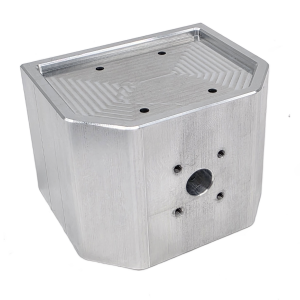
Two signals. One aperture. Zero interference between them. That is the fundamental promise of a waveguide orthomode transducer – and in satellite communications, radio astronomy, and radar front-ends operating above 18 GHz, keeping that promise is what separates a functional system from one that fails at the component level.
Most RF engineers working below X-band never encounter one. But at millimeter wave frequencies, where circular apertures are standard, simultaneous dual-polarisation operation is not a design luxury – it is an operational requirement. Understanding how an orthomode transducer achieves polarisation separation, what limits its performance, and where it fits in the signal chain is essential knowledge for anyone designing or specifying high-frequency waveguide systems.
This article covers the operating principle of the orthomode transducer, the primary waveguide junction architectures used in practice, the key performance parameters that matter in real system deployments, and the application domains where these devices are indispensable.
The Polarisation Problem: Why OMTs Exist
A circular waveguide or horn antenna supports two degenerate orthogonal modes – the TE11x and TE11y modes – which are physically identical except for their polarisation orientation, rotated 90 degrees relative to each other. In a well-designed circular aperture, these two modes propagate independently without coupling. This property is exploited in dual-polarisation systems to double the information capacity of a single aperture, transmit and receive simultaneously on one antenna, or to separate left-hand and right-hand circularly polarised signals after decomposition.
The engineering problem is separating the two polarisations into independent rectangular waveguide ports once they have been collected or before they are transmitted. That is exactly what a waveguide orthomode transducer does: it accepts a circular or square waveguide carrying both polarisations simultaneously and routes each to a separate rectangular waveguide output with high isolation between the two ports.
The performance of that separation – quantified as cross-polarisation isolation and return loss – determines the overall system’s polarisation purity, which directly affects link margin, channel interference, and in radar applications, the accuracy of polarimetric measurements.
Operating Principle: Symmetry, Mode Matching, and Junction Design
The Turnstile Junction
The earliest and still widely used orthomode transducer architecture is the turnstile junction, also called the star junction. In this design, four rectangular waveguide side-arms are arranged symmetrically around a circular waveguide at 90-degree intervals. The symmetry of the structure forces horizontal polarisation to couple only into the pair of waveguides oriented along the horizontal axis and vertical polarisation only into the orthogonally oriented pair.
The two outputs from each aligned pair are then combined in a 180-degree hybrid – typically a magic-T or waveguide rat-race – to produce a single output port for each polarisation. The hybrid junction provides the first stage of isolation enhancement beyond what the mechanical symmetry alone achieves, by combining the outputs in phase for the desired polarisation and out of phase for the cross-polarisation.
Turnstile junction performance depends critically on dimensional tolerances. At Ka-band (26.5 – 40 GHz) and above, machining errors of even 10 micrometres can measurably degrade isolation. High-performance OMTs at millimeter wave frequencies are typically CNC-machined from a single aluminium or brass block, avoiding the assembly misalignments that degrade symmetry in multi-piece designs.
The In-Line Junction Architecture
An alternative to the turnstile approach uses a sequential extraction architecture, where one polarisation is extracted through narrow side slots in the circular waveguide wall – slots oriented so they couple exclusively to the E-field of one TE11 mode orientation – while the orthogonal polarisation passes straight through and exits via the common port at the end of the waveguide.
This design separates the two polarisations sequentially rather than simultaneously, which simplifies the physical structure and reduces the requirement for matched hybrid junctions. In – line OMT designs tend to have better bandwidth characteristics and are easier to integrate into compact feed chains because the through port aligns naturally with the antenna feed axis. They are widely used in high – frequency waveguide assemblies from Ku-band through W-band where feed chain compactness is a priority.
Septum Polariser
For circular polarisation systems – where the input is left – hand or right-hand circular rather than linear – a septum polariser performs an analogous function. A metal septum of carefully profiled thickness is inserted into a square waveguide, converting circular polarisation into two linear outputs with 90 – degree phase offset. The septum polariser is functionally equivalent to an orthomode transducer in systems requiring circular polarisation separation and is commonly found in SATCOM feed assemblies operating from Ku-band through Ka-band.
Key Performance Parameters
When specifying or evaluating a waveguide orthomode transducer, the following parameters define system-level suitability:
- Cross-polarisation isolation: The ratio of signal power at the desired port to leakage at the cross-polarisation port. Values of 30 dB are typical for standard systems; high – performance radio telescope and polarimetric radar applications require 40 dB or better across the operating bandwidth.
- Return loss: Mismatch at the common port degrades both signal level and noise figure. Well-designed OMTs achieve return loss greater than 25 dB across the operating band.
- Insertion loss: Resistive losses in the waveguide walls, particularly at millimeter wave frequencies where skin depth is very small, contribute directly to system noise figure in receive chains. Precision-machined OMTs with plated internal surfaces minimise conductor loss and preserve signal chain integrity.
- Operating bandwidth: The frequency range over which all specifications – isolation, return loss, insertion loss – are simultaneously met. Turnstile-based designs typically achieve 20-25% fractional bandwidth; sequential extraction designs can reach 40% or more.
- Power handling: In transmit applications, the OMT must handle peak power without breakdown. At Ka-band and above, even moderate transmit powers require careful waveguide geometry design, particularly for satellite payload applications operating in near-vacuum environments.
Where Orthomode Transducers Are Used
Satellite Communications
SATCOM ground terminals and space-segment feeds routinely use orthomode transducers to separate transmit and receive polarisations on a single antenna aperture. Ku-band and Ka-band VSAT systems use OMTs in the feed chain immediately behind the horn antenna, directing the receive signal to a low-noise block downconverter while routing the transmit signal from the block upconverter to the same aperture.
In high-throughput satellite systems operating with frequency reuse across orthogonal polarisations, the cross-polarisation isolation of the OMT is a primary link-budget parameter. Insufficient isolation causes inter-polarisation interference that degrades channel capacity on both polarisations simultaneously.
Radio Astronomy and Deep Space
Radio telescope receivers require the highest-performance waveguide components available. The signal levels involved – fractions of a Kelvin above the cosmic microwave background – mean that even tenths of a dB in receiver noise temperature matter. Precision sub-THz components, including orthomode transducers, are used in wideband feeds covering frequencies from L-band through W-band and beyond, where minimising insertion loss and maintaining high cross-polarisation isolation across the full cryogenic operating temperature range are non-negotiable requirements.
Polarimetric Radar
Weather radar systems operating at C-band and X-band use simultaneous dual-polarisation transmission and reception to extract differential reflectivity, specific differential phase, and co-polar correlation coefficient – parameters that identify precipitation type, drop size distribution, and severe weather precursors. The orthomode transducer in a polarimetric radar feed must maintain its isolation specification across temperature and over the operational lifetime of the system, since any drift in cross-polarisation performance introduces systematic bias in the polarimetric variables.
mmWave Sensing and Instrumentation
At W-band (75-110 GHz) and beyond, orthomode transducers appear in millimeter wave imaging systems, atmospheric radiometers, and materials characterisation instruments. Precision sub-THz components operating in this range require the same disciplines that define high-performance waveguide manufacturing at lower frequencies: tight dimensional control, appropriate surface treatment, and rigorous RF verification across the full operating bandwidth.
Design Considerations at Millimeter Wave Frequencies
Scaling an orthomode transducer design from Ku-band to Ka-band or W-band is not simply a matter of dimensional reduction. Several physical effects become more significant at higher frequencies:
- Surface roughness: At W-band and above, the skin depth in conductor materials is sub-micrometre. Surface roughness on the order of the skin depth increases effective conductor loss significantly, requiring polished and plated internal surfaces for acceptable insertion loss performance.
- Tolerance sensitivity: Dimensional tolerances required for consistent performance scale with wavelength. A tolerance acceptable at Ka-band may be completely inadequate at W-band, often necessitating 100% RF testing and selective assembly.
- Thermal expansion: Satellite and airborne OMTs must maintain performance over wide temperature ranges. Differential thermal expansion between the OMT body and the waveguide flanges to which it connects can degrade return loss if not accounted for in the mechanical design.
- Mode purity: At higher frequencies, higher-order modes become propagating at lower relative waveguide dimensions. Junction geometries must be designed to suppress unwanted modes that would otherwise carry power between the polarisation ports and degrade isolation.
Conclusion
A waveguide orthomode transducer is a passive, reciprocal device that solves a problem with no clean solution at the circuit level: separating two orthogonally polarised signals that coexist in the same physical aperture without degrading either. Its operating principle relies on the spatial symmetry properties of waveguide junctions, and its performance is governed entirely by the precision of its mechanical realisation.
In satellite communications, radio astronomy, and polarimetric radar, the orthomode transducer sits at the interface between the antenna and the rest of the receive or transmit chain. Its isolation, insertion loss, and return loss performance directly determine what the rest of the system can achieve. For millimeter wave system designers, selecting or specifying an OMT is one of the first constraints that sets the performance floor for everything downstream.
As operating frequencies extend toward 100 GHz and beyond, the fabrication demands on orthomode transducers continue to increase. Meeting those demands requires a combination of tight mechanical tolerancing, appropriate surface treatment, and rigorous RF verification – the same disciplines that define precision millimeter wave component manufacturing across the full range of high-frequency waveguide products.