
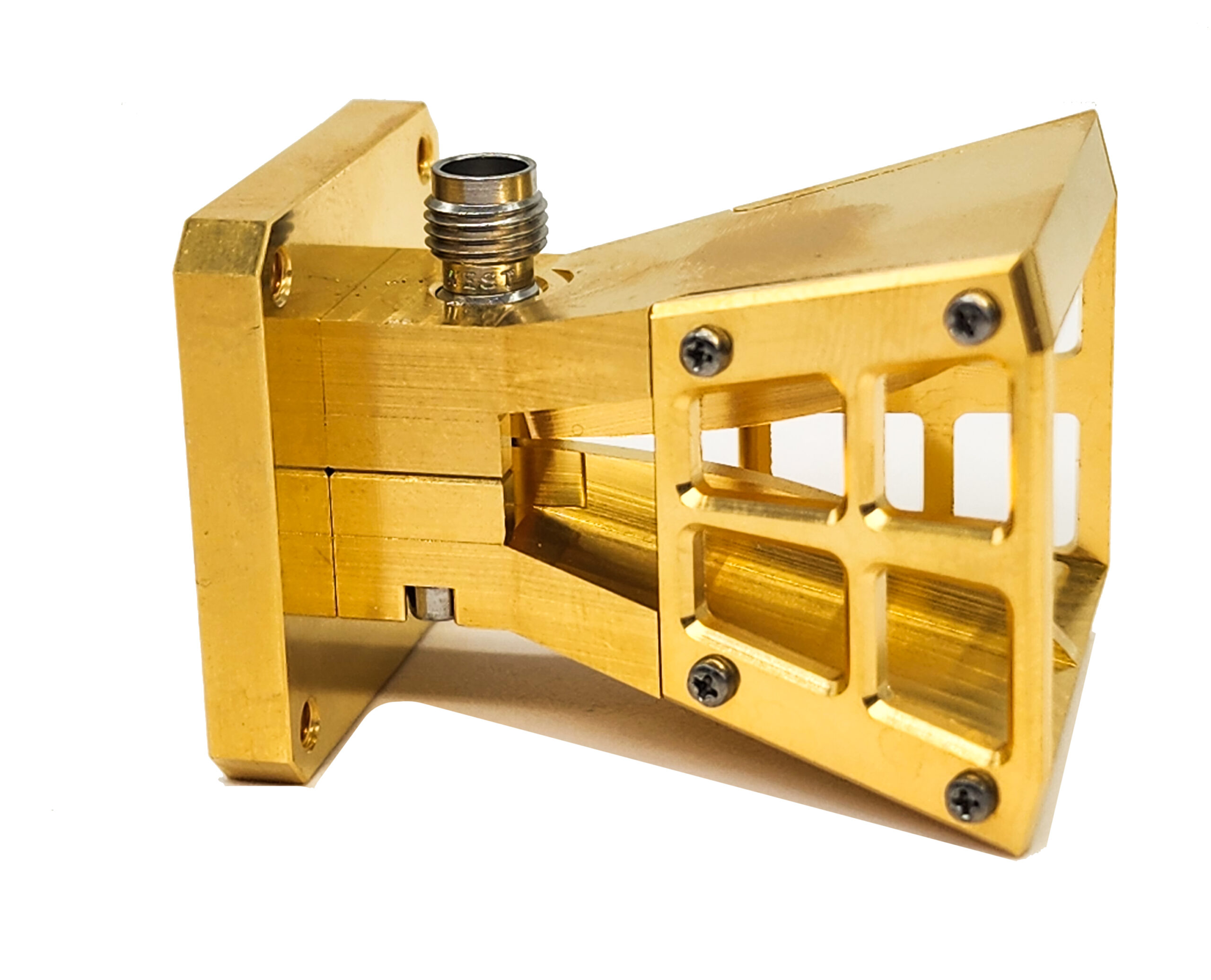
Mi-Wave’s Series 265 Dual Ridged Horn Antennas are precision-engineered, ultra-wideband antennas designed to support satellite communications (SatCom) systems that require broad frequency coverage, stable radiation characteristics, and repeatable electrical performance. Covering a continuous frequency range from 7 GHz to 70 GHz, these antennas are ideally suited for SatCom gateway testing, feeder link evaluation, antenna characterization, and system validation across multiple satellite bands.
The Series 265 dual ridged horn design incorporates internal metallic ridges that significantly extend bandwidth beyond conventional horn antennas by lowering the effective cutoff frequency. This architecture enables a single antenna to support multiple satellite frequency bands without gaps, reducing system complexity and minimizing the need for multiple band-specific antennas.
Series 265 dual ridged horn antennas are widely used in SatCom ground stations, integration labs, test ranges, and research facilities, where broadband coverage and predictable performance are essential for accurate measurement and validation.
Our dual-ridged horns support the critical SatCom bands used in modern systems, including 37.5–39.5 GHz, 39.5–42.5 GHz, 37.5–42.0 GHz, 47.2–50.2 GHz, and 50.4–51.4 GHz. This allows engineers to perform complete uplink/downlink link analysis, antenna evaluation, and system characterization across the same spectrum used in next-generation satellite networks.
Note: The dual ridged horn antennas shown on this website represent only a portion of Mi-Wave’s manufacturing capabilities. Mi-Wave designs and builds additional dual ridged horn antenna configurations beyond those listed, including custom frequency segmentation, connector types, polarization options, and mechanical designs. Consult with Mi-Wave to discuss your specific SatCom requirements.
*All data presented is collected from a sample lot.
* Actual data may vary unit to unit, slightly.
*All testing was performed under +25 °C case temperature.
*Consult factory to confirm if material, plating, size, shape, orientation and any electrical parameter is critical for the application as website information is for reference only.
*Millimeter Wave Products, Inc. reserves the right to change the information presented on website without notice as we continue to enhance the performance and design of our products.
Why Choose Mi-Wave for SatCom
Mi-Wave is a trusted manufacturer of RF, microwave, and millimeter-wave antennas and components, supporting satellite communication systems worldwide. Our Series 265 dual ridged horn antennas are engineered to deliver wideband performance, stable radiation patterns, and long-term reliability in demanding SatCom environments.
High-Frequency SatCom Engineering Expertise
With decades of experience in broadband RF and microwave design, Mi-Wave develops dual ridged horn antennas optimized for low VSWR, extended bandwidth, and controlled beam behavior across multiple satellite communication bands.
Precision Manufacturing and Quality Control
Each Series 265 antenna is manufactured using precision machining and controlled assembly processes to ensure repeatable electrical performance, mechanical stability, and long-term reliability in continuous-duty SatCom test and validation environments.
Broad SatCom Frequency Support
Mi-Wave supports dual ridged horn antennas across a wide range of satellite communication frequency bands, enabling use in gateway testing, feeder link verification, uplink and downlink evaluation, and broadband SatCom system validation.
Custom SatCom Antenna Solutions
In addition to standard offerings, Mi-Wave provides custom dual ridged horn antenna designs tailored to specific SatCom frequency plans, bandwidth requirements, polarization schemes, connector interfaces, and mechanical constraints. Our sales engineering team works closely with customers to ensure seamless system integration.
What Dual Ridged Horn Antennas Do in SatCom Systems
Dual ridged horn antennas are ultra-wideband directional antennas designed to transmit and receive RF energy across a very broad frequency range while maintaining stable impedance matching and predictable radiation characteristics. In SatCom systems, they are commonly used as broadband test antennas for evaluating system performance across multiple satellite bands.
Unlike narrowband horns, dual ridged horn antennas enable:
-
Multi-band SatCom testing with a single antenna
-
Continuous frequency sweeps across satellite bands
-
Simplified test setups and reduced hardware changes
-
Consistent measurement results across frequency
How Dual Ridged Horn Antennas Work
In SatCom applications, RF energy is fed into the antenna through a coaxial or waveguide transition connected to the SatCom RF chain. The dual ridges inside the horn modify the electromagnetic field distribution, lowering the cutoff frequency and enabling broadband operation.
As the signal propagates through the horn flare, the electromagnetic fields are smoothly transformed into free-space radiation, producing:
-
Broadband impedance matching
-
Low VSWR across wide frequency ranges
-
Stable beam shape and gain
-
Reduced reflections and signal distortion
This makes Series 265 antennas ideal for frequency-agile SatCom testing and validation.
SatCom Frequency Coverage and Interfaces
Mi-Wave Series 265 dual ridged horn antennas provide continuous coverage from 7 GHz to 70 GHz, spanning multiple satellite communication bands within a single antenna platform.
This range supports testing and validation across:
-
X-Band SatCom
-
Ku-Band SatCom
-
Ka-Band SatCom
-
Lower Q-Band allocations
-
Extended millimeter-wave research bands
Depending on frequency range and configuration, Series 265 antennas can be supplied with appropriate coaxial or waveguide interfaces, ensuring seamless integration into SatCom RF chains, including upconverters, downconverters, HPAs, LNAs, and test instrumentation.
Why Dual Ridged Horns Matter in SatCom
Modern SatCom systems increasingly rely on multi-band operation, frequency agility, and wideband validation. Dual ridged horn antennas play a critical role by enabling:
-
Broadband gateway and feeder link testing
-
Rapid frequency sweeps across multiple satellite bands
-
Reduced antenna swaps during test and integration
-
Consistent and repeatable measurement results
-
Efficient SatCom system development and troubleshooting
These advantages make dual ridged horn antennas essential tools in SatCom ground stations, integration labs, and system validation environments.
Features
-
Ultra-wideband frequency coverage from 7–70 GHz
Supports multi-band SatCom testing with a single antenna. -
Dual ridged horn architecture
Extends bandwidth well beyond conventional horn antennas. -
Low VSWR across the operating band
Ensures efficient power transfer and accurate SatCom measurements. -
Stable radiation patterns over wide bandwidths
Maintains predictable performance across satellite frequency bands. -
Controlled beamwidth and sidelobe behavior
Supports consistent measurements and system validation. -
Smooth, consistent gain response
Ideal for broadband and frequency-agile SatCom testing. -
Linear polarization performance
Suitable for most SatCom validation and measurement scenarios. -
High power handling capability
Supports uplink and transmit-chain validation. -
Precision mechanical construction
Ensures repeatable performance and long-term reliability. -
Laboratory and field-ready design
Suitable for SatCom integration labs and test ranges. -
Custom SatCom configurations available
SatCom Applications
-
Satellite gateway and ground station testing
-
Feeder link and backhaul validation
-
Multi-band SatCom system characterization
-
Uplink and downlink performance evaluation
-
SatCom test, measurement, and commissioning
-
Antenna pattern and polarization measurements
-
Broadband RF chain validation
-
Research and development for next-generation SatCom systems
-
Production testing and quality assurance