
Products> Antenna Products > Dual Ridged Horn Antennas
Mi-Wave’s Series 265 Dual Ridged Horn Antennas are precision-engineered, ultra-wideband antennas designed to deliver continuous frequency coverage, stable radiation patterns, and reliable electrical performance across a wide operating range from 7 GHz to 70 GHz. These antennas are widely used in applications that require broadband operation, predictable gain, and consistent beam characteristics across multiple RF and microwave bands.
The dual ridged horn design incorporates internal metallic ridges within the horn structure to lower the cutoff frequency and significantly extend the operational bandwidth compared to conventional horn antennas. This enables a single Series 265 antenna to cover multiple frequency bands without gaps, reducing system complexity and eliminating the need for multiple narrowband antennas.
Series 265 dual ridged horn antennas are well suited for EMC and EMI testing, antenna characterization, RF measurement, communications, radar systems, and research environments, where wideband performance and repeatability are essential.
Note: The dual ridged horn antennas shown on this website represent only a portion of Mi-Wave’s manufacturing capabilities. Mi-Wave designs and builds a wide range of additional dual ridged horn antenna configurations beyond those listed, including custom frequency ranges, connector interfaces, polarization options, and mechanical designs. Consult with Mi-Wave to discuss your specific application requirement
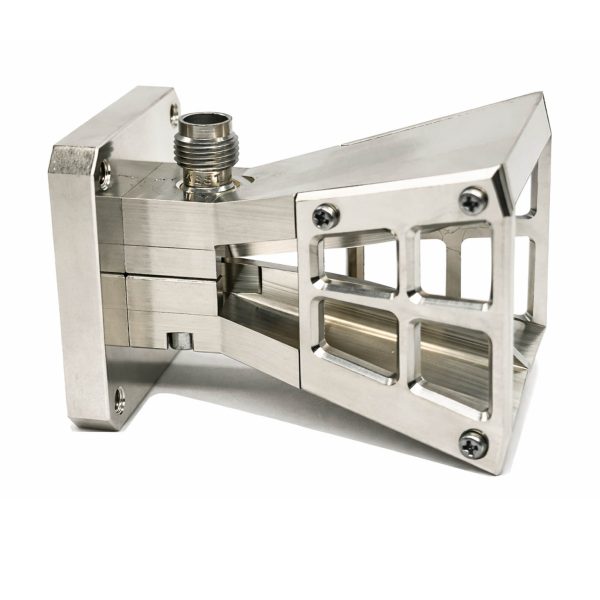
*Actual product may be different from the image shown per customers specifcations
*All data presented is collected from a sample lot.
* Actual data may vary unit to unit, slightly.
*All testing was performed under +25 °C case temperature.
*Consult factory to confirm if material, plating, size, shape, orientation and any electrical parameter is critical for the application as website information is for reference only.
*Millimeter Wave Products, Inc. reserves the right to change the information presented on website without notice as we continue to enhance the performance and design of our products.
Key Features & Performance Benefits
Ultra-Wideband Frequency Coverage (7–70 GHz)
Supports continuous operation across a broad frequency range, eliminating gaps between bands and reducing the need for multiple antennas in multi-band systems.
Dual Ridged Waveguide Design for Extended Bandwidth
Internal metallic ridges lower the cutoff frequency and expand operational bandwidth, enabling true wideband performance compared to standard horn antennas.
Stable Radiation Patterns Across Frequency
Maintains consistent beam shape and predictable radiation characteristics throughout the operating band, supporting reliable system performance.
Consistent Gain Performance
Designed to provide smooth gain response across wide frequency ranges, ensuring repeatable measurements and stable communication links.
Low VSWR and Broadband Impedance Matching
Offers excellent impedance matching across the entire frequency range, minimizing reflections and maximizing power transfer efficiency.
Single Antenna for Multi-Band Operation
Replaces multiple narrowband antennas with a single wideband solution, simplifying system design and reducing size, weight, and cost.
Controlled Directivity
Provides directional performance with stable beam characteristics, supporting accurate signal transmission and reception.
High Measurement Repeatability
Delivers consistent electrical performance, making these antennas ideal for calibration, testing, and validation environments.
Suitable for EMC and EMI Testing
Wideband operation makes these antennas ideal for radiated emissions and susceptibility testing, covering multiple compliance bands with a single antenna.
Robust Mechanical Construction
Precision-machined for durability and consistent performance across environmental conditions and high-frequency operation.
Flexible Integration Options
Available with various connector interfaces and mechanical configurations to support diverse RF system requirements.
Custom Engineering Available
Supports custom designs including extended frequency ranges, specialized connectors, polarization options, and application-specific mechanical adaptations.
Dual Ridged Horn Antenna Engineering Calculators
These RF engineering calculators help estimate antenna performance for dual ridged horn antennas, including EMC and EMI testing systems, antenna characterization setups, radar platforms, communications systems, and RF laboratory environments. Use them to calculate antenna gain, beamwidth, aperture size required for target gain, effective aperture, free-space path loss, and wavelength across broadband RF and microwave frequencies.
Dual ridged horn antennas are designed for ultra-wideband coverage, stable radiation patterns, low VSWR, and repeatable multi-band performance. A typical starting efficiency range for many systems is 0.50 to 0.75.
Antenna Gain Calculator
Antenna Gain (dBi):
Antenna Beamwidth Calculator
Aperture Size Required for Target Gain
Antenna Effective Aperture Calculator
Effective Aperture (m²):
Free Space Path Loss Calculator
RF Wavelength Calculator
Wavelength (mm):
Applications
Dual Ridged Horn Antenna Applications
Mi-Wave Dual Ridged Horn Antennas are widely used in RF, microwave, and broadband systems that require continuous frequency coverage, stable radiation patterns, and repeatable performance across multiple bands.
EMC and EMI Testing
Dual ridged horn antennas are commonly used in electromagnetic compatibility (EMC) and electromagnetic interference (EMI) environments due to their ultra-wideband performance.
Typical applications include:
- Radiated emissions testing
- RF susceptibility and immunity testing
- EMC compliance verification
- Broadband interference analysis
- Test chamber illumination
Their wide frequency coverage allows a single antenna to replace multiple narrowband antennas, simplifying EMC test setups.
Antenna Measurement and Characterization
These antennas are widely used in antenna testing environments where broadband performance and repeatability are critical.
Typical applications include:
- Antenna gain and pattern measurements
- Broadband antenna characterization
- Near-field and far-field testing
- Calibration and reference measurements
- Radiation pattern validation
RF Test & Measurement Systems
Used in laboratory and production environments for wideband RF system evaluation.
Typical applications include:
- RF subsystem testing
- Signal propagation experiments
- Measurement system calibration
- Component validation across multiple bands
Communications Systems
Dual ridged horn antennas support communication systems requiring multi-band or wideband operation.
Typical applications include:
- Broadband communication links
- Multi-band wireless systems
- Experimental communication platforms
- Signal transmission and reception testing
Radar Systems
Used in radar applications where wide frequency coverage and stable beam characteristics are required.
Common applications include:
- Radar calibration and verification
- FMCW and pulse radar testing
- Multi-band radar systems
- Experimental radar research
Research and Development (R&D)
Widely used in advanced RF and microwave research environments.
Typical applications include:
- Academic research programs
- Government and defense research
- Prototype system validation
- Broadband antenna development
- Electromagnetic studies
Millimeter-Wave Systems
Supports applications operating at higher frequencies requiring consistent broadband performance.
Typical applications include:
- mmWave system testing
- High-frequency sensing
- Advanced wireless research
- Experimental RF platforms
Frequently Asked Questions (FAQ)
What are dual ridged horn antennas used for?
Dual ridged horn antennas are used in RF, microwave, and broadband systems that require ultra-wide frequency coverage, stable radiation patterns, and repeatable performance. Common applications include EMC testing, antenna measurement, radar systems, and RF laboratory research.
What makes a dual ridged horn antenna different from a standard horn antenna?
Dual ridged horn antennas incorporate internal ridges within the waveguide structure, which lower the cutoff frequency and significantly expand bandwidth. This allows a single antenna to operate across multiple frequency bands, unlike standard horns which are typically narrowband.
What frequency range do Mi-Wave dual ridged horn antennas support?
Mi-Wave Series 265 dual ridged horn antennas operate from 7 GHz to 70 GHz, providing continuous coverage across multiple RF and microwave bands.
Why are dual ridged horn antennas ideal for EMC and EMI testing?
Their wideband performance allows them to cover multiple compliance frequency ranges with a single antenna, reducing test complexity and improving efficiency in EMC and EMI measurement environments.
Do dual ridged horn antennas provide consistent gain across frequency?
Yes. These antennas are designed to maintain smooth gain response and stable radiation characteristics across their operating bandwidth, ensuring reliable measurement and system performance.
Are dual ridged horn antennas suitable for antenna measurement and calibration?
Yes. Their repeatable performance, stable beam patterns, and broadband operation make them ideal for antenna characterization, calibration, and RF measurement systems.
What type of polarization do dual ridged horn antennas support?
Dual ridged horn antennas typically support linear polarization, with consistent polarization characteristics maintained across the frequency range.
Can dual ridged horn antennas replace multiple narrowband antennas?
Yes. Their ultra-wideband design allows a single antenna to replace several narrowband antennas, reducing system size, cost, and complexity.
Are these antennas directional?
Yes. Dual ridged horn antennas provide controlled directivity with stable beam patterns, making them suitable for both transmission and reception applications.
Can Mi-Wave dual ridged horn antennas be customized?
Yes. Custom configurations are available to support specific frequency ranges, connector interfaces, polarization requirements, and mechanical designs.
What industries commonly use dual ridged horn antennas?
These antennas are widely used in aerospace, defense, telecommunications, research institutions, and EMC testing facilities.
What are dual ridged horn antennas used for?
Dual ridged horn antennas are used in RF, microwave, and broadband systems that require ultra-wide frequency coverage, stable radiation patterns, and repeatable performance. Common applications include EMC testing, antenna measurement, radar systems, and RF laboratory research.
What makes a dual ridged horn antenna different from a standard horn antenna?
Dual ridged horn antennas incorporate internal ridges within the waveguide structure, which lower the cutoff frequency and significantly expand bandwidth. This allows a single antenna to operate across multiple frequency bands, unlike standard horns which are typically narrowband.
What frequency range do Mi-Wave dual ridged horn antennas support?
Mi-Wave Series 265 dual ridged horn antennas operate from 7 GHz to 70 GHz, providing continuous coverage across multiple RF and microwave bands.
Why are dual ridged horn antennas ideal for EMC and EMI testing?
Their wideband performance allows them to cover multiple compliance frequency ranges with a single antenna, reducing test complexity and improving efficiency in EMC and EMI measurement environments.
Do dual ridged horn antennas provide consistent gain across frequency?
Yes. These antennas are designed to maintain smooth gain response and stable radiation characteristics across their operating bandwidth, ensuring reliable measurement and system performance.
Are dual ridged horn antennas suitable for antenna measurement and calibration?
Yes. Their repeatable performance, stable beam patterns, and broadband operation make them ideal for antenna characterization, calibration, and RF measurement systems.
What type of polarization do dual ridged horn antennas support?
Dual ridged horn antennas typically support linear polarization, with consistent polarization characteristics maintained across the frequency range.
Can dual ridged horn antennas replace multiple narrowband antennas?
Yes. Their ultra-wideband design allows a single antenna to replace several narrowband antennas, reducing system size, cost, and complexity.
Are these antennas directional?
Yes. Dual ridged horn antennas provide controlled directivity with stable beam patterns, making them suitable for both transmission and reception applications.
Can Mi-Wave dual ridged horn antennas be customized?
Yes. Custom configurations are available to support specific frequency ranges, connector interfaces, polarization requirements, and mechanical designs.
What industries commonly use dual ridged horn antennas?
These antennas are widely used in aerospace, defense, telecommunications, research institutions, and EMC testing facilities.
Glossary of Dual Ridged Horn Antenna Terms
This glossary defines key terms related to dual ridged horn antennas, which are widely used in RF, microwave, and broadband systems requiring ultra-wideband performance, stable radiation patterns, and consistent multi-band operation.
Antenna Fundamentals
Dual Ridged Horn Antenna
A wideband horn antenna that uses internal metallic ridges to extend bandwidth and lower the cutoff frequency, enabling operation across multiple RF and microwave bands.
Horn Antenna
A flared waveguide structure designed to efficiently radiate electromagnetic energy into free space.
Radiation Pattern
A graphical representation of how RF energy is distributed in space by an antenna.
Main Lobe
The primary direction in which the antenna radiates the strongest signal.
Sidelobes
Secondary radiation patterns outside the main lobe, typically lower in amplitude.
Back Lobe
Radiation emitted in the opposite direction of the main beam.
Electrical Performance Terms
Gain (dBi)
A measure of how effectively an antenna focuses energy in a specific direction compared to an isotropic radiator.
Directivity
The degree to which an antenna concentrates RF energy in a particular direction.
VSWR (Voltage Standing Wave Ratio)
A metric indicating how well the antenna is impedance matched to the transmission line.
Return Loss (dB)
The amount of reflected signal due to impedance mismatch at the antenna interface.
Insertion Loss
The amount of signal power lost when passing through the antenna system.
Bandwidth
The frequency range over which the antenna maintains acceptable performance.
Ultra-Wideband (UWB)
A very wide frequency range that spans multiple RF and microwave bands.
Impedance Matching
The process of ensuring maximum power transfer between components by minimizing reflections.
RF and Frequency Terms
Radio Frequency (RF)
Electromagnetic signals typically ranging from kHz to hundreds of GHz used for communication and sensing.
Microwave Frequencies
Frequencies typically ranging from 1 GHz to 30 GHz.
Millimeter-Wave (mmWave)
Frequencies from approximately 30 GHz to 300 GHz, characterized by short wavelengths.
Frequency Range
The operational span of frequencies supported by the antenna.
Wavelength (λ)
The physical distance between repeating cycles of an electromagnetic wave.
Waveguide and Structural Design
Waveguide
A structure that directs RF energy from one point to another with minimal loss.
Ridge Waveguide
A waveguide that includes internal ridges to extend bandwidth and improve impedance characteristics.
Cutoff Frequency
The lowest frequency at which a waveguide mode can propagate.
Flange Interface
A mechanical and electrical connection standard used to join waveguide components.
Aperture
The opening of the antenna from which RF energy is radiated.
Performance and Design Characteristics
Broadband Performance
The ability of an antenna to operate effectively across a wide frequency range.
Gain Stability
The consistency of antenna gain across its operating frequency band.
Radiation Efficiency (η)
The ratio of radiated power to input power, accounting for losses.
Field Distribution
The spatial distribution of electromagnetic energy across the antenna aperture.
Polarization
The orientation of the electric field of the radiated wave, typically linear in dual ridged horn antennas.
Beamwidth
The angular width of the main lobe, usually measured at the half-power (-3 dB) points.
Measurement and Testing Applications
EMC (Electromagnetic Compatibility)
The ability of electronic systems to operate without causing or experiencing interference.
EMI (Electromagnetic Interference)
Unwanted electromagnetic emissions that disrupt system performance.
Radiated Emissions Testing
Measurement of electromagnetic energy emitted from a device.
RF Immunity Testing
Assessment of a device’s resistance to external RF interference.
Antenna Measurement Range
A controlled environment used to evaluate antenna performance such as gain and radiation pattern.
Calibration
The process of verifying and adjusting measurement systems to ensure accuracy.
System and Application Context
Multi-Band Operation
The ability of a system or antenna to operate across multiple frequency bands.
Broadband Communication Systems
Systems designed to transmit and receive signals over a wide frequency spectrum.
Radar Systems
Systems that use RF signals to detect, track, and identify objects.
Test and Measurement Systems
Equipment used to evaluate RF components, antennas, and communication systems.
Research and Development (R&D)
Experimental and engineering activities focused on developing new RF technologies.
Practical Engineering Concepts
Dynamic Range
The range between the smallest and largest signals an RF system can process.
Signal Integrity
The preservation of signal quality throughout a system.
Spurious Signals
Unwanted frequencies generated within RF systems.
System Integration
The process of combining RF components into a complete operational system.
Double Ridged Horn Antenna — Industry Synonym & Use Cases
The dual ridged horn antenna is also widely referred to as the double ridged horn antenna across EMC and antenna measurement literature. Both terms describe the same wideband antenna design featuring two ridged internal structures that extend the operating bandwidth well below that of a standard horn. Mi-Wave’s Series 265 double ridged horn antenna covers 7–70 GHz in a single unit, eliminating the need for multiple antennas in broadband test setups. Typical use cases include radiated emissions testing, antenna calibration, gain measurement, RCS characterization, and radar cross-section studies.
Why Choose Mi-Wave
Mi-Wave is a trusted manufacturer of RF, microwave, and millimeter-wave antennas and components, supporting commercial, government, and research systems worldwide. Our Series 265 dual ridged horn antennas are engineered to deliver wideband performance, stable radiation patterns, and reliable electrical characteristics in demanding high-frequency environments.
High-Frequency Engineering Expertise
With decades of experience in broadband RF and microwave design, Mi-Wave develops dual ridged horn antennas optimized for low VSWR, extended bandwidth, and controlled beam behavior across multiple frequency bands.
Precision Manufacturing and Quality Control
Each Series 265 antenna is manufactured using precision machining and controlled assembly processes to ensure repeatable electrical performance, mechanical stability, and long-term reliability in both laboratory and field environments.
Broad Frequency and Application Support
Mi-Wave supports dual ridged horn antennas across a wide range of RF and microwave frequencies, making them suitable for EMC testing, communications, radar, telemetry, and measurement environments.
Custom Antenna Solutions
In addition to standard offerings, Mi-Wave provides custom dual ridged horn antenna designs tailored to specific frequency ranges, bandwidth requirements, polarization options, connector types, and mechanical constraints. Our sales engineering team works closely with customers to ensure seamless system integration.
How Dual Ridged Horn Antennas Work
RF energy is fed into the antenna through a coaxial or waveguide transition and propagates into the horn structure. The dual ridges inside the horn alter the electromagnetic field distribution, lowering the cutoff frequency and enabling wideband operation.
As the signal travels through the horn flare, the electromagnetic fields are smoothly transformed into free-space radiation, producing:
-
Broadband impedance matching
-
Controlled beam shape
-
Reduced reflections and signal distortion
-
Stable radiation patterns across the operating band
Frequency Coverage and Interfaces
Mi-Wave Series 265 dual ridged horn antennas provide continuous coverage from 7 GHz to 70 GHz, spanning multiple RF and microwave bands within a single antenna.
Typical configurations support:
-
Ultra-wideband RF and microwave operation
-
Coaxial or waveguide transitions, depending on frequency range
-
Linear polarization, with custom options available
Custom frequency segmentation, interfaces, and mounting options are available upon request.
Features
-
Ultra-wideband frequency coverage from 7 GHz to 70 GHz
Supports continuous operation across multiple RF and microwave bands with a single antenna, eliminating the need for band-specific horn changes. -
Dual ridged horn architecture
Internal ridges lower the waveguide cutoff frequency and extend usable bandwidth far beyond conventional horn antennas while maintaining controlled radiation behavior. -
Low VSWR across the operating band
Provides efficient power transfer, reduced reflections, and improved measurement accuracy across wide frequency ranges. -
Stable radiation patterns over wide bandwidths
Maintains predictable beam shape and consistent performance as frequency changes, critical for broadband testing and characterization. -
Controlled beamwidth and sidelobe performance
Optimized horn geometry ensures usable directivity and reduced pattern distortion across the full frequency span. -
Consistent gain characteristics
Delivers smooth gain response across frequency, supporting frequency-agile measurements and broadband system validation. -
Linear polarization performance
Provides stable polarization behavior suitable for measurement, communication, and EMC testing applications. -
High power handling capability
Suitable for both transmit and receive applications, including demanding test and validation environments. -
Precision mechanical construction
Manufactured with tight tolerances to ensure repeatable electrical performance, mechanical stability, and long-term reliability. -
Multiple interface and mounting options
Available with appropriate coaxial or waveguide transitions and mounting configurations to support laboratory and field deployments. -
Custom configurations available
Optional customization for frequency segmentation, connectors, polarization, mechanical form factor, and environmental requirements.
Applications
-
EMC and EMI Testing
Widely used in electromagnetic compatibility and interference testing where ultra-wideband coverage and predictable radiation patterns are required to meet regulatory standards. -
RF, Microwave, and Millimeter-Wave Measurements
Supports broadband signal measurement, frequency sweeps, and system evaluation across multiple bands using a single antenna. -
Antenna Characterization and Pattern Measurement
Used for gain, beamwidth, sidelobe, and polarization measurements in antenna test ranges and validation setups. -
Broadband Communication Systems
Suitable for wideband RF and microwave communication links requiring stable performance across large frequency spans. -
Radar and Telemetry Systems
Supports radar and telemetry applications where frequency agility and broadband antenna coverage are needed. -
System Calibration and Validation
Used to verify and calibrate RF systems, signal chains, and test equipment across wide frequency ranges. -
Research and Development Platforms
Ideal for R&D environments exploring new RF, microwave, and millimeter-wave technologies where flexible, broadband antennas are essential. -
Production Testing and Quality Assurance
Enables efficient broadband testing in manufacturing and QA environments, reducing test time and equipment complexity. -
Educational and Experimental RF Labs
Commonly used in academic and experimental settings for broadband RF experimentation and instruction.