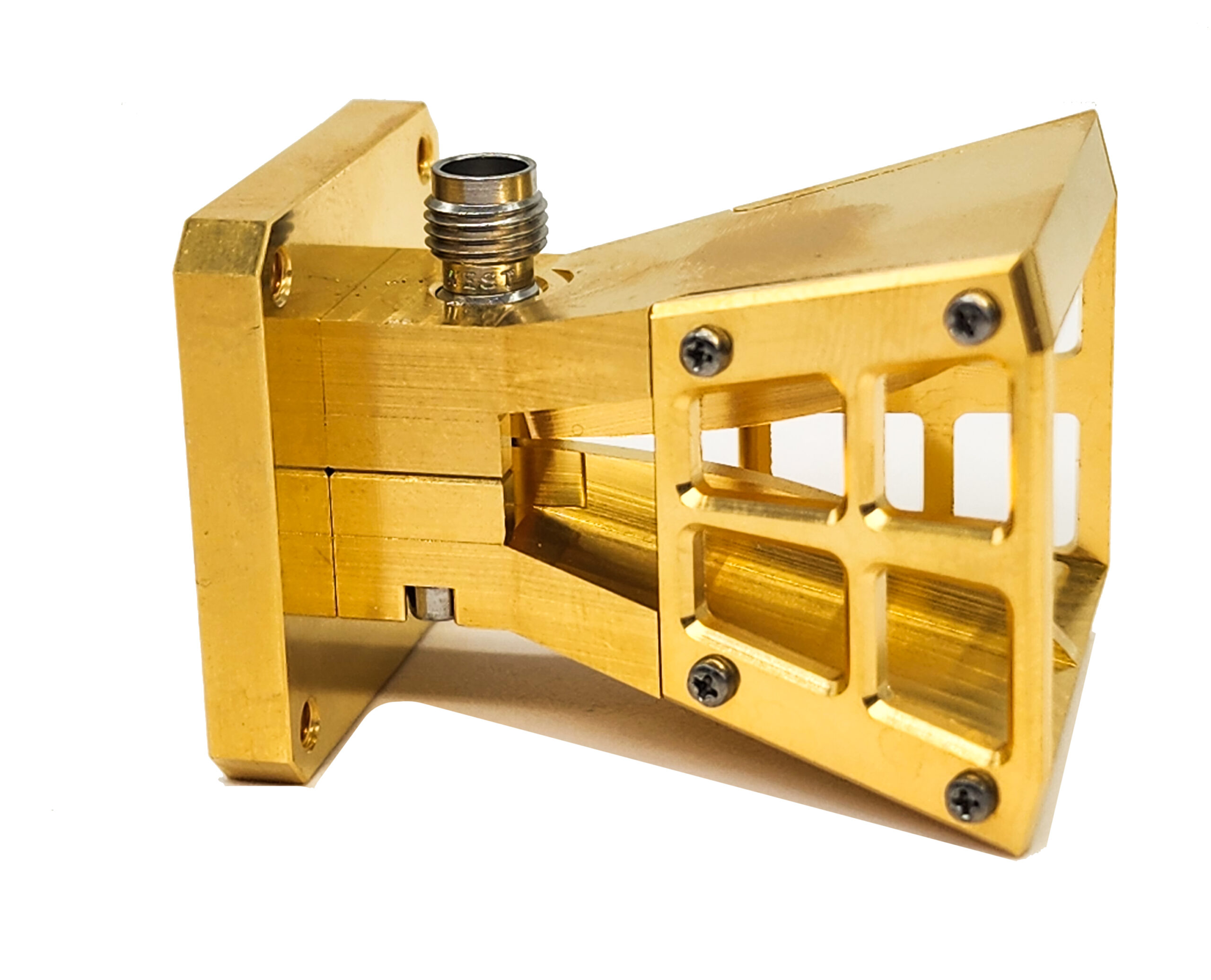
Mi-Wave provides dual-ridged horn antennas designed specifically for Satellite Communication (SatCom) testing, calibration, and system evaluation across a broad 7–70 GHz operating range. These wideband antennas deliver consistent gain, stable radiation patterns, and repeatable measurement performance, making them essential tools for gateway testing, terminal development, feeder link verification, and Ka-, Q-, and V-Band SatCom research.
Our dual-ridged horns support the critical SatCom bands used in modern systems, including 37.5–39.5 GHz, 39.5–42.5 GHz, 37.5–42.0 GHz, 47.2–50.2 GHz, and 50.4–51.4 GHz. This allows engineers to perform complete uplink/downlink link analysis, antenna evaluation, and system characterization across the same spectrum used in next-generation satellite networks.
Features
- Wideband frequency operation for multi-band SatCom testing
-
Smooth and stable radiation pattern across all bands
-
Repeatable, predictable gain values
-
Ideal reference antenna for calibration and chamber measurements
-
Rugged mechanical construction for lab or field use
-
Low reflections and efficient broadband performance
Mi-Wave dual-ridged horn antennas are widely used in:
-
Satellite gateway and teleport testing
-
LEO/MEO terminal development
-
Q/V-Band feeder link evaluation
-
High-throughput satellite (HTS) link analysis
-
Modem, antenna, and RF front-end testing
-
Chamber-based radiation pattern measurement
-
mmWave SatCom and aerospace research
The 7–70 GHz span enables comprehensive testing across:
-
Ka-Band (26–40 GHz)
-
Q-Band (37–50 GHz) → includes 37.5–39.5 & 39.5–42.5 GHz
-
V-Band (47–52 GHz) → includes 47.2–50.2 & 50.4–51.4 GHz
This aligns directly with the bands used in next-gen SatCom gateways, feeder links, HTS systems, and advanced mmWave communication platforms.
If you’re developing or testing Ka-, Q-, or V-Band satellite systems, Mi-Wave’s dual-ridged horn antennas deliver the performance and precision required for modern SatCom testing and link verification.