
Products> Amplifiers > 5G Amplifiers
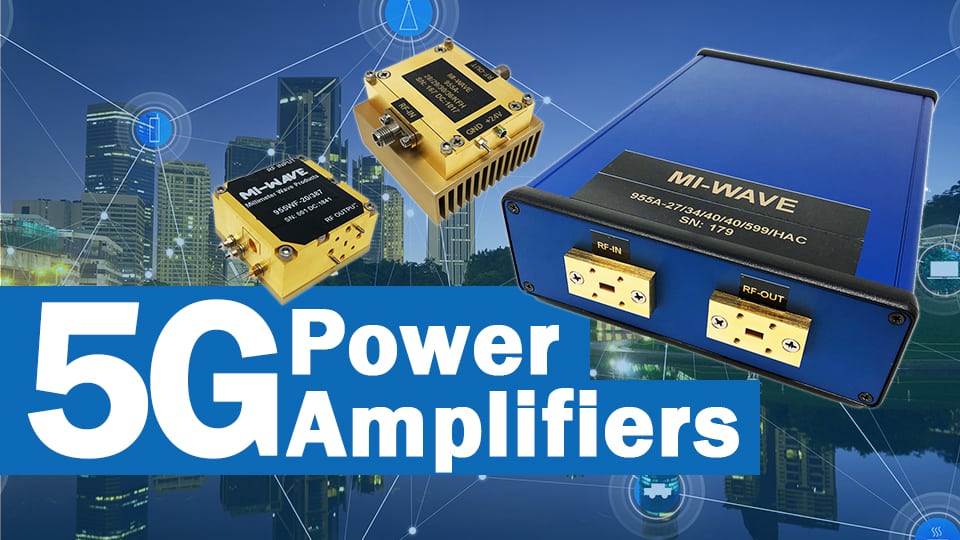
Mi-Wave 5G Power and Low Noise Amplifiers
Mi-Wave 5G Power Amplifiers & Low Noise Amplifiers
Mi-Wave’s 955 Series 5G Power Amplifiers and Low Noise Amplifiers (LNAs) are engineered to meet the demanding performance requirements of modern 5G and millimeter-wave (mmWave) wireless systems, delivering high gain, excellent linearity, low noise, and stable operation across a wide range of microwave and millimeter-wave frequencies.
Designed to support FR2 and extended mmWave bands, these RF amplifiers are well suited for both transmit and receive chains in advanced 5G architectures. Applications include 5G base stations and small cells, wireless backhaul links, beamforming and phased-array systems, customer premise equipment (CPE), and advanced RF test platforms. The 955 Series offers a broad selection of frequency ranges, bandwidth options, gain levels, noise figures, and output power configurations to support diverse deployment scenarios.
5G RF Power Amplifiers
Mi-Wave 5G RF power amplifiers are optimized to handle wideband, high-order modulated signals, maintaining the spectral purity and linearity required for modern 5G waveforms. These amplifiers provide stable output power and controlled compression behavior to support efficient transmission while meeting EVM, ACLR, and spectral mask requirements. Robust biasing and thermal design practices ensure reliable operation in laboratory, field, and outdoor environments.
5G Low Noise Amplifiers (LNAs)
Mi-Wave 5G LNAs are designed to enhance receiver sensitivity by amplifying weak mmWave signals with minimal added noise. Featuring low noise figure, high gain, and strong stability, these LNAs are ideal for front-end receiver stages, beamforming arrays, and mmWave access systems where signal integrity is critical. Careful RF design minimizes distortion and supports consistent performance across temperature and operating conditions.
Scalable Designs for Development and Production
In addition to high-performance solutions for R&D and system validation, Mi-Wave offers cost-effective, production-ready amplifier designs tailored for high-volume 5G deployments. These solutions balance performance, reliability, and manufacturability, making them suitable for commercial communications infrastructure while still meeting the stringent requirements of advanced RF and mmWave systems.
Mi-Wave continues to develop and manufacture a wide range of 5G RF and mmWave power amplifiers and LNAs, supporting the evolving needs of the 5G ecosystem from early-stage development and prototyping through full-scale production and deployment.
| Model | Band | Frequency Range | Gain | Psat | Input / Output Port | DC Bias | LINK |
|---|---|---|---|---|---|---|---|
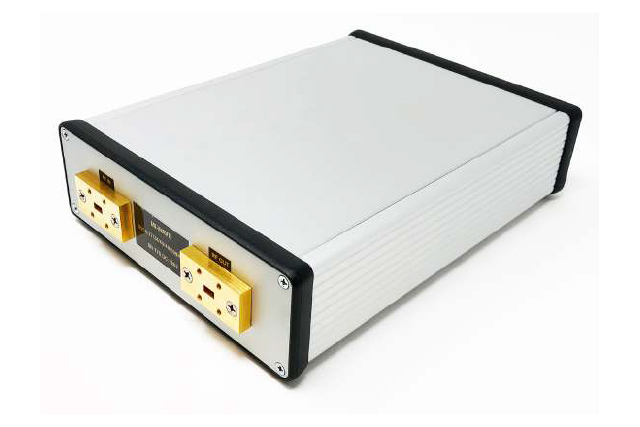
| 955A 27-33GHz | Ka-Band (5G) | 27–34 GHz | 40 dB | +41.5 dBm | WR-28 Waveguide, UG-599/U Flange | ||
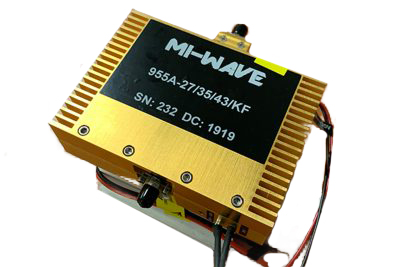
| 955A-27/35/43/KF | Ka-Band (5G) | 26–28 GHz | 42 dB | +43 dBm | 2.92 mm Female (K) | +21–24 V | |
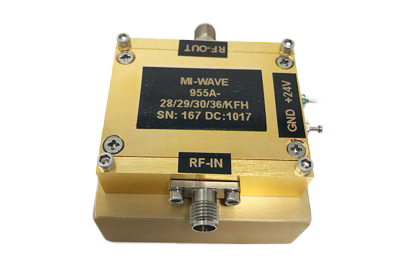
| 955A-28/29/30/36/KFH | Ka-Band (5G) | 28–29 GHz | 40 dB | +36 dBm | 2.92 mm Female (K), H-Plane | +20–24 V | |
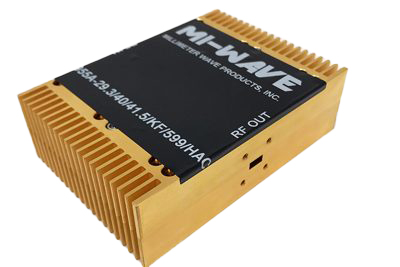
| 955A-29.3/40/41.5/KF/599HAC | Ka-Band (5G) | 29.3 ± 0.3 GHz | 40 dB | +41.5 dBm | 2.92 mm Female (K) / UG-599HAC | 100–120 V AC | |
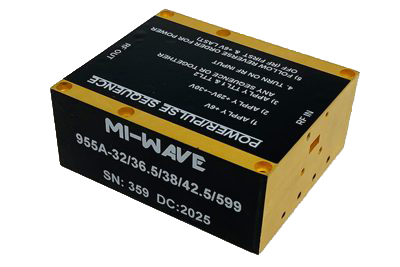
| 955A-32/36.5/38/42.5/599 | Ka-Band (5G) | 32–36 GHz | 45 dB | +42.5 dBm | WR-28 Waveguide, UG-599/U Flange | +6–30 V Max | |
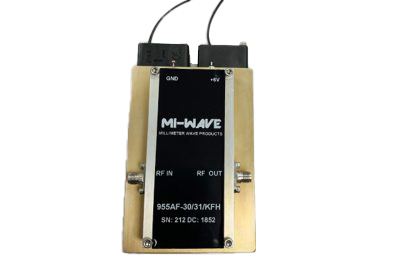
| 955AF-30/31/KFH | Ka-Band (5G) | 26–40 GHz | 30 dB | +31 dBm | 2.92 mm Female (K), H-Plane | +6–8 V Max |
5G NR Band & Frequency Calculator
Use this calculator to quickly identify whether a frequency is FR1 (sub-6 GHz) or FR2 (mmWave), estimate wavelength, and map common 5G NR bands to their typical frequency ranges. Handy for PA/LNA selection, converter planning, antenna sizing, and 5G test setups.
Enter a Frequency
Tip: Try 3.5 GHz (FR1) and 28 GHz (FR2).
Results
Common 5G NR Bands (Quick Lookup)
Note: Band availability varies by country and operator. This is a practical engineering cheat-sheet for planning and component selection.
Power Amplifier Features & Performance Benefits (5G / mmWave)
High Gain and High Output Power for 5G FR2
Mi-Wave 5G RF power amplifiers deliver high small-signal gain and stable output power across 5G FR2 and extended millimeter-wave frequency bands. High gain reduces the need for additional driver stages, while high output power supports base stations, small cells, wireless backhaul, and mmWave transmit arrays.
Excellent Linearity for Wideband 5G Signals
5G waveforms place strict demands on amplifier linearity. Mi-Wave power amplifiers are engineered to support high-order modulation schemes while maintaining low Error Vector Magnitude (EVM) and strong Adjacent Channel Leakage Ratio (ACLR) performance. This ensures spectral compliance and efficient use of licensed and unlicensed spectrum.
Wideband and Band-Specific Architectures
The 955 Series includes both wideband power amplifiers and band-optimized designs to match specific 5G allocations. Engineers can select amplifiers optimized for efficiency, linearity, and power density across Ka-band, V-band, E-band, and higher mmWave frequencies.
Stable Output Power Across Temperature and Frequency
Consistent output power is critical for link margin and beamforming accuracy. Mi-Wave power amplifiers maintain stable output levels across operating frequency and temperature ranges, supporting repeatable calibration in both laboratory and field deployments.
Optimized for Beamforming and Phased Arrays
High gain consistency, controlled phase behavior, and repeatable output power make these amplifiers well suited for beamforming and phased-array architectures used in 5G FR2 radios. Stable amplifier performance helps preserve beam accuracy and array efficiency.
Robust Biasing and Thermal Management
Advanced bias regulation and thermal design practices support reliable operation under wideband modulation and continuous duty cycles. These features enable deployment in outdoor 5G infrastructure, remote radio heads, and integrated antenna systems.
Production-Ready for 5G Infrastructure
In addition to development and prototyping models, Mi-Wave offers production-ready 5G power amplifier designs optimized for repeatability and manufacturability. These solutions support high-volume deployment while maintaining RF performance and long-term reliability.
Low Noise Amplifier (LNA) Features & Performance Benefits (5G / mmWave)
Low Noise Figure for mmWave Receiver Front Ends
Mi-Wave 5G low noise amplifiers are optimized for low noise figure, significantly improving receiver sensitivity and signal-to-noise ratio (SNR) in FR2 and mmWave systems. Low NF is essential for recovering weak signals in dense urban deployments and long-range links.
High Gain with Excellent Stability
High, stable gain allows LNAs to boost low-level signals early in the receiver chain, minimizing the impact of downstream noise. Mi-Wave LNAs are designed for unconditional stability, supporting reliable operation across temperature and load variations.
Wideband and Band-Specific LNA Designs
The 955 Series includes LNAs tailored for specific 5G bands as well as wideband designs for flexible system architectures. This allows designers to optimize front-end performance for base stations, small cells, beamforming receivers, and test platforms.
Optimized for Beamforming and MIMO Systems
Consistent gain and low noise performance across channels make Mi-Wave LNAs ideal for beamforming and MIMO receiver arrays. Uniform LNA behavior helps preserve phase coherence and improves overall array performance.
High Isolation and Low Input Return Loss
Careful RF design ensures strong isolation and good impedance matching, reducing reflections and improving front-end robustness in complex 5G receiver architectures.
Rugged and Reliable for Infrastructure Deployment
LNAs are built with robust biasing and thermal practices to support continuous operation in outdoor 5G infrastructure, distributed antenna systems, and remote radio units.
Scalable Designs for Development and Production
Mi-Wave LNAs support both early-stage development and high-volume production, offering consistent RF performance across units for scalable 5G deployments.
Typical Applications for Microwave & Millimeter-Wave Power Amplifiers
Mi-Wave 955 Series microwave and millimeter-wave power amplifiers are used in a wide range of RF transmit, signal conditioning, and system-integration applications where stable output power, linear amplification, and spectral integrity are required.
Satellite Communication (SatCom)
Power amplifiers are critical in satellite uplink chains to boost RF signals prior to transmission.
Common SatCom applications include:
-
Satellite uplink transmit chains
-
VSAT and gateway terminals
-
Ground station and teleport infrastructure
-
Integration with RF upconverters and BUC architectures
-
High-throughput satellite (HTS) systems
Stable gain and controlled output power support clean uplink spectra and regulatory compliance.
Radar and Sensing Systems
In radar platforms, microwave and mmWave power amplifiers provide the necessary transmit power for signal generation and injection.
Typical radar applications include:
-
Surveillance and tracking radar transmitters
-
FMCW and pulse-Doppler radar systems
-
Ground-based, airborne, and maritime radar platforms
-
Radar signal injection and calibration
High linearity and gain stability improve range performance and target detection accuracy.
Point-to-Point Microwave and Millimeter-Wave Links
Power amplifiers support long-distance and high-capacity wireless links.
Applications include:
-
Microwave and mmWave backhaul links
-
Fixed wireless access (FWA) systems
-
Private and critical infrastructure networks
-
High-throughput point-to-point radio systems
Clean amplification helps maintain link margin and spectral efficiency.
5G and Millimeter-Wave Wireless Development
Microwave and mmWave power amplifiers are widely used in development and validation of next-generation wireless systems.
Applications include:
-
5G FR2 base station and small cell testing
-
mmWave transmitter development
-
Beamforming and MIMO system validation
-
Wireless backhaul and access research
Linear amplification is essential for wideband modulation and EVM performance.
RF Test, Measurement, and Research
In laboratory and production environments, power amplifiers provide controlled RF output levels.
Typical uses include:
-
RF and mmWave test benches
-
Signal source amplification
-
Device and subsystem characterization
-
Automated test equipment (ATE)
Repeatable performance supports accurate testing and validation workflows.
5G Power Amplifier & Low Noise Amplifier FAQ
These frequently asked questions cover 5G RF power amplifiers (PAs) and low noise amplifiers (LNAs) used in FR2 and millimeter-wave systems, including beamforming radios, small cells, base stations, wireless backhaul, and 5G test platforms.
Quick Answers
What is the role of a power amplifier in a 5G system?
A 5G RF power amplifier increases the signal level before transmission to an antenna. In FR2 and mmWave systems, the PA must deliver high output power while maintaining low EVM and strong ACLR to support wideband, high-order modulation.
What is the role of an LNA in a 5G receiver?
A low noise amplifier (LNA) amplifies weak incoming RF signals at the receiver front end while adding minimal noise. Low noise figure is critical in 5G FR2 systems to preserve receiver sensitivity and improve link margin.
What frequency bands are used for 5G mmWave?
5G FR2 commonly operates in the 24–40 GHz range, with additional mmWave bands extending into V-band, E-band, and beyond for backhaul, research, and future deployments.
Why is linearity important for 5G power amplifiers?
High linearity ensures low Error Vector Magnitude (EVM) and controlled Adjacent Channel Leakage Ratio (ACLR), which are essential for meeting 5G spectral masks and maintaining data throughput.
Are these amplifiers suitable for beamforming systems?
Yes. Consistent gain, stable output power, and predictable phase behavior make these power amplifiers and LNAs well suited for beamforming and phased-array architectures used in 5G base stations and small cells.
More Technical Questions
What is EVM and why does it matter in 5G systems?
What is ACLR in a 5G power amplifier?
How does noise figure impact 5G receiver performance?
Are these amplifiers used only in production systems?
Can these amplifiers support wideband 5G waveforms?
Glossary of 5G Power Amplifier & LNA Terms
Core Amplifier Definitions
Power Amplifier (PA)
A power amplifier increases the power level of an RF signal so it can be transmitted efficiently by an antenna.
In 5G and mmWave systems, power amplifiers must deliver high output power while maintaining linearity, low distortion, and spectral compliance.
Low Noise Amplifier (LNA)
A low noise amplifier amplifies very weak incoming RF signals at the receiver front end while adding minimal noise.
LNAs are critical in 5G FR2 systems where high path loss makes receiver sensitivity and noise figure especially important.
RF Amplifier
A general term for an amplifier operating at radio frequencies. In 5G systems, RF amplifiers include both PAs (transmit side) and LNAs (receive side).
5G and Frequency Band Terms
5G FR2
Frequency Range 2 defined by 3GPP, covering approximately 24.25 GHz to 52.6 GHz.
FR2 includes millimeter-wave bands used for high-capacity 5G deployments.
Millimeter-Wave (mmWave)
Frequencies typically above 24 GHz where wavelengths are on the order of millimeters.
mmWave enables very high data rates but requires highly optimized PAs and LNAs due to increased path loss.
Ka-Band
Approximately 26.5 to 40 GHz. Widely used in 5G FR2, satellite communications, and radar systems.
V-Band
Roughly 40 to 75 GHz. Used in 5G backhaul, high-capacity wireless links, and advanced research systems.
E-Band
Typically 71–76 GHz and 81–86 GHz. Used for high-throughput wireless backhaul and emerging 5G and 6G applications.
Performance and Linearity Metrics
Small-Signal Gain
The amplification provided by an amplifier when operating well below compression.
High small-signal gain reduces the need for additional driver stages in 5G transmit chains.
Output Power (Psat)
The maximum output power an amplifier can deliver when fully saturated.
Psat is important for determining maximum transmit range and link margin.
1 dB Compression Point (P1dB)
The output power level where amplifier gain compresses by 1 dB from linear operation.
P1dB defines the usable linear output range for modulated 5G signals.
Linearity
The ability of an amplifier to amplify signals without distortion.
High linearity is essential for 5G systems using wideband, high-order modulation schemes.
Noise Figure (NF)
A measure of how much noise an amplifier adds to the signal.
Low noise figure is critical for LNAs in 5G receivers to preserve signal-to-noise ratio (SNR).
5G Modulation and Spectral Metrics
Error Vector Magnitude (EVM)
A measure of modulation accuracy comparing the transmitted signal to the ideal constellation.
Low EVM is required to support high-order modulation used in 5G systems.
Adjacent Channel Leakage Ratio (ACLR)
A measure of how much signal energy leaks into adjacent frequency channels.
Good ACLR performance ensures compliance with 5G spectral masks and reduces interference.
Spectral Purity
The cleanliness of the transmitted spectrum, including low distortion, low spurious emissions, and controlled out-of-band energy.
System Architecture Terms
Beamforming
A technique that uses multiple antennas and amplifiers to steer RF energy in specific directions.
Consistent gain and phase behavior from PAs and LNAs is essential for effective beamforming.
Phased Array
An antenna system using multiple elements with individual RF chains, often including dedicated PAs and LNAs per element.
Transmit Chain
The sequence of components that generate, amplify, and transmit an RF signal, typically including upconverters, drivers, and power amplifiers.
Receive Chain
The sequence of components that receive and process an RF signal, typically including LNAs, filters, downconverters, and ADCs.
Power, Bias, and Thermal Terms
Biasing
The DC operating conditions applied to an amplifier to set gain, linearity, and efficiency.
Stable biasing is critical for consistent 5G PA and LNA performance.
Thermal Management
Design techniques used to dissipate heat generated by amplifiers.
Proper thermal design ensures reliability and long-term performance in high-power 5G systems.
Efficiency
The ratio of RF output power to DC input power.
Higher efficiency reduces heat generation and power consumption in base stations and small cells.
Integration and Deployment Terms
Small Cell
A low-power cellular base station used to improve coverage and capacity in dense 5G environments.
Wireless Backhaul
High-capacity wireless links, often operating at mmWave frequencies, used to connect base stations to the core network.
Automated Test Equipment (ATE)
Test systems that use PAs and LNAs to validate performance, linearity, and compliance of 5G components and radios.
Role of PAs and LNAs in 5G Systems
In 5G and mmWave architectures, power amplifiers and low noise amplifiers directly determine system performance.
PA linearity affects EVM, ACLR, and transmit efficiency, while LNA noise figure sets receiver sensitivity and link margin.
High-performance PAs and LNAs are therefore foundational components in 5G base stations, beamforming radios, wireless backhaul systems, and advanced test platforms.
5G LNAs
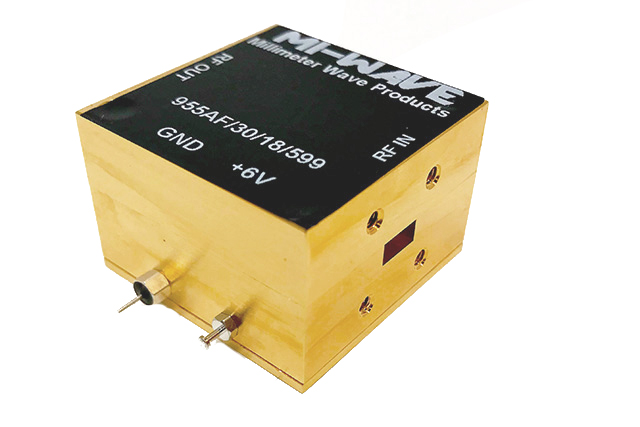
5G RF and Microwave Power Amplifiers
RF and Microwave Power Amplifiers for 5G Systems
RF and microwave power amplifiers (PAs) are a critical enabling technology in 5G wireless systems, particularly in mmWave (FR2) deployments, where high output power, linearity, and spectral purity are essential. In 5G transmit chains, power amplifiers raise low-level modulated signals to power levels suitable for antenna transmission while preserving error vector magnitude (EVM), adjacent channel leakage ratio (ACLR), and overall signal integrity.
5G power amplifiers are used throughout the wireless ecosystem, including base stations, small cells, beamforming arrays, wireless backhaul links, and 5G test platforms, where wide bandwidth operation, efficiency, and reliability directly impact system performance.
5G RF Power Amplifiers
A 5G RF power amplifier boosts a modulated RF signal to a level capable of driving antennas, phased-array elements, or downstream RF subsystems. These amplifiers are designed to support wideband modulated waveforms, high peak-to-average power ratios (PAPR), and fast-changing signal envelopes common in 5G New Radio (NR).
5G RF and microwave power amplifiers operate across a broad range of frequency bands, including sub-6 GHz and mmWave FR2 bands, extending through Ka-band, Q-band, U-band, V-band, and W-band, depending on the application and system architecture.
Key performance characteristics of 5G power amplifiers include:
-
Output power and saturated power capability
-
Small-signal gain and gain flatness over wide bandwidths
-
Linearity metrics such as P1dB, IP3, EVM, and ACLR
-
Efficiency and thermal performance under high PAPR signals
-
Spectral purity and spurious suppression
These parameters directly affect 5G coverage, link margin, regulatory compliance, and overall network efficiency.
Microwave and Millimeter-Wave Power Amplifiers for 5G
Microwave and millimeter-wave power amplifiers play a central role in 5G FR2 and future wireless architectures, where operation at high frequencies introduces challenges related to device losses, thermal management, and linearity. These amplifiers are commonly implemented using GaAs, GaN, or InP semiconductor technologies, selected to balance output power, efficiency, and modulation fidelity.
Millimeter-wave power amplifiers are essential for 5G mmWave base stations, beamforming modules, and wireless backhaul systems, enabling high data rates, low latency, and dense network deployments.
Linear and High-Efficiency Amplifier Architectures for 5G
5G power amplifiers are available in multiple architectures to meet diverse system requirements:
-
Linear amplifiers optimized for low distortion and excellent EVM and ACLR
-
High-efficiency amplifiers designed to minimize DC power consumption in dense deployments
-
Wideband amplifiers supporting multi-gigahertz bandwidths
-
Driver amplifiers used ahead of final PA stages in beamforming and MIMO systems
The choice of amplifier architecture depends on modulation format, channel bandwidth, PAPR, beamforming strategy, and system efficiency targets.
Common 5G Applications for RF and Microwave Power Amplifiers
5G Base Stations and Small Cells
-
FR2 base station and small cell transmit chains
-
Indoor and outdoor mmWave access points
-
Distributed antenna and remote radio head (RRH) systems
Beamforming and MIMO Systems
-
Phased-array transmit modules
-
Massive MIMO and adaptive beam steering
-
Active antenna systems (AAS)
Wireless Backhaul and Fronthaul
-
High-capacity point-to-point mmWave links
-
Fixed wireless access (FWA)
-
Network densification infrastructure
5G Test and Measurement
-
Signal amplification for 5G NR waveform testing
-
Automated test equipment (ATE)
-
System characterization, validation, and compliance testing
Integration Within 5G RF Signal Chains
In a typical 5G transmit architecture, the power amplifier follows an RF upconverter or frequency synthesizer, increasing the signal to the required transmit power level. When combined with an upconverter in a single enclosure, the assembly is commonly referred to as a Block Upconverter (BUC).
5G power amplifiers may also be integrated into custom RF subsystems, including beamforming arrays, transceivers, multi-channel radio platforms, and compact mmWave front ends.
Reliability, Thermal Management, and Packaging for 5G Deployments
5G RF and microwave power amplifiers are designed for operation in commercial wireless infrastructure, industrial environments, and outdoor deployments, where thermal stability and long-term reliability are critical. Robust mechanical packaging, regulated biasing, and thermal management ensure stable operation under continuous-wave and modulated signal conditions.
Packaging options include compact modules, waveguide assemblies, rack-mount systems, and ruggedized enclosures, supporting both laboratory evaluation and fielded 5G installations.
The Role of Power Amplifiers in 5G Systems
Within a 5G system, the power amplifier plays a decisive role in coverage, throughput, spectral compliance, and energy efficiency. Nonlinear behavior in the PA stage directly impacts EVM, ACLR, beamforming accuracy, and network performance.
By delivering stable output power, wideband linearity, and spectrally clean amplification, 5G RF and microwave power amplifiers enable reliable operation of modern wireless networks across microwave and millimeter-wave frequencies.
Build Your 5G Power Amplifier Solution
With more than 35 years of experience in microwave and millimeter-wave RF engineering, our team designs and supports high-performance 5G RF and microwave power amplifiers for demanding wireless applications. Our capabilities include custom amplifier design, prototyping, manufacturing, and system integration, allowing us to deliver production-ready solutions tailored to specific 5G frequency bands, output power levels, linearity targets, efficiency goals, and thermal constraints.
Contact Mi-Wave to discuss 5G power amplifiers, mmWave FR2 amplifiers, driver amplifiers, linear and high-efficiency PA architectures, and custom 5G RF amplifier sub-assemblies. We work closely with customers to ensure EVM and ACLR compliance, thermal reliability, and seamless integration into advanced 5G communication and test systems.