
Product Description
Mi-Wave’s Series 268 Scalar Feed Horn Antennas are high-performance, wideband antennas engineered for satellite communications (SatCom) systems operating across microwave, millimeter-wave, and sub-millimeter-wave frequencies. These antennas are designed to provide smooth radiation patterns, low VSWR, stable phase center behavior, and consistent gain, all of which are critical for reliable satellite uplink and downlink performance.
The scalar feed geometry improves the transition from waveguide to free-space radiation, reducing impedance mismatch and minimizing pattern distortion across wide bandwidths. This results in predictable beam symmetry and polarization performance, making Series 268 scalar feed horns well suited for SatCom gateway terminals, feeder links, and ground station infrastructure.
Series 268 scalar feed horn antennas are commonly used as feeds for reflector antennas, standalone directional antennas, or reference antennas in SatCom test and validation environments.
Note: This website highlights a limited selection of the antennas Mi-Wave produces. Our engineering team regularly develops custom antenna solutions tailored to specific frequency bands, performance targets, and system requirements. Contact Mi-Wave for custom designs.
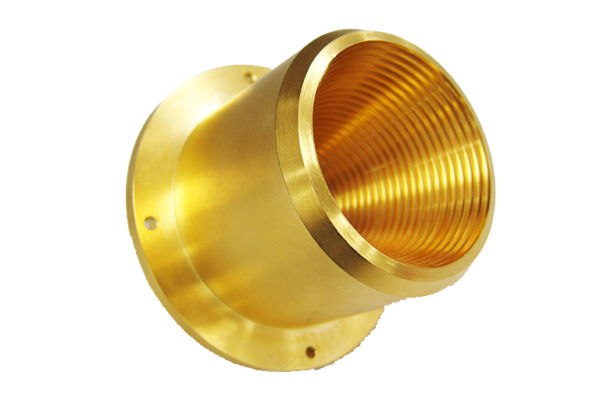
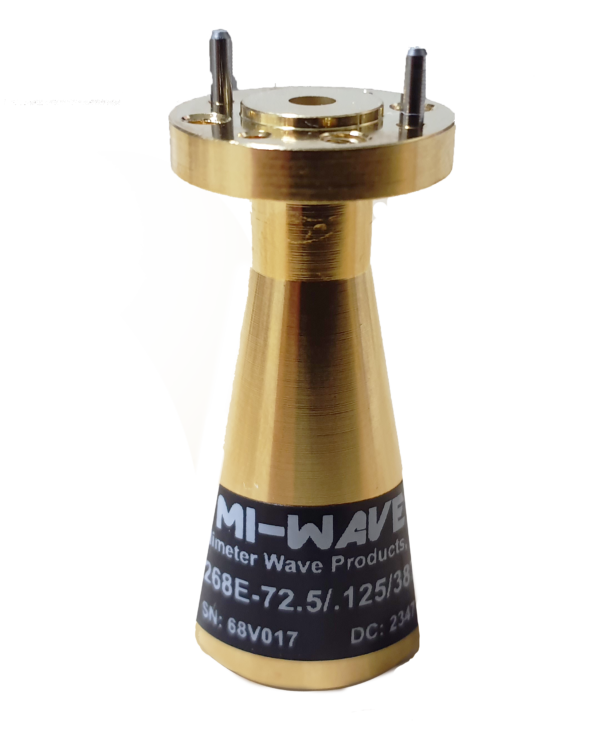
| Waveguide Band | Model No. | Circular Waveguide Internal Diameter (.XXX in Model No.) in Inches | Frequency Range (GHz) | Gain (dB) (XX in Model No) | 3 dB Beamwidth E Plane (degrees) | 3 dB Beamwidth H Plane (degrees) | Polarization | VSWR | Antenna Port |
|---|---|---|---|---|---|---|---|---|---|
| X Band | 268X-XX/.XXX/39 268X-XX/39 | .XXX=1.094 .XXX=.938 .XXX= .797 | 8.2-9.97 8.5-11.6 9.97-12.4 | 15 | 22 | 26 | Linear and Circular | 1.5:1 | Circular Waveguide with UG-39/U Flange or WR-90 with UG-39/U |
| Ku Band | 268Ku-XX/.XXX/419 268Ku-XX/419 | XXX=.660 XXX=.550 | 12.4-14.6 14.6-18 | 15 | 22 | 26 | Linear and Circular | 1.5:1 | Circular Waveguide with UG-419/U Flange or WR-62 with UG-419/U |
| K Band | 268K-XX/.XXX/595 268K-XX/595 | XXX=.470 XXX .396 XXX=.328 | 18-20.5 20.4-24.5 24.5-26.5 | 15 | 22 | 26 | Linear and Circular | 1.5:1 | Circular Waveguide with UG-595/U Flange or WR-42 Waveguide with UG-595/U Flange |
| Ka-Band | 268A-XX/.XXX/599 268A-XX/599 | XXX=.328 XXX=.281 XXX=.250 XXX= .219 | 26.5-28.5 28.5-33.0 33.0 -38.5 38.5-40.0 | 15 | 22 | 26 | Linear and Circular | 1.5:1 | Circular Waveguide with UG-599/U Flange |
| B-band | 268B-XX/.XXX/383 268B-XX/383 | XXX=.250 XXX=.219 XXX=.188 | 33.0-38.5 38.5-43.0 43.0-50.0 | 15 | 22 | 26 | Linear and Circular | 1.5:1 | Circular Waveguide with UG-383/U Flange |
| U-band | 268U-XX/.XXX/383 268U-XX/383 | XXX=.219 XXX=.188 XXX=.165 XXX=.141 | 38.5-43.0 43.0-50.0 50.0-58.0 58.0-60.0 | 15 | 22 | 26 | Linear and Circular | 1.5:1 | Circular Waveguide with UG-383/U-M Flange |
| V-band | 268V-XX/.XXX/385 268V-XX/385 | XXX=.165 XXX=.141 XXX=.125 | 50.0-58.0 58.0-68.0 68.0-75.0 | 15 | 22 | 26 | Linear and Circular | 1.5:1 | Circular Waveguide with UG-385/U Flange |
| E-band | 268E-XX/.XXX/387 268V-XX/387 | XXX=.141 XXX=.125 XXX=.110 XXX=.094 | 60.0-68.0 68.0-77.0 77.0-87.0 87.0-90.0 | 15 | 22 | 26 | Linear and Circular | 1.5:1 | Circular Waveguide with UG-387/U Flange |
| W-band | 268W-XX/.XXX/387 268W-XX/387 | XXX=.125 XXX=.110 XXX=.094 XXX=.082 | 75.0-77.0 77.0-87.0 87.0-100.0 100.0-110.0 | 15 | 22 | 26 | Linear and Circular | 1.5:1 | Circular Waveguide with UG-387/U-M Flange |
Scalar Feed Horn Antennas for Satellite Communications (SatCom)
Mi-Wave designs and manufactures high-performance scalar feed horn antennas engineered for reliable operation in satellite communications (SatCom) systems across microwave, millimeter-wave, and sub-millimeter-wave frequency ranges. With decades of experience in high-frequency RF hardware, Mi-Wave delivers scalar feed horn antennas built to meet the electrical stability, mechanical precision, and repeatability required in satellite ground infrastructure.
Scalar feed horn waveguide antennas are widely used in SatCom systems due to their high power handling capability, strong directivity, low insertion loss, and stable electrical performance across wide bandwidths. Mi-Wave scalar feed horn antennas are designed to maintain low gain variation and predictable beam symmetry across the operating frequency band, making them well suited for satellite gateways, feeder links, and ground station applications.
Wide-angle scalar feed horn antennas are commonly used as feeds for reflector antennas in SatCom systems, ensuring efficient reflector illumination, stable polarization behavior, and consistent uplink and downlink performance. These antennas support both fixed gateway installations and transportable ground station platforms.
Key Features for SatCom Systems
-
Low VSWR across wide operating bandwidths, improving power transfer efficiency and maximizing uplink and downlink link margin
-
Wideband frequency coverage, allowing a single antenna to support multiple SatCom bands without retuning or replacement
-
Narrow, well-controlled beamwidths, providing high directivity and efficient reflector illumination for gateway and feeder link antennas
-
Polarization-insensitive design, supporting consistent performance and reducing polarization mismatch losses in satellite links
-
High power handling capability, suitable for SatCom uplink transmit chains
-
Low insertion loss and stable electrical characteristics, ensuring reliable long-term operation in continuous-duty SatCom environments
-
Precision mechanical construction, delivering repeatable performance in both indoor gateway facilities and outdoor ground station installations
-
Compatibility with standard WR waveguide interfaces, enabling direct integration into SatCom RF chains including HPAs, LNAs, up-/down-converters, and monitoring equipment
SatCom Applications
-
Satellite Gateway and Ground Station Systems
Used as primary feeds or standalone antennas in gateway and ground station installations where stable beam shape, controlled polarization, and reliable electrical performance are required. -
Ka-Band, Q-Band, and V-Band Feeder Links
Supports high-capacity feeder links operating at Ka-, Q-, and V-Band frequencies, enabling higher data throughput and efficient spectrum utilization in modern satellite networks. -
Point-to-Point Satellite Communication Links
Ideal for focused, line-of-sight satellite links requiring strong link margins, minimal interference, and predictable radiation characteristics. -
High-Throughput Satellite (HTS) Infrastructure
Enables HTS gateway architectures by providing consistent beam control and wideband operation for multi-beam and frequency-reuse systems. -
SatCom Test, Measurement, and System Validation
Commonly used in laboratory and field environments for antenna characterization, feeder link validation, gateway commissioning, and performance verification of satellite communication hardware.
Why Choose Mi-Wave
Mi-Wave is a trusted manufacturer of RF, microwave, and millimeter-wave antennas and components, supporting commercial, government, and research systems worldwide. Our scalar feed horn antennas are engineered to deliver wideband performance, stable radiation patterns, and reliable electrical characteristics in demanding high-frequency applications.
High-Frequency Engineering Expertise
With decades of experience in microwave and millimeter-wave design, Mi-Wave develops scalar feed horn antennas optimized for low VSWR, controlled beamwidth, and consistent gain across broad operating bandwidths.
Precision Manufacturing and Quality Control
Each antenna is manufactured using precision machining and assembly processes to ensure repeatable electrical performance, mechanical stability, and long-term reliability.
Broad Frequency and Application Support
Mi-Wave supports scalar feed horn antennas across a wide range of RF and microwave frequency bands, making them suitable for communications, radar, telemetry, and test environments.
Custom Antenna Solutions
In addition to standard offerings, Mi-Wave provides custom scalar feed horn antenna designs tailored to specific frequency ranges, bandwidths, polarization requirements, waveguide interfaces, and mechanical constraints. Our sales engineering team works closely with customers to ensure seamless system integration.
How Scalar Feed Horn Antennas Work and What They Do in SatCom Systems
Scalar feed horn antennas are wideband horn antennas designed for satellite communications (SatCom) that use a precision scalar feed structure to control how electromagnetic energy transitions from a waveguide into free space. The scalar feed typically consists of concentric grooves or corrugations near the horn aperture, which shape the electromagnetic fields to improve impedance matching, beam symmetry, and polarization performance across wide satellite frequency bands.
This design results in low VSWR, stable phase center behavior, smooth radiation patterns, and consistent gain, all of which are critical for reliable uplink and downlink performance in SatCom systems. Compared to standard horn antennas, scalar feed horns provide improved beam symmetry, polarization purity, and sidelobe control, making them especially well suited for Ka-Band, Q-Band, and V-Band satellite applications.
Wideband Satellite Uplink and Downlink Radiation
Scalar feed horn antennas efficiently launch RF energy into free space with narrow, well-controlled beamwidths and predictable radiation patterns. In SatCom systems, these antennas are commonly used as feeds for reflector antennas, ensuring efficient reflector illumination and minimizing spillover losses that can degrade link margin.
Their wideband capability allows a single antenna to support multiple satellite frequency bands without retuning, simplifying gateway design and supporting high-capacity feeder links and frequency-reuse architectures. Stable beam shape and low reflection loss help maintain consistent performance across varying environmental and operational conditions.
SatCom Frequency Coverage and WR Waveguide Interfaces
Mi-Wave scalar feed horn antennas support operation across an extended range of microwave, millimeter-wave, and sub-millimeter-wave frequencies, depending on configuration. Typical coverage spans from 8.2 GHz through 330 GHz, supporting both legacy and next-generation SatCom bands up to H-Band.
Supported rectangular waveguide (WR) interfaces include:
-
WR-90 | 8.2–12.4 GHz | X-Band
-
WR-62 | 12.4–18.0 GHz | Ku-Band
-
WR-42 | 18.0–26.5 GHz | K-Band
-
WR-28 | 26.5–40.0 GHz | Ka-Band
-
WR-22 | 33.0–50.0 GHz | Q-Band
-
WR-15 | 50.0–75.0 GHz | V-Band
-
WR-10 | 75.0–110.0 GHz | W-Band
-
WR-6.5 | 110–170 GHz | D-Band
-
WR-5.1 | 140–220 GHz | G-Band
-
WR-3.4 | 220–330 GHz | H-Band
This broad compatibility allows scalar feed horn antennas to integrate directly into SatCom RF chains, including high-power amplifiers (HPAs), low-noise amplifiers (LNAs), up- and down-converters, and monitoring equipment used in gateway and ground station systems.
Why Scalar Feed Horns Matter in Satellite Communications
Because of their controlled aperture fields and wideband impedance matching, scalar feed horn antennas provide several performance advantages that are especially important in SatCom environments:
-
Low VSWR across wide bandwidths, improving power transfer efficiency and uplink/downlink link margin
-
Stable polarization characteristics, reducing polarization mismatch losses in satellite links
-
Symmetrical radiation patterns, ensuring predictable gateway and feeder link performance
-
Consistent gain and beamwidth across Ka-, Q-, and V-Band operating ranges
-
Reduced sidelobes and pattern distortion, supporting dense gateway deployments and frequency reuse
These characteristics make scalar feed horn antennas a reliable solution for satellite gateways, feeder links, high-throughput satellite (HTS) infrastructure, and SatCom test, measurement, and system validation environments.