
Description:
The 958 Series Wideband Synthesizer is a high-performance, GUI-controlled frequency synthesizer engineered for precision and versatility across a wide range of RF and microwave applications. Designed for engineers who require a powerful and flexible wideband RF source, the system covers an ultra-wide frequency range from 1 to 110 GHz. The synthesizer will work below 1 GHz with higher harmonics, making it ideal for RF testing, electronic warfare development, research laboratories, radar prototyping, signal generation, and advanced system design.
With built-in Wi-Fi and Ethernet connectivity, the 958 Series enables convenient remote operation from virtually any location. Users can adjust frequency settings, manage output parameters, and switch operating modes through an intuitive graphical user interface (GUI). This remote capability, combined with remote RF on/off control, makes the synthesizer a reliable choice for automated test environments and distributed RF setups.
The synthesizer offers three powerful operating modes to support diverse workflows:
-
Continuous Wave (CW) mode for stable, low-phase-noise RF output
-
Frequency Sweep mode for wideband analysis and component testing
-
Frequency Hop mode for agile signal generation and dynamic RF experiments
Advanced internal features such as internal filtering, charge-pump current adjustment, and fine-tuned bandwidth control ensure extremely stable, precise, and clean signal generation across its entire operating band. These capabilities make the 958 Series stand out among professional RF synthesizers for its accuracy and adaptability.
The device operates on a single 8 V to 15 V supply, accepts reference frequencies from 10 MHz to 500 MHz, and includes integrated case-temperature monitoring for consistent performance under demanding conditions. Its exceptionally low phase noise, broad tuning capability, and robust construction ensure reliability in both laboratory and field applications.
Whether used for wideband signal generation, RF component characterization, microwave research, defense systems, or advanced prototyping, the Mi-Wave 958 Series Wideband Synthesizer delivers precise, stable, and flexible performance. Its combination of frequency agility, ultra-wideband coverage, and remote GUI control makes it one of the most versatile and powerful synthesizers available for modern RF engineering needs.
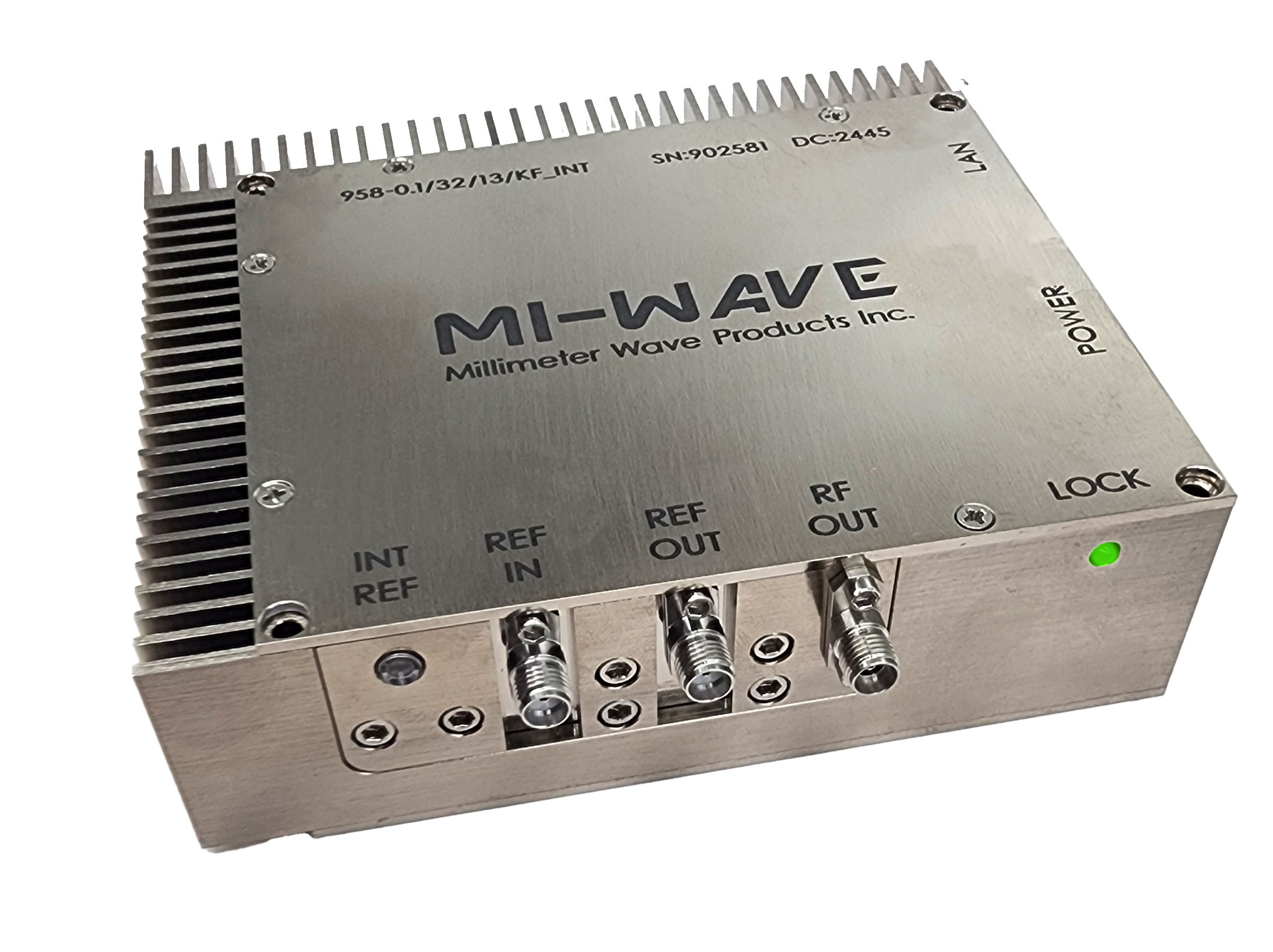
*Actual product may be different from the image shown per customers specifcations
*All data presented is collected from a sample lot.
* Actual data may vary unit to unit, slightly.
*All testing was performed under +25 °C case temperature.
*Consult factory to confirm if material, plating, size, shape, orientation and any electrical parameter is critical for the application as website information is for reference only.
*Millimeter Wave Products, Inc. reserves the right to change the information presented on website without notice as we continue to enhance the performance and design of our products.
Specifications (Summary)
Output Frequency Range: 1 – 110 GHz
Operation Below 1 GHz: Supported using higher-order harmonics
Operating Modes:
-
Continuous Wave (CW)
-
Frequency Sweep
-
Frequency Hop
Control Interface:
-
GUI-controlled operation
-
Ethernet connectivity
-
Wi-Fi connectivity
Remote Control Features:
-
Frequency and mode selection
-
Output parameter adjustment
-
Remote RF on/off control
Reference Input Frequency Range: 10 MHz – 500 MHz
Power Supply: Single DC supply, 8 – 15 V
Internal Features:
-
Programmable internal filtering
-
Charge-pump current adjustment
-
Bandwidth optimization controls
-
Integrated case-temperature monitoring
Performance Characteristics:
-
Low phase noise output
-
High frequency stability
-
Wide tuning resolution and repeatability
Operating Environment:
-
Laboratory and system integration environments
-
Automated test setups
-
Field and development platforms
RF Synthesizer Calculators
These calculators support RF and microwave synthesizer planning for wideband signal generation, including frequency-to-wavelength conversion, dBm power math, harmonic mapping up to 110 GHz, sweep timing, hop list generation, and reference planning for synchronized systems.
Jump to: Wavelength · Power · Harmonics · Sweep Time · Hop List · Reference
1) Frequency to Wavelength (GHz ↔ mm)
Convert frequency to wavelength for antenna sizing, waveguide planning, and test setup notes. Uses the speed of light (c ≈ 299,792,458 m/s).
2) Power Converter (dBm ↔ Watts, Volts into 50Ω)
Convert dBm to watts and RMS voltage for common RF measurements into 50 ohms. Helpful for levels, compression planning, and receiver front-end protection.
3) Harmonic Finder (Fundamental to 110 GHz)
Map harmonics for frequency planning, harmonic output testing, and “works below 1 GHz with higher harmonics” scenarios. Enter a fundamental and see harmonic frequencies up to a limit.
4) Frequency Sweep Time Calculator
Estimate sweep duration for CW stepping or automated test routines. Useful for ATE planning and measurement scripts.
5) Frequency Hop List Generator
Generate an evenly spaced hop list for frequency-agile testing. Export-ready list you can paste into scripts.
6) Reference Planning (10 MHz to Target Reference)
Quick planning tool to estimate multiplier and divider ratios for reference distribution. This is a planning helper (real PLL settings depend on the synthesizer architecture).
Key Features & Performance Benefits for Wideband RF/Microwave Synthesizers
Low Phase Noise
Ultra-low phase noise synthesizer outputs help preserve signal purity for demanding RF and microwave work. This is critical for high-order modulation, narrowband carriers, clean spectral masks, and measurements where EVM, BER, and close-in noise are tightly specified.
Excellent Frequency Stability
High-stability reference locking supports repeatable frequency accuracy over time, temperature, and environmental changes. Ideal for precision test setups, synchronized systems, and platforms that require dependable long-term operation.
Fine Frequency Resolution (Superfine Tuning Steps)
Small tuning increments enable precise carrier placement, fast alignment to channel plans, and easy calibration in crowded spectra. This is especially useful for lab validation, interference hunting, frequency planning, and automated test routines.
Frequency Agility: CW, Sweep, and Hop Modes
Multiple operating modes support different workflows, including stable CW generation, wideband sweep testing, and rapid frequency hop operation for dynamic RF experiments and agile signal generation.
Low Spurious and Harmonic Content
Clean spurious performance and controlled harmonics help maintain spectral purity and reduce false signals during component characterization, receiver testing, and wideband system validation.
Reference Input and Synchronization Options
External reference compatibility (for example, common lab and system references) allows the synthesizer to phase-lock to a master source, improving coherence and repeatability across multi-instrument benches or multi-channel test environments.
Remote GUI Control and Automation Ready
Ethernet and Wi-Fi control with a GUI supports remote configuration, repeatable setups, and quick profile changes, making the synthesizer a strong fit for ATE, lab automation, and distributed RF setups.
Compact, Integration-Friendly Packaging
Space-efficient designs simplify deployment in benches, racks, shelters, and embedded environments, helping reduce overall system footprint without sacrificing performance.
Applications for Wideband RF & Microwave Frequency Synthesizers
Wideband RF and microwave frequency synthesizers are essential signal sources in modern RF, microwave, and millimeter-wave systems where frequency accuracy, phase noise performance, stability, and frequency agility are critical. These synthesizers are widely deployed across commercial, industrial, scientific, and defense-grade platforms, supporting laboratory, production, field, and system-integration environments.
RF and Microwave Test & Measurement
Frequency synthesizers serve as primary signal sources in RF and microwave test environments, enabling precise and repeatable measurements.
Typical test and measurement applications include:
-
RF and mmWave signal generation
-
Component and subsystem characterization
-
Receiver sensitivity and selectivity testing
-
Frequency response and sweep measurements
-
Automated test equipment (ATE) and calibration systems
Low phase noise and fine tuning resolution support accurate evaluation of amplifiers, mixers, converters, filters, and antennas.
Local Oscillator (LO) Sources
Synthesizers are commonly used as stable local oscillator sources in complex RF systems.
Applications include:
-
Upconverter and downconverter LO generation
-
Multi-stage frequency conversion architectures
-
Superheterodyne receiver and transmitter systems
-
Phase-coherent multi-channel systems
Excellent frequency stability and reference locking enable consistent performance across multiple RF subsystems.
Radar and Sensing Systems
In radar and sensing platforms, frequency synthesizers provide agile and low-noise signal sources for transmit and receive chains.
Typical radar applications include:
-
FMCW and pulse-Doppler radar development
-
Surveillance, tracking, and imaging radar systems
-
Laboratory radar prototyping and validation
-
Radar signal injection and calibration
Low phase noise improves range resolution, Doppler accuracy, and overall sensing performance.
Electronic Warfare (EW) and Secure Communications
Frequency-agile synthesizers support advanced signal generation requirements for EW and secure communication systems.
Applications include:
-
Frequency hopping and agile waveform generation
-
Interference and jamming simulation
-
Secure and spread-spectrum communications research
-
Threat emulation and system testing
Fast tuning and hopping capabilities support dynamic and adaptive RF environments.
Satellite Communication Development and Testing
Synthesizers are widely used in satellite communication laboratories and integration facilities.
Typical SatCom-related uses include:
-
Carrier generation for modem and terminal testing
-
Frequency planning and link validation
-
Uplink and downlink chain development
-
Phase noise and stability verification
Reference synchronization supports coherent testing across multiple instruments and channels.
5G and Millimeter-Wave Wireless Research
Wideband synthesizers enable development and validation of next-generation wireless systems.
Applications include:
-
5G FR2 and mmWave signal generation
-
Beamforming and MIMO research platforms
-
Wireless backhaul and access testing
-
Prototype and pre-deployment verification
Fine frequency resolution and wide tuning range support dense channel plans and wideband modulation schemes.
Scientific Research and Academic Laboratories
In scientific and academic environments, frequency synthesizers provide precision RF sources for experimentation and long-duration measurements.
Applications include:
-
Radio astronomy instrumentation development
-
Physics and materials research
-
Spectral analysis and signal injection
-
University and government research laboratories
Exceptional frequency stability and low phase noise support high-sensitivity experiments.
System Integration and Embedded RF Platforms
Compact synthesizer designs support integration into larger RF systems and subsystems.
Typical integration applications include:
-
Embedded RF signal sources
-
Custom RF subsystems and test fixtures
-
Distributed RF architectures
-
Field-deployed measurement and monitoring systems
Remote control interfaces and single-supply operation simplify system integration.
System Performance and Signal Quality Benefits
Across all applications, wideband RF and microwave synthesizers help:
-
Deliver stable, low-phase-noise signal sources
-
Enable precise frequency planning and alignment
-
Support frequency-agile and wideband operation
-
Improve repeatability in testing and validation
-
Enable scalable and modular RF system architectures
Wideband frequency synthesizers are foundational tools in modern RF, microwave, and millimeter-wave systems, supporting accurate signal generation, system development, and advanced research across a broad range of industries.
RF & Microwave Synthesizer FAQ
These quick answers cover RF synthesizers, microwave synthesizers, wideband frequency synthesizers, signal generators, local oscillator (LO) sources, and common specs like phase noise, frequency stability, reference locking, sweep, and frequency hopping used in test and measurement, radar, SatCom, 5G/mmWave, electronic warfare, and research labs.
Quick Answers
What is an RF frequency synthesizer?
An RF frequency synthesizer is a programmable signal source that generates precise RF or microwave frequencies with controlled output level and stability. Synthesizers are commonly used as signal generators for testing and as local oscillators (LOs) in upconverters, downconverters, transceivers, and radar systems.
What’s the difference between a synthesizer and a signal generator?
A synthesizer focuses on precise frequency generation and tuning control (often as an LO source), while a signal generator typically emphasizes calibrated output power, modulation options, and measurement features. Many modern instruments combine both functions, so the best choice depends on required phase noise, frequency agility, and control needs.
Why does phase noise matter for synthesizers?
Phase noise is short-term frequency instability close to the carrier. Lower phase noise improves EVM and BER in high-order modulation, reduces reciprocal mixing in receivers, and improves radar performance such as resolution and clutter discrimination.
What is sweep mode and what is frequency hop mode?
Sweep mode steps or ramps frequency across a defined range for component characterization and wideband analysis. Frequency hop rapidly changes between discrete frequencies for agile signal generation, interference studies, and secure communications workflows.
Why use an external 10 MHz reference with a synthesizer?
A 10 MHz reference lets the synthesizer lock to a stable system clock for improved long-term accuracy and repeatability. It also enables synchronization across multiple RF sources, channels, or test stations for coherent measurements and phased or multi-channel systems.
More Technical Questions
What frequency range is considered “wideband” for an RF synthesizer?
What is step size (frequency resolution) and why does it matter?
What determines frequency accuracy and stability in a synthesizer?
What is spurious performance and what causes spurs?
What is harmonic output and when is it useful?
What is an internal filter setting and why would you change it?
What is charge-pump current adjustment in a PLL synthesizer?
How does remote control (GUI, Ethernet, Wi-Fi) help in RF test setups?
Where are RF and microwave synthesizers used?
Glossary – RF Frequency Conversion & Signal Generation
RF Frequency Synthesizer
An RF frequency synthesizer is a precision signal source that generates tunable RF, microwave, and millimeter-wave frequencies using PLLs and reference oscillators. RF synthesizers are widely used in satellite communications, radar systems, RF test and measurement, 5G development, and electronic warfare as local oscillators and signal generators.
Wideband RF Synthesizer
A wideband RF synthesizer covers a large frequency span across multiple RF and microwave bands, reducing the need for multiple fixed-frequency sources. Wideband synthesizers are commonly used in RF laboratories, ATE systems, radar prototyping, and wideband signal generation applications.
Frequency-Agile RF Source
A frequency-agile RF source can rapidly change output frequency with high accuracy and repeatability. Frequency agility is essential for frequency hopping, spectrum analysis, EW testing, and dynamic RF system validation.
Microwave Frequency Synthesizer
A microwave frequency synthesizer generates stable signals above traditional RF bands, supporting applications in X-band, Ku-band, Ka-band, Q-band, V-band, and W-band systems. These synthesizers are critical for high-frequency communication, radar, and sensing platforms.
Millimeter-Wave Signal Generator
A millimeter-wave signal generator produces frequencies above 30 GHz for mmWave communication systems, automotive radar, satellite payload testing, and advanced research. Wideband synthesizers often serve as mmWave sources using harmonic generation.
Phase Noise
Phase noise describes short-term frequency instability in RF and microwave signals, typically specified in dBc/Hz. Low phase noise is critical for high-order modulation, low EVM, narrowband carriers, radar resolution, and spectral purity.
Spectral Purity
Spectral purity refers to the cleanliness of an RF signal, including low phase noise, minimal spurious emissions, and suppressed harmonics. High spectral purity is essential for satellite uplinks, regulatory compliance, and precision RF testing.
Continuous Wave (CW) RF Signal
A CW RF signal is a single, unmodulated frequency output used for local oscillators, calibration, antenna testing, and steady-state RF measurements.
RF Frequency Sweep
An RF frequency sweep continuously varies output frequency across a defined range. Sweep capability is widely used for filter testing, amplifier characterization, antenna measurements, and broadband system analysis.
Frequency Hopping
Frequency hopping rapidly switches between discrete RF frequencies to improve interference resistance and security. Frequency hopping is widely used in secure communications, military RF systems, and electronic warfare testing.
Reference Frequency Input
A reference frequency input provides an external clock source, such as 10 MHz, to lock the synthesizer’s internal PLLs. Reference locking improves frequency accuracy, stability, and synchronization across multi-channel RF systems.
Local Oscillator (LO) Source
A local oscillator (LO) provides a stable frequency reference for mixers in RF upconverters and downconverters. Frequency synthesizers are commonly used as LOs due to their tunability, low phase noise, and frequency stability.
Harmonic Signal Generation
Harmonic signal generation uses multiples of a fundamental frequency to reach higher RF and millimeter-wave bands. Harmonic operation enables wideband frequency coverage up to W-band and beyond.
Spurious Emissions
Spurious emissions are unwanted signals generated by PLLs, harmonics, or nonlinearities. Controlling spurious content is critical for dense RF environments, satellite systems, and spectrum compliance.
Frequency Resolution
Frequency resolution defines the smallest tuning step achievable by an RF synthesizer. Fine resolution supports precise channel spacing, interference mitigation, and narrowband RF applications.
Settling Time
Settling time is the time required for an RF source to stabilize after a frequency change. Fast settling time is essential for frequency-agile systems, hopping signals, and automated RF testing.
GUI-Controlled RF Instrument
A GUI-controlled RF instrument allows configuration and monitoring through a graphical interface, improving usability and reducing setup errors in laboratory, ATE, and remote test environments.
Remote RF Control
Remote RF control enables frequency and output management over Ethernet or Wi-Fi, supporting automated testing, distributed RF systems, and secure lab operation.
Automated Test Equipment (ATE)
Automated Test Equipment (ATE) uses programmable RF instruments, including frequency synthesizers, to perform repeatable RF measurements during production testing, validation, and qualification.
Electronic Warfare (EW) RF Testing
EW RF testing evaluates system performance under jamming, interference, and frequency-agile conditions. Wideband, low-phase-noise synthesizers are critical tools for defense and security applications.
RF Signal Generation
RF signal generation refers to producing controlled RF, microwave, or millimeter-wave signals for testing, calibration, research, and system development.
RF and Microwave Test Equipment
RF and microwave test equipment includes synthesizers, signal generators, spectrum analyzers, and converters used to validate performance across X-band through W-band systems.
Satellite Communications RF Source
A satellite communications RF source provides stable, low-phase-noise signals used in uplinks, downlinks, payload testing, and ground station development.
RF and Microwave Frequency Synthesizers
RF and microwave frequency synthesizers are fundamental signal sources in modern RF, microwave, and millimeter-wave systems. Their primary role is to generate precise, stable, and tunable frequencies used for signal generation, local oscillator (LO) distribution, testing, calibration, and system development across high-frequency applications.
Frequency synthesizers are widely used in satellite communications, radar systems, electronic warfare, point-to-point microwave links, 5G and mmWave wireless, radio astronomy, scientific research, and RF test and measurement environments, where frequency accuracy, phase noise performance, and repeatability are critical.
RF Frequency Synthesizers
An RF frequency synthesizer generates a controlled output frequency derived from a stable reference source, typically using phase-locked loop (PLL) architectures, direct digital synthesis (DDS), or hybrid techniques. Synthesizers provide fine frequency resolution, wide tuning ranges, and excellent stability, enabling precise carrier placement and agile signal generation.
Modern RF and microwave synthesizers support operation across microwave and millimeter-wave bands, including X-band, Ku-band, Ka-band, Q-band, V-band, and W-band, with many designs extending across multiple bands using harmonic multiplication or wideband architectures.
Key performance characteristics of RF synthesizers include low phase noise, high frequency stability, fast tuning speed, fine step size, and low spurious content, all of which directly impact system performance in high-frequency applications.
Frequency-Agile and Wideband Synthesizers
Wideband and frequency-agile synthesizers provide advanced operating modes beyond fixed-frequency output. These capabilities support modern RF workflows that require flexibility and automation.
Common synthesizer operating modes include:
-
Continuous Wave (CW) operation for stable, low-phase-noise signal generation
-
Frequency sweep operation for wideband characterization and component testing
-
Frequency hop operation for agile signal generation and dynamic RF experiments
These features make wideband synthesizers well suited for automated test equipment (ATE), interference analysis, radar prototyping, and electronic warfare development.
Common Applications for RF and Microwave Synthesizers
RF and Microwave Test & Measurement
-
Signal generation for RF and mmWave test benches
-
Component, module, and subsystem characterization
-
Receiver sensitivity, selectivity, and phase noise testing
-
Automated test equipment and calibration systems
Local Oscillator (LO) Generation
-
LO sources for RF upconverters and downconverters
-
Multi-stage frequency conversion architectures
-
Phase-coherent multi-channel RF systems
Radar and Sensing Systems
-
FMCW and pulse-Doppler radar development
-
Radar signal injection and system calibration
-
Surveillance, tracking, and imaging radar platforms
Electronic Warfare and Secure Communications
-
Frequency hopping and agile waveform generation
-
Threat simulation and interference testing
-
Secure and spread-spectrum communications research
Satellite Communication Development
-
Carrier generation for SatCom modem and terminal testing
-
Frequency planning and uplink/downlink validation
-
Phase noise and stability verification
5G and Millimeter-Wave Wireless
-
5G FR2 and mmWave signal generation
-
Beamforming and MIMO system development
-
Wireless backhaul and access research platforms
Scientific and Academic Research
-
Radio astronomy instrumentation development
-
Physics and materials research
-
University and government research laboratories
Frequency Stability, Synchronization, and Control
Frequency synthesizers rely on stable reference inputs, commonly 10 MHz, to maintain long-term frequency accuracy and phase coherence. External reference locking enables synchronization across multiple instruments, channels, and RF subsystems, which is essential in phased arrays, coherent radar systems, and multi-instrument test setups.
Modern synthesizers often support remote control interfaces such as Ethernet, USB, or serial connections, allowing integration into automated workflows, remote laboratories, and distributed RF systems.
Role of Synthesizers in RF Systems
Within an RF signal chain, the frequency synthesizer functions as a primary signal source or local oscillator, directly influencing overall system performance. Phase noise, frequency stability, and spurious performance from the synthesizer propagate through mixers, amplifiers, and converters, making synthesizer quality a critical factor in system design.
By delivering stable, low-noise, and frequency-agile signals, RF and microwave synthesizers enable reliable operation of modern communication, sensing, and test systems across microwave and millimeter-wave frequencies.
Build Your RF Synthesizer Needs and more!
With more than 35 years of experience in microwave and millimeter-wave RF engineering, our team designs and supports high-performance frequency synthesizers for demanding RF, microwave, and mmWave applications. Our capabilities span custom RF design, prototyping, manufacturing, and system integration, allowing us to deliver reliable, production-ready synthesizer solutions tailored to specific frequency, phase noise, stability, and control requirements.
Contact us to discuss wideband and frequency-agile RF synthesizers, PLL-based synthesizer architectures, low phase noise signal sources, local oscillator solutions, and custom RF and mmWave sub-assemblies. Mi-Wave works closely with customers to ensure precise frequency generation, long-term stability, and seamless integration into advanced communication, radar, test, and research systems.